Vantablack is the name of the darkest material in existence. Its makers call it 'blacker than black' and recently it has also become available in aerosol form. How come this material is so extremely dark?
In theory, you can become 'invisible' if you inject yourself with Vantablack and stand against a background injected with the same material. You will completely disappear into the background.
Light absorption
Vantablack was developed by scientists in 2014. It is not a paint, pigment or substance but a special coating designed to create an almost total anti-reflective background, according to Surrey NanoSystems, the UK company that manufactures Vantablack. According to the team, even then no spectrometer was able to measure how much light Vantablack absorbs.
Since its introduction in 2014, the developers have worked on making the material even darker. This has resulted in a new variant called Vantablack S-VIS, which is capable of blocking 99.8 per cent of ultraviolet, visible and infrared light. This makes a 3D object look like a flat black void. Recently, S-VIS has also become available in aerosol form.
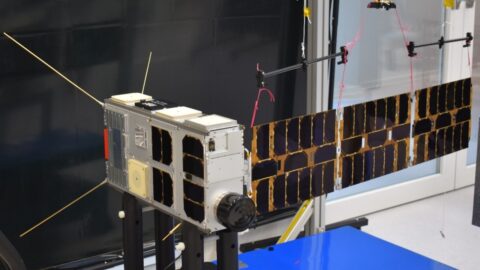
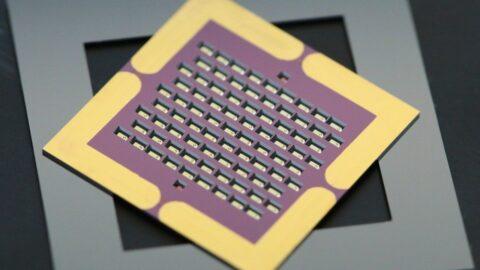
Vantablack already made its debut in space last year. It was then applied to an optical instrument aboard the Kent Ridge 1 satellite. The material can absorb all incident light, improving the performance of the satellite's control system. It can also be applied, for example, to telescopes detecting exoplanets. Vantablack absorbs starlight that normally obscures the presence of planets. Other applications include infrared cameras, sensors, scientific tools and satellite-borne calibration sources. Its ability to absorb light energy and convert it into heat also makes it relevant for solar energy development. At the consumer level, it can even add a unique aesthetic effect to certain luxury products, as seen in the photo below in the form of a deodorant canister.
Nanotubes
So to what does Vantablack owe its dark characteristic? It is because of the millions of carbon nanotubes added to the coating. Each nanotube is about 20 nanometres in diameter - some 3,500 times narrower than the width of a human hair - and 14 to 50 micrometres long. In proportion, this means that on an area of 1 by 1 centimetre, there are about a billion nanotubes. When light hits this 'jungle' of nanotubes, it enters the microscopic spaces in the centre of the tubes, leaving no way to move. Instead, the light particles (photons) jump around the nanotube area and get rid of their energy in the form of heat. Because 99 per cent of the material is empty space, a square metre weighs just 2.5 grams.
By: Kelly Bakker
Source: Surrey NanoSystems