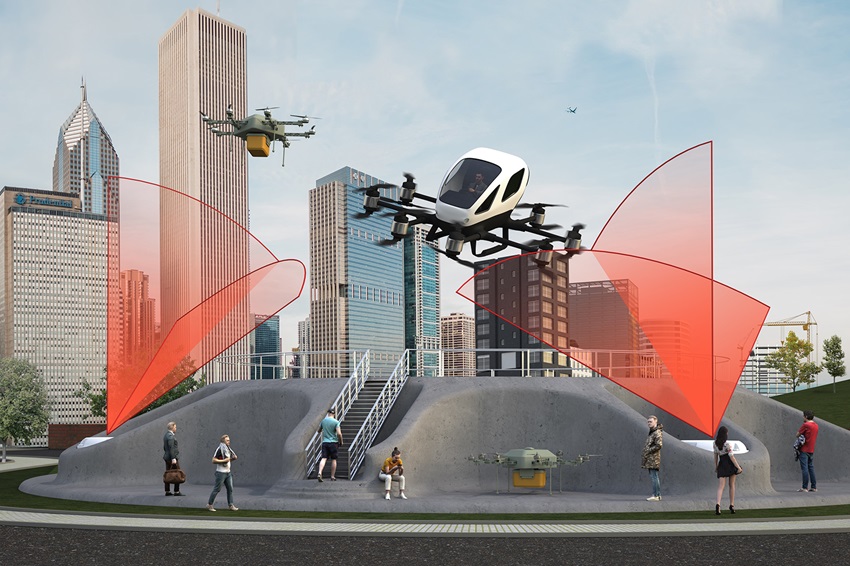

For the first time, visitors to the 2024 Olympics will be able to fly to venues by air taxi, Fraunhofer FHR says. Vertically rising aircraft such as drones, multirotors and air taxis will take off from and land on platforms known as vertiports. Researchers at the Fraunhofer Institute for High Frequency Physics and Radar Techniques FHR are developing a fully digital sensor network, including a radar sensor. This will be able to closely monitor air traffic at a vertiport and ensure safe transport.
Drones and multirotors are already being used in civil protection, by fire brigades and for bridge inspections. In the future, these unmanned aerial vehicles (UAVs) will also be used for other tasks, such as in logistics for package delivery. At the 2024 Olympics in Paris, the first passengers in Europe may take air taxis to fly to venues. Airlines plan to equip Olympic venues with electric vertical take-off and landing systems, also known as eVTOLs.
Transport via vertiports
Initially, a human will pilot the drone systems, with one passenger per taxi. In the coming years, autonomous control is the aim, provided society accepts it. An important aspect of this concept is the safety of the vertiports. These are used to launch and land eVTOLs. The aim is to integrate them into rooftops, train stations, car parks and other urban structures. Vertiports must meet the strictest safety requirements. Researchers at Fraunhofer FHR want to address an important part of the safety of the new drone stops. How? By equipping them with a modular, fully digital sensor network, including a radar sensor. The network kis adaptable to the size of each vertiport. In doing so, it uses both active and passive sensors.
Radar network
"The nodes are fully digital and each sensor in the network functions completely autonomously. The sensors themselves form a network. They can locate and organise themselves independently. Based on the principle of edge computing, each sensor has its own computing unit. It can detect the location of other sensors in the network," explains Oliver Biallawons. He is a scientist and member of the interdisciplinary expert group "Civil Drone Systems" at Fraunhofer FHR in Wachtberg. The task of transmitting and receiving is divided between the individual sensors. These cooperate with each other. Installation of the decentralised active and passive sensors is done on the ground. They work together to observe the entire take-off and landing platform and the airspace above it. The network decides which sensor operates in active (transmit and receive) and passive (receive only) mode as required. The more sensors in the network, the larger the area that can be monitored. Even when adding or removing a sensor or radar node, the radar network can continue to function flawlessly.
Wireless communication
The key to the autonomous organisation and decentralised processing of the network is the connection between individual nodes via wireless communication channels. These are integrated into the radar signal. By integrating network communications into the radar signal, the signal can be seamlessly integrated into future telecommunications infrastructures. This is an important milestone towards merging full-fledged radar and telecommunications. "We integrate the communication signal into the radar waves instead of using separate channels for radar and communication," said the engineer.
Classify obstacles
Civil Drone Systems (CDS) Network researchers mention another important feature of the radar network. The system, unlike test surveillance systems based on mobile radio, can detect eVTOLs that do not have a communication device such as a chip or tag. With the addition of AI, the security solution can not only detect obstacles blocking incoming or outgoing flight paths, but also classify them. This means it can classify objects such as trees, birds and drones. The radar network can even recognise a drone's size and number of rotors.
Sensor system
The sensor system already exists as a demonstration model, but has not yet been miniaturised. "As urbanisation continues, at some point we also expect transport systems to take to the air. This can only be achieved with advanced safety systems such as our modular, resilient network of low-radiation, communicating radar nodes. With this, flawless take-off and landing is possible," the researcher said. The system is not only being considered for use in vertiports. In the future, it could also monitor corridors through cities used by transport drones.
Featured image: Radar networks for the future of urban air mobility (photo: Fraunhofer FHR/Andreas Schoeps)
See also: Futuristic eVTOL for Melbourne










