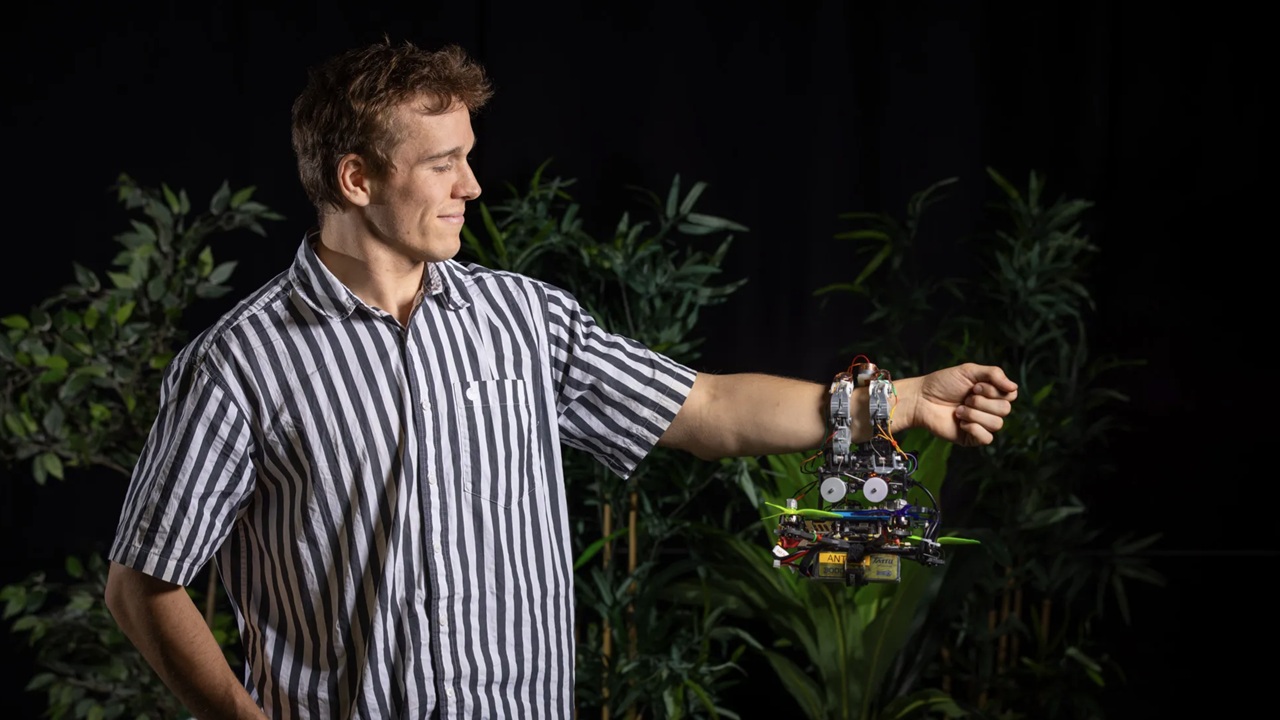

A drone carrying out measurements in a rainforest could last much longer by landing on a branch and switching off its motors, rather than continuing to fly continuously. But landing reliably is tricky: when the drone approaches a branch, its own gripper can block the camera’s view. Researchers at Delft University of Technology have developed a drone that behaves more like a bird.
Traditionally, drones rely heavily on visual perception to understand their surroundings. They need a clear view or an accurate model of a branch before they can attempt to land. This drone, by contrast, starts with only a rough estimate of where the target might be and refines that estimate through touch. It feels its way towards a branch before landing. Using soft tactile sensors built into a humanoid hand, the drone detects contact with a branch. It learns where the branch is and how it is oriented. It adjusts its position and grips the branch firmly.
Drone search pattern
The drone flies a figure-of-eight search pattern whilst opening and closing its three-fingered ‘hand’. As the fingers open and close, the first point of contact reveals the position and orientation of the branch. The drone rotates and repositions itself until the sensors on all three fingers confirm stable contact, after which it shuts down its motors. If the grip fails, the drone retreats to a safe hovering position and tries again.
Grasping before seeing
The idea is inspired by the way animals interact with the world. Birds use their sense of touch to guide the final moments of a landing: they sense a branch through their feet and adjust their grip in real time.
Associate Professor Dr Salua Hamaza wants to apply this functionality to flying robots. “Sight tells you where something is until the moment it really matters – and then your own gripper gets in the way. Animals don’t have this problem, because they can rely on their sense of touch. That’s what we wanted to give a drone: the ability to reach into a space for what it cannot see, to sense what is there, and to correct itself whilst it is already in contact.”
Drone with a hand
The result is a lightweight, anthropomorphic hand designed to fly. The hand has three fingers, each with three phalanges (segments), inspired by the proportions of the human hand. Torsion springs ensure that the fingers close naturally, allowing the drone to maintain its grip without consuming energy once it has settled on a surface. A single tendon per finger causes the fingers to open, whilst soft silicone pads provide friction and ensure the hand adapts to different surfaces and textures.
Nine touch sensors distributed across the robotic hand
Each finger joint is fitted with a tactile sensor: a small copper electrode beneath the silicone surface. When this touches an object, the electrical signal changes, producing a simple ‘yes’ or ‘no’ contact signal. On its own, this signal provides only limited information. However, because the drone knows the shape and position of its fingers, it can determine exactly where each touch occurs. A simple touch signal thus becomes a point in space and a direction of movement.
“Each sensor simply tells us ‘there’s something here’. But if you know the shape of your own hand, that’s enough to reconstruct where the branch is and how it’s oriented. The drone builds an increasingly accurate ‘picture’ of the target, simply by bumping into it.”
Touch as an asset, not a disadvantage
The approach is robust because it uses touch to correct errors in perception. In flight experiments, the researchers discovered that the drone remained reliable even when the position, orientation and size of the target were misjudged, whilst a conventional, vision-based strategy quickly failed. The research could potentially be applied to drones capable of monitoring environments over extended periods, even where visual observation alone is unreliable, such as in forest canopies, cluttered industrial structures or locations without ‘motion-capture systems’.
A shift in thinking
More generally, the research suggests a shift in thinking about contact in aerial robotics: not as a risk to be avoided, but as a source of information to guide actions. Just as in nature, future drones could use touch to navigate the world and find landing sites that they cannot yet see in their entirety.
Source: TU Delft, Image: Studio Oostrum