By 2005, the Service Logistics Forum had already been in existence for almost ten years as a meeting place for companies, knowledge institutions and experts in the field of service logistics. During meetings, experiences were exchanged and practical problems discussed. Yet, gradually, a feeling arose that more should be possible. “It was interesting to talk to one another about service logistics,” says Rommert Dekker. “But we wanted to take it a step further. Not just share knowledge, but also conduct joint research.”
Jan Willem Rustenburg, who was then affiliated with the consultancy firm Districon and active within the SLF network, worked with SLF board member Ben Gräve and the SLF organisation to draw up a plan to enable companies and universities to collaborate systematically on scientific research: Service Logistic Forum Research, or SLF-R for short.
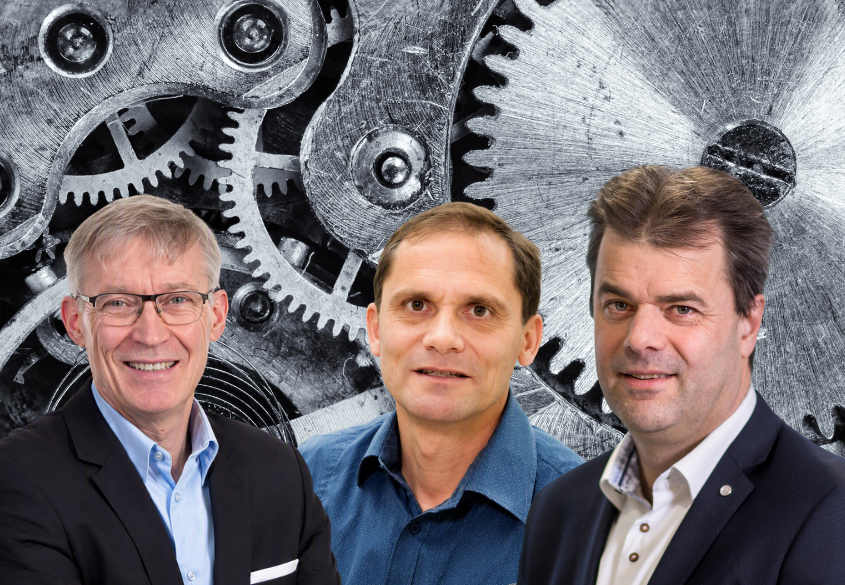
More than twenty years on, Professors Rommert Dekker (Erasmus University Rotterdam), Matthieu van der Heijden (University of Twente) and Geert-Jan van Houtum (Eindhoven University of Technology) look back on a project that extended far beyond its original research objectives.
Driving force
According to the three professors, Rustenburg was indeed the driving force behind the initiative. Van Houtum: “Jan Willem approached companies, built support and helped to actually get the research programme off the ground.” The SLF-R business plan was published in 2005. Fourteen companies committed to the programme and jointly funded half of the research costs. The other half was contributed by the three participating universities. This enabled three PhD candidates to be appointed: one in Rotterdam, one in Eindhoven and one in Twente.
A crucial network
Looking back, Van Houtum describes it as an innovative arrangement. “Companies jointly funded part of the research and universities covered the rest. You see that model much more often these days, but at the time it was quite innovative. In fact, SLF-R was a forerunner of the public-private research projects that later emerged through TKI Dinalog.” The collaboration took place via the existing SLF network. It was precisely that network that proved crucial to its success. “Without SLF, this would never have succeeded,” says Van Houtum. “All the participating companies were already active within the forum.” Thanks to that network, a foundation of trust was already in place, enabling researchers and companies to collaborate closely on practical issues.
Three universities, three lines of research
Within SLF-R, each university worked on its own research topic, always linked to specific real-world issues. Erasmus University Rotterdam focused on demand forecasting for spare parts. Among other things, this involved investigating how organisations can better align their stock levels with the geographical distribution of installations and customers. “We really put the concept of install-base forecasting on the map,” says Dekker. “When aircraft, machines or computers are moved, the demand for spare parts changes too. In that case, you don’t want to wait until the demand arises, but to know in advance where you’ll need stock.”
Eindhoven University of Technology focused on the design and organisation of service networks. Topics included stock locations, repair strategies, tool stock and the global distribution of spare parts. Van Houtum: “Companies such as Philips Healthcare had global service networks for hospital equipment. This raises questions such as: where do you store stock, which parts do you repair, and for which faulty parts do you buy new ones? We investigated those kinds of strategic and tactical choices.”
The University of Twente investigated the relationship between service contracts and logistics performance. The central question was how companies can offer different service levels without incurring unnecessarily high costs. “Customers pay different amounts for different service contracts,” says Van der Heijden. “So, logistically, you also need to be able to distinguish between a standard contract and a premium contract. Otherwise, you’ll end up providing everyone with the same service at far too high a cost.”
Immediate practical impact
Alongside PhD research, final-year projects formed an important part of SLF-R. Students worked on specific problems at companies under supervision. According to Dekker, this was a key source of added value. “The PhD research was often fundamental in nature. The final-year projects were much more directly linked to real-world issues. Companies formulated their own problem statements and students set to work on them.” The list of participating organisations is impressive: ASML, DAF, IBM, Philips, Fokker Services, Vanderlande, NedTrain/NS, Thales, Voestalpine Railpro, Océ, Ceva, IHC Holland, Ortec and Marel Stork.
Sharing knowledge and insights
Moreover, the results were not limited to the companies where the research took place. Through workshops and presentations, knowledge and insights were shared with all participants within the SLF network. “It often turned out that companies in completely different sectors were facing similar problems,” says Van Houtum. “A presentation at one company regularly resonated with other participants. That’s what made the cross-fertilisation within the network so valuable.”
A foundation for the future
When SLF-R was completed around 2010, the collaboration did not end. On the contrary. Its success formed an important foundation for later research programmes such as ProSeLo and ProSeLoNext, which were partly funded by TKI Dinalog. According to the three professors, this is perhaps where the greatest significance of SLF-R lies. “We pioneered this together,” says Van Houtum. “Not only in terms of content, but also in the way universities and businesses were able to collaborate. SLF was the catalyst for this.” Van der Heijden is particularly pleased with the professionals the programme has produced. “Many students who graduated back then went on to work in service logistics. Some subsequently became mentors to new students themselves. This has created a network in which knowledge continues to develop and spread.”
Dekker sees continuity, above all, as a key achievement. “Many research projects are one-off ventures. Here, a collaboration has emerged that is still ongoing twenty years later. That is remarkable.”
Text: Pieter Pulleman