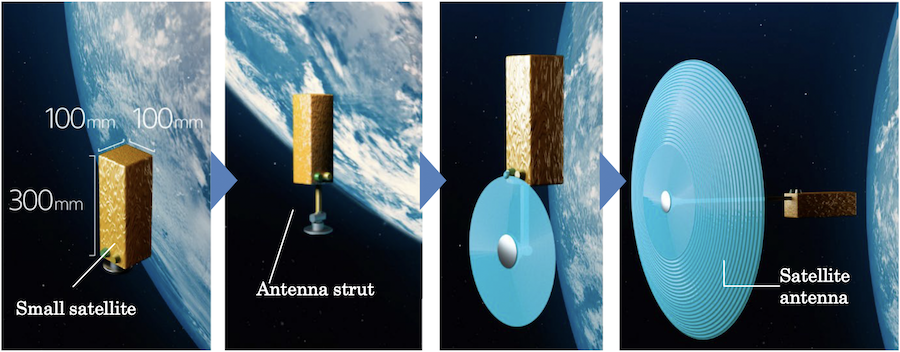

Mitsubishi Electric Corporation wants to 3D-print satellite antennas in space. The Japanese company presents an additive manufacturing technology that can be used in space. The technology uses light-sensitive resin and ultraviolet sunlight.
Producing antenna reflectors for satellites is a complex process. For instance, there are conflicting requirements for achieving high yield, wide bandwidth and low weight. For example, high yield and wide bandwidth require a large aperture. However, a conventional launch simultaneously requires a lightweight and small design that fits - often folded up - into a launch vehicle. Combining these requirements is challenging.
Satellite bus to be launched with 3D printer
To this challenge, Mitsubishi Electric now thinks it has a solution. Instead of a full satellite, the company is launching a satellite bus with a 3D printer. This 3D printer then prints antennas with a large aperture in space. In this way, the company achieves the desired high yield and wide bandwidth.
The resin used by the new technology has been specially developed by this application. The material is designed for stability in a vacuum. The resin enables the production of structures in space using a sustainable process. This process uses ultraviolet light from the sun for photopolymerisation. The polymer created by curing the material can withstand temperatures of at least 400°C. This is higher than the maximum temperature satellites in orbit must withstand.
Large components no longer launch
With the new technology, Mitsubishi Electric aims to be able to fit small satellite buses - the main body of a satellite - with large structures, such as efficient antenna reflectors. Such bulky components can be manufactured in space using the technology. As a result, they no longer need to be launched from Earth.
This offers several advantages. For instance, satellite components are expected to be a lot thinner. Current satellites are designed with an eye on the stress created while leaving and entering the atmosphere. If components are manufactured outside the atmosphere, designers do not have to take this into account. This can reduce both the overall weight of the satellite and launch costs.
No supporting structures required
Because the printing process takes place in space, supporting structures are not needed. The 3D printer uses the antenna's struts and motors meant for adjusting the angle of the antenna.
Mitsubish Electric explains the development in the video below.
Author: Wouter Hoeffnagel
Photo: Mitsubishi Electric