
Methane is an almost 30 times more potent greenhouse gas than CO₂. Researchers from SRON (Netherlands Institute for Space Research) are therefore tracking down large methane leaks around the world. A rubbish dump in Buenos Aires turns out to emit dozens of tonnes of methane per hour. This is comparable to the climate impact of one and a half million cars. They also point to rubbish dumps in India and Pakistan as major emitters.
Methane accounts for the largest share of the man-made greenhouse effect after CO₂. This is due to its high Global Warming Potential (GWP-100). By weight, methane is almost 30 times more potent as a greenhouse gas than CO₂. Human activity, think oil installations, coal mines, cattle pens or landfills, releases methane. You make it less harmful by flaring it off, converting it to CO₂. And if you capture it, you can put that conversion to good use in your boiler or gas cooker.
Methane satellites
SRON researchers have now used satellite data to detect large quantities of methane around a number of landfill sites. Four landfill sites in Argentina, India and Pakistan emit several or even tens of tonnes of methane per hour.
Space instrument Tropomi
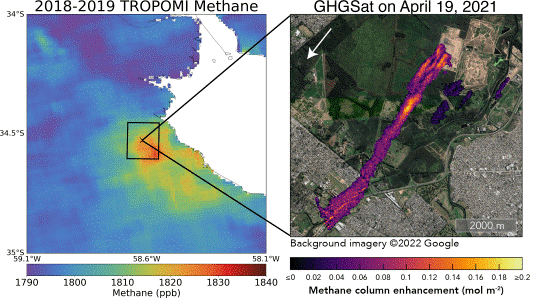
SRON's methane research team used the Dutch space instrument Tropomi to identify cities with high emissions. Buenos Aires, Delhi, Lahore and Mumbai stood out. Their urban emissions here are on average twice as high as estimates based on global inventories. They then asked the Canadian satellite GHGSat to zoom in. This showed that the landfills in these cities are responsible for a large part of the emissions. The landfill in Buenos Aires emits 28 tonnes of methane per hour, comparable to the climate impact of one and a half million cars*. The three other rubbish dumps account for three, six and 10 tonnes of methane per hour, respectively. These numbers still equate to the impact of one hundred and thirty thousand to five hundred thousand cars.
*Based on the US Environment Protection Agency's (EPA) estimate of 4.6 tonnes of CO2 emitted annually by a typical passenger vehicle.
Combating climate change
With the detection of methane leaks, new low-hanging fruit has been found in the fight against climate change. "Methane is odourless and colourless. So it is difficult to see where it leaks," says lead author Bram Maasakkers of SRON. "But satellites are ideally suited for this. With Tropomi, we track down super-emitters that pump large clouds of methane into the atmosphere. That's a shame because you can solve it with relatively little effort. For example, you can separate and compost the organic waste so that much less methane is released. And if you mix all the waste anyway, you can still capture or flare the methane gas produced."
Methane has lifespan of 10 years in atmosphere
Methane has a lifespan of around ten years in the atmosphere. Maasakkers: “So if we take action on emissions now, we will soon see the results in the form of reduced global warming. Of course, reducing methane alone isn’t enough – we also need to cut CO₂ emissions – but it can help us slow down climate change.”
Image: Left: Methane concentrations in 2018-2019 measured by Tropomi around Buenos Aires. Right: zoom-in by GHGsat on 19 April 2021 showing methane plumes coming from the city centre landfill. The white arrow indicates the wind direction. Credit: SRON/GHGSat, contains Copernicus Sentinel data (2018-2019), processed by SRON
Read also: Dutch particulate matter meter SPEXone mounted on NASA's climate satellite