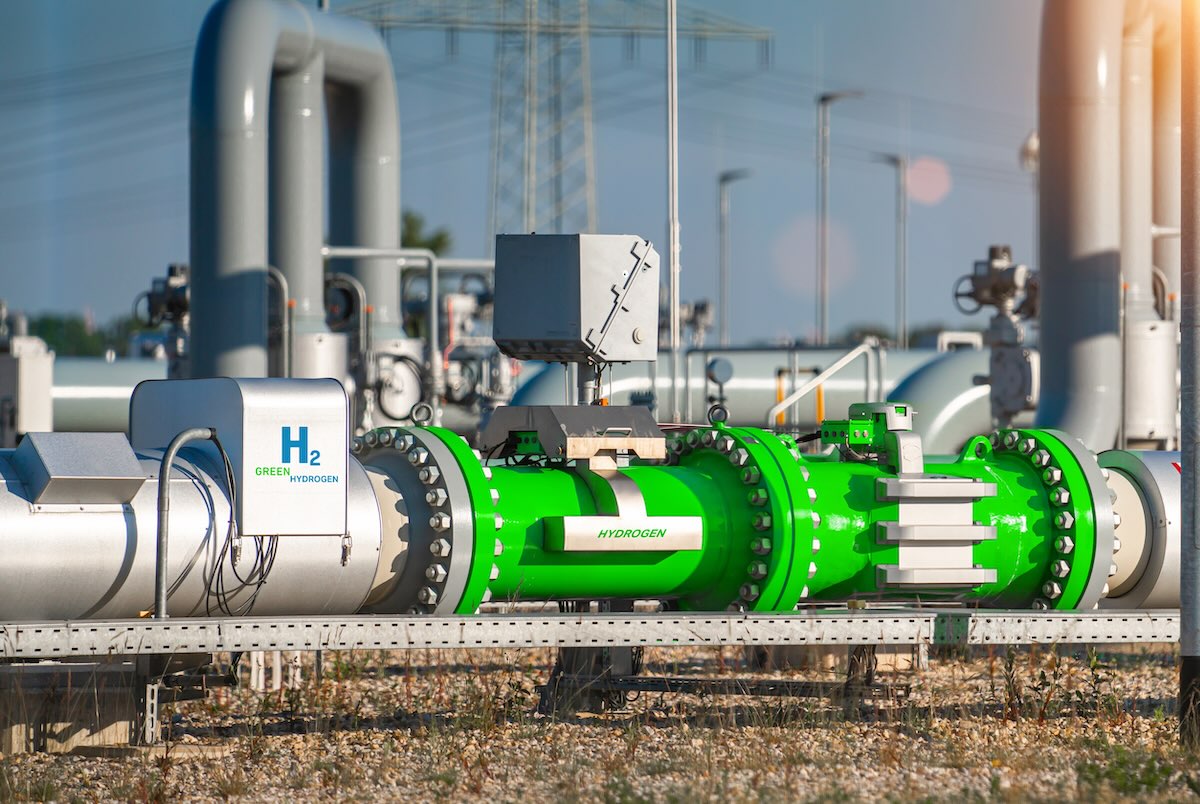

The government prioritises hydrogen and CO₂ infrastructure in the Delta Rhine Corridor (DRC). It thus wants to accelerate the sustainability of industry and prevent further delays in the DRC.
This was announced by Climate and Green Growth Minister Hermans together with Infrastructure and Water Management Minister Madlener and Housing and Spatial Planning Minister Keijzer to the House of Representatives. The Delta Rhine Corridor is a large-scale project to build underground pipelines from the port of Rotterdam via Moerdijk to Germany. The government calls the project crucial for the future of industry in the Netherlands. The construction of pipelines for hydrogen and CO₂, on the one hand, helps reduce greenhouse gas emissions and, at the same time, provides industry with the necessary infrastructure to produce more cleanly.
Various challenges
The project has long faced several challenges, including complex technical requirements, spatial constraints and implementation delays. Originally, the plan for the DRC included the combination of different modalities such as ammonia and direct current cables. However, the government argues that these original plans proved too complex and ambitious.
"Interdependencies and spatial constraints led to significant delays. Focusing the project now on hydrogen and CO₂, important for making industry more sustainable, will allow the project to move forward and create clarity for all parties involved," the government reports.
Preventing further delays
The government is therefore prioritising hydrogen and CO2 within the project, for which it sees a crucial role in making industry more sustainable. This choice should ensure that the project can move forward and provide clarity for all stakeholders. For instance, the decision should allow involved parties to implement the construction of the hydrogen and CO₂ pipelines according to a clear timeline. They are scheduled to be completed between 2031 and 2033.
The government also wants to offer companies certainty, thus encouraging them to continue investing in sustainable technology. The DRC should strengthen the Netherlands' position as an international hydrogen hub and reliable location for CO₂ storage.
Consequences for ammonia and direct current cables
The ammonics component has been removed from the project by the cabinet as it would not be sufficiently elaborated. The same applies to the reusable pipeline that was planned. However, the cabinet does report that the possibility of realising these components later remains open.
The direct current cables needed to transport generated electricity from offshore wind farms to the mainland are also not part of the project for now. This affects the timely availability of green power in the Netherlands. According to Tennet, the construction of these cables will not start until 2040. the government reports that it is currently looking for alternative routes to speed this up.
Decision prevents further delay
While acknowledging the impact of this decision, the government stresses that sticking to the original integrated approach would lead to significant delays. By opting for the hydrogen and CO₂ infrastructure now, it wants to accelerate the sustainability of the industry. This provides stakeholders with the necessary certainty and strengthens international cooperation, with Germany as an important partner.
The government says it recognises the impact of the decision, but stresses that sticking to the original approach would cause significant delays. "This decision creates space to build the necessary hydrogen and carbon infrastructure, which will allow the sustainability of the industry to accelerate. This offers certainty to parties involved and strengthens international cooperation, including with Germany as a partner," the government reports.
Province of Brabant disappointed
The province of Brabant reacts to the decision with disappointment. "This decision makes it unnecessarily complicated to tackle the major social tasks in Brabant," said Provincial Executive member Martijn van Gruijthuijsen of the province of North Brabant. "It is positive that there is now at least a decision on the hydrogen and CO₂ pipelines and connections for Brabant's industrial clusters, but we are far from there yet. Together with the other southern provinces, we have invested a lot of time and energy in this project over the past three years and have contributed constructively. We have even already started investigating which hazardous substances can pass through an additional pipeline together. It is disappointing that the government is largely ignoring these efforts. We therefore call on the government to conclude a covenant with the provinces on the ammonia and so-called multipurpose pipelines for other hazardous substances. In this way, we can still reach an integral solution that does justice to all the tasks in our regions."
The province and several Brabant municipalities fear that the decision misses a "historic opportunity to tackle several major tasks simultaneously". These include making industry more sustainable, increasing safety around the railway and accelerating housing construction.
'Missed opportunity'
Theo Weterings, mayor of Tilburg: "It is a missed opportunity to lay only two and not immediately four pipelines. Trains carrying hazardous materials continue to rumble through our city centres, through our villages and across the countryside, while there is a safe alternative. Why not take this step proactively instead of unzipping Brabant a second time in the future to lay pipelines after all? The opportunity to get these trains out of our centres faster so we can start housing development in our station areas should be seized by all of us with both hands."
Breda mayor Paul Depla: "What a pity that The Hague does not really follow through. As cities, we want to put all our energy into tackling the housing shortage. Something that is also high on The Hague's agenda. But with this decision, dangerous trains continue to run through our villages and cities. Right through busy areas. Right through areas where lots of housing can and should be built. The government could have removed an important bump in the road. Unfortunately, it did not. With all the consequences for opportunities for our building plans and safety of our residents."
TenneT expresses concerns
TenneT says it understands the complexity of the choice made by ministers, but is at the same time disappointed with the decision to remove direct current connections from the Delta Rhine Corridor. The grid operator says it feels responsible for the energy transition and, in particular, the electrification of the Netherlands. "The joint procedure initiated would have led to optimal use of scarce space, also considering the large space requirements of the energy transition," TenneT writes.
"TenneT has major concerns about how to connect offshore wind farms to the high-voltage grid deep inland (deep landfall) and how to bring the power further inland without creating new bottlenecks in the grid. This may have implications for future grid congestion and the possibilities of (industrial) electrification in Limburg in particular in the longer term."
The grid operator stresses the consequences regarding congestion and warns of high costs. "Due to the lack of deep landfall of Wind at Sea in Limburg as envisaged in the Delta Rhine Corridor, we will face high social costs, approximately €400 million redispatch costs per year to solve grid congestion," TenneT said. It says it is working with the Ministry of Climate and Green Growth to find solutions that will minimise the impact of the decision.
'Port of Rotterdam: 'Good that clarity is given'
On the contrary, the Port of Rotterdam Authority is positive about the decision, calling it important that the pipelines for hydrogen and CO2 are constructed as soon as possible. It calls the cabinet's decision of great importance for being able to meet the targets for making industry more sustainable. Boudewijn Siemons, CEO Port of Rotterdam Authority: "For industrial clusters in Rotterdam, the Netherlands, Germany and North-West Europe, this is a very important decision. It underlines the urgency to give industry a future. Infrastructure comes before investment in sustainability. It is very good that this clarity is given."
Author: Wouter Hoeffnagel
Image: Vilius Kukanauskas via Pixabay











