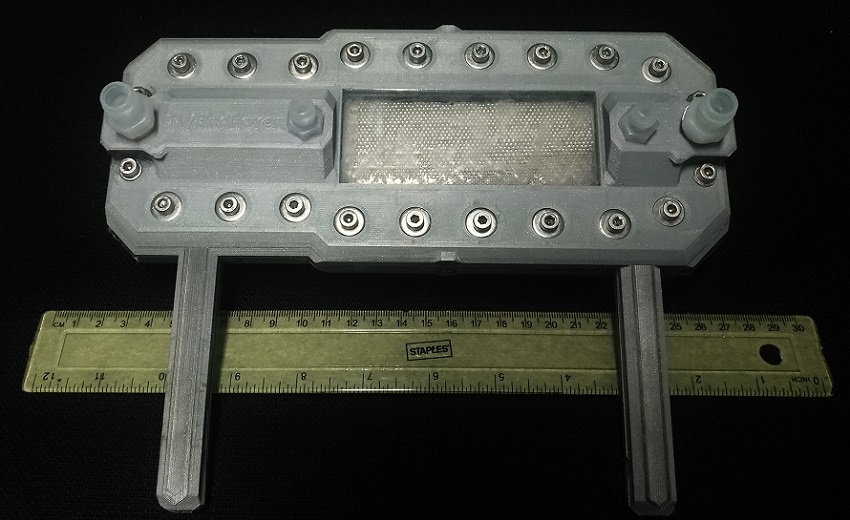

3D-printing an electrolyser to save time and money? It’s possible! Stephane Weusten has proven it. He completed his PhD on this topic at Eindhoven University of Technology with a thesis entitled ‘Demystifying mass transfer in electrolysis through 3D-printed reactors’. This could help accelerate research into producing cheaper and more efficient hydrogen.
Electrolyzers are expected to play an important role in energy transition in the future. The devices split water molecules into hydrogen and oxygen using electricity. But the extent to which oil and gas will be replaced by hydrogen does depend on the performance of electrolyzers. Hydrogen is a lot more expensive relative to fossil fuels. And although electrolyzers have been around for about 100 years, they have not changed much in that time.
Cost of electrolyzers
Scientific calculations and simulations help to learn more about the device. But does the theory work in practice? And how do you improve the performance of electrolyzers to ensure that hydrogen actually becomes a formidable competitor to oil and gas? Test equipment is expensive because it has to be custom-made. It costs around EUR 3,000 to try out a limited set. This is why Weusten chose to use a 3D printer.
Higher reaction speed
Using a 3D printer keeps costs down. Once you have a 3D printer, all you need to do is buy a spool of filament. However, Weusten did not immediately succeed in printing a device that worked properly. “With each improvement, we were soon six versions down the line. At a certain point, you lose count.” Step by step, the problems were eliminated. For example, making the electrolyser leak-proof proved not to be straightforward. “Step by step, I was able to improve performance. For example, by adjusting the geometry of the electrolyser. I changed the shape of the inlet so that the molecules collided more quickly and, due to the higher reaction rate, more hydrogen was produced in a shorter time. I also adjusted the 3D electrodes. Overall, all these adjustments resulted in a seven-fold increase in the reaction rate.”
Faster testing
"Still, the gains are mainly in 3D printing," the researcher argues. "In the past, we rarely used a 3D printer to build electrolyzers. Now other researchers can also work with these and test their theories faster. That's how you accelerate research into electrolyzers and hydrogen, and that's really the added value of my work."

Source and image: TU Eindhoven











