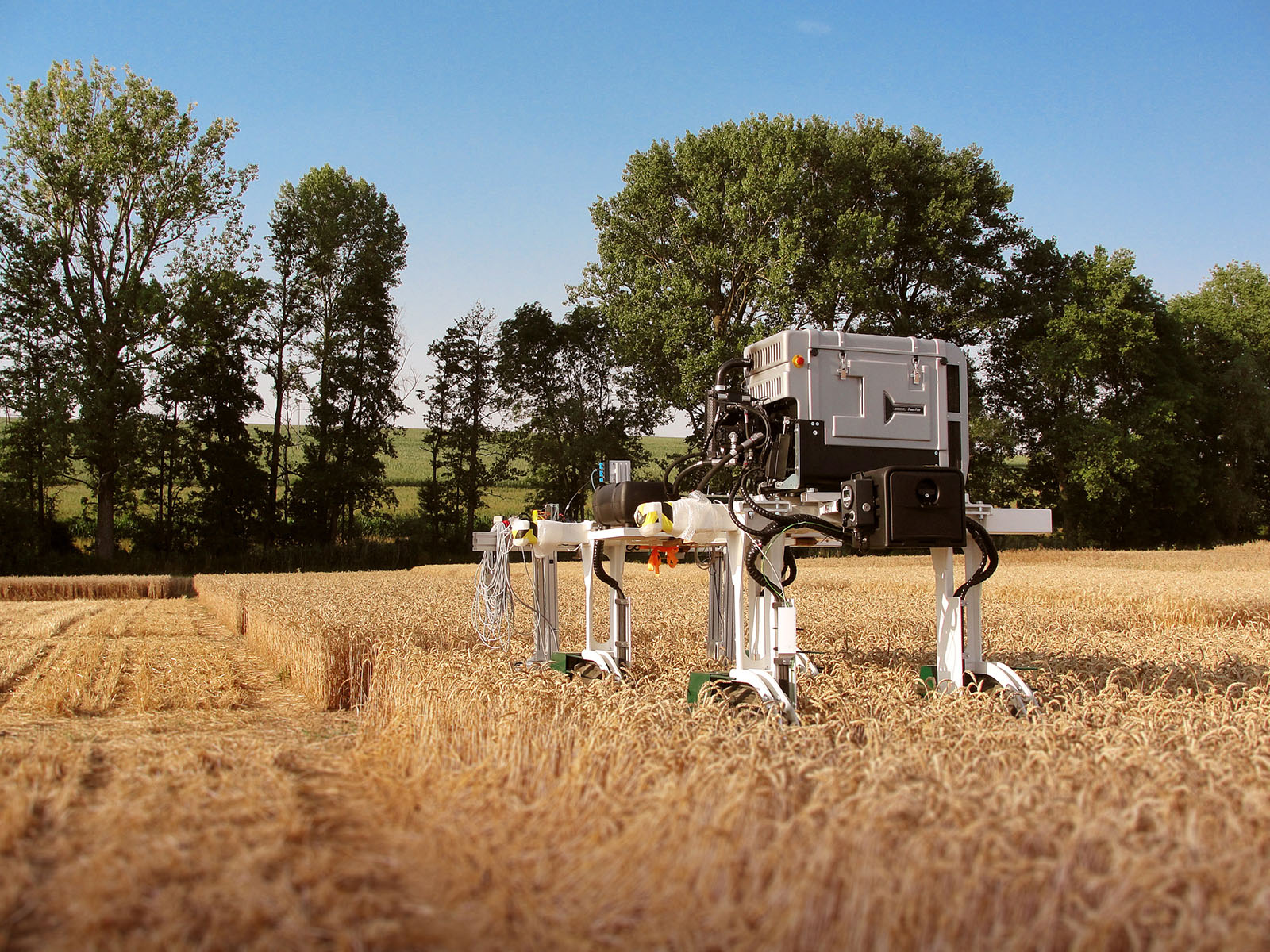

Climate change poses major challenges, especially for plant breeders. An intelligent field robot and X-ray technology help them select heat-tolerant plant varieties. The sensors in the high-tech machine were developed by the Fraunhofer Development Centre for X-ray Technology, a division of the Fraunhofer Institute for Integrated Circuits IIS.
Our summers are getting hotter. The drought that accompanied last summer also affected plants. With an ample water supply, these plants can cool themselves by evaporation. With drought stress, however, they cannot. Therefore, plant breeders hope to develop heat-tolerant, drought-resistant plants that can survive with less water. And this without sacrificing good yields while requiring as little fertiliser and pesticides as possible.
Fraunhofer
For years, researchers at the Fraunhofer EZRT have been researching technologies for determining the phenotype of plants. This refers to their outward appearance, which encompasses a multitude of factors. These include leaf size, leaf arrangement, root thickness and yield. "People have been selecting crops based on external characteristics for thousands of years," explains Dr Stefan Gerth, head of department at the Fraunhofer Development Centre X-ray Technology at Fraunhofer IIS. "We are developing technologies to measure these phenotype traits objectively. On this basis, it is possible to optimise breeding."
Using 3D imaging to predict yields
For example, the research team led by Dr Gerth has developed sensor technology for a robot used for agricultural applications, the DeBiFix. As DeBiFix makes its way through densely packed crops, it continuously takes X-ray images of the plants. At the same time, the robot generates 3D images using an optical system. This is important information for the breeder who owns the field where the robot is working. It allows him to actually look into the crops and determine whether the variety he is growing will produce a good yield.
Biogenic value creation and smart farming project
The main objective of the transregional Fraunhofer smart farming project is to support breeders. As part of this project, the Fraunhofer Centre for Plant Phenotyping Technologies is being launched in Triesdorf, Bavaria. At this location, Dr Gerth and his colleagues aim to further develop their expertise and apply it in practice. Triesdorf is home to agricultural educational institutions and the Weihenstephan-Triesdorf University of Applied Sciences. Fraunhofer IIS works closely with the Competence Centre for Digital Agriculture based there.
Selecting heat-resistant plant varieties
In the laboratory for phenotyping plants in climate-controlled environments at Fraunhofer EZRT in Fürth, Dr Gerth demonstrates how breeders will work in the future. Pots of different crop plants are arranged in neat rows on the narrow conveyor belt in front of the X-ray machine. The door of the X-ray machine opens, and a pot rolls in. Once the door is closed, the pot undergoes a computer tomography scan, among other tests. Five minutes later, it is time for the next pot.
Analysis of images
“More than ten years ago, we started taking X-rays of potato plants to gather information about the growth of the tubers,” says Dr Gerth. “Based on the 3D X-ray scans, we can determine the weight of the tubers. We don’t need to dig them up to do so.” This process is used, amongst other things, to select particularly heat-resistant varieties. To this end, the plants are placed in a laboratory chamber under heat stress. The scans then show which plants cope best with the stress and form strong tubers despite the heat.
X-ray device for underground plant parts
With the first computer tomography scans, it was possible to capture thick roots and tubers. Today, the new systems can also capture the delicate underground root structure of wheat. "Our new X-ray machine is the most modern, powerful system for taking X-ray images of underground plant parts," says Dr Gerth.
3D images
Researchers at the Fraunhofer EZRT also create 3D digital images of the above-ground parts of plants, such as leaves and ears of wheat. This data can be used to determine more than just the area of the leaf surface. The 3D images also provide information about the plant's heat tolerance. Does the plant raise its leaves to protect itself from the sun? Does it curl up its leaves as a result of stress?
Plant recognition systems
The efficiency of Fraunhofer EZRT's optical plant recognition systems was clearly demonstrated in a test field at the seed company Strube D&S GmbH. In this case, the second BlueBob prototype was used. This is a field robot that self-navigates and automatically removes weeds in sugar beet fields. As it moves between rows, it takes images of all living plants using multispectral cameras.
Artificial intelligence
"By using artificial intelligence, the phenotype of each individual plant is analysed and classified as a weed or beet," explains Christian Hügel, head of the Technical Centre for Seed Research at Strube. When BlueBob 2.0 identifies a weed, it removes it from the soil with its hoeing tools. It removes weeds between rows using static implements. Inside the rows, it uses moving implements. As a result, almost all weeds around the beet plants are removed. This means that the use of chemical herbicides can be drastically reduced.
Photo and source: Fraunhofer IIS









