
Research institute Differ and Eindhoven University of Technology (TU/e) are going to work together. Together, they are pushing for the construction of a national facility for high-energy X-ray research. For this kind of research, Dutch researchers currently have to reserve expensive and scarce time at huge synchrotrons abroad. This will soon change.
Robert-Jan Smits, chairman of the TU/e Executive Board and Differ director Marco de Baar, signed a Memorandum of Understanding regarding the construction of an X-ray lab. Its aim is to eventually realise a research facility at Differ in Eindhoven based on the technology developed under the leadership of TU/e professor Jom Luiten, within the Interreg consortium Smart*Light.
Smart*Light
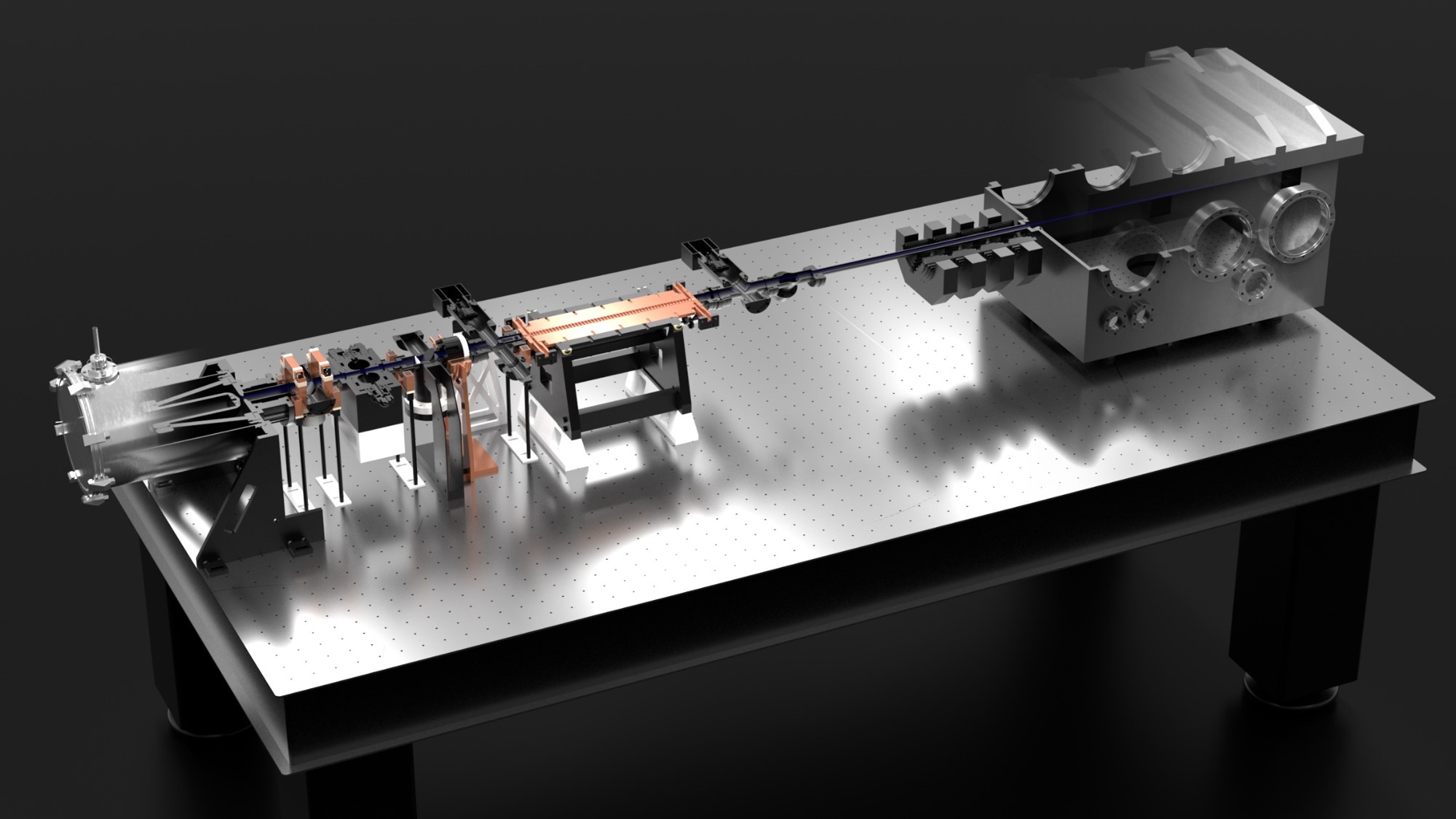
The Smart*Light project is developing a compact and transportable source of very bright X-rays with adjustable wavelength, a 'table-top synchrotron'. Synchrotrons are light sources based on circular particle accelerators. For decades, they have been the workhorses of X-ray research that can be used to look very precisely into materials. However, these are huge installations, with diameters of hundreds of metres, and very high costs. The Netherlands has no synchrotron, and in Europe there are only a dozen.
Alternative technology
According to Professor Jom Luiten, Synchrotons are so sought-after that there are huge waiting lists to use them. This puts a brake on several areas of research. In addition, long duration tests are not possible either. That is why the SmartLight was developed. It is an alternative technology that can do more or less the same thing with an arrangement of only a few metres: generate extremely bright and coherent X-ray beams, while also being able to quickly vary the energy.
Collisions between laser and electrons
SmartLight uses new accelerator technology to convert laser light into intense and coherent X-rays by colliding it (via 'inverse Compton scattering') with a high-energy beam of electrons. This radiation can then be used to perform state-of-the-art analyses of value to various sectors of society. Although SmartLight does not aim to replace existing synchrotron facilities, its compact design will make it an important addition to them. Users will therefore be less dependent on scarce measurement time at large synchrotrons.
The first tests
Smart*Light's prototype is just about ready. Luiten expects to conduct the first tests this year. Work is also underway to further develop the prototype into a robust user facility, which can also serve multiple users with multiple questions and user requirements. In the next phase, harder X-rays will be generated for research on high-density objects. The light intensity will also be further increased, making it suitable for even more applications.
Applications
The X-ray lab can be used to develop new materials needed for sustainable energy, for example for a nuclear fusion reactor or for hydrogen production. But there will also be great demand from medical research, nanotechnology, metal fatigue research and research into ancient art - think of discovering overpainted layers of paint in old masters.
Operational
The new research facility being developed by Differ and TU/e should be operational in a few years' time. The parties are open to cooperation with third parties. The plan fits within the Ministry of Education, Culture and Science's ambition to strengthen the national research infrastructure.
Working together
Differ director Marco de Baar about the new research facility: "At Differ, we develop and research materials for the energy transition. We prefer to do that together with others: companies and researchers from outside. The development of this X-ray facility fits into our line to develop and open up complex measurement instruments for materials research for energy applications. This future facility will enable better analysis of new materials, e.g. for electrodes and catalysts. We are therefore happy with this step."
Sources: TU/e and Smart*Light
Image: TU/e









