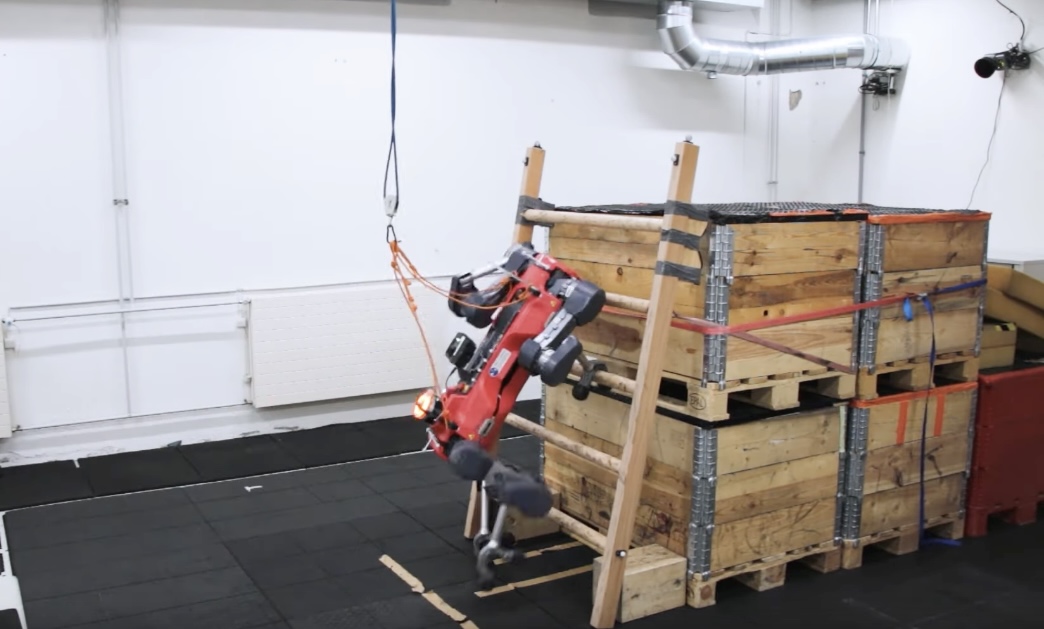

Researchers at Swiss university ETH Zurich have succeeded in teaching a four-legged robot to climb ladders. Even if disturbed by unexpected events in the process, the robot is able to climb the ladder successfully.
Four-legged robots are increasingly found in industrial environments. Here, equipped with all kinds of sensors, they can perform inspections, among other things, without people having to go into dangerous, hard-to-reach or uncomfortable locations. However, a major obstacle that many existing variants cannot overcome are ladders, which are particularly common in industrial environments.
Researchers at ETH Zurich have succeeded in developing a model that does enable four-legged robots to do so. It used an ANYmal robot, developed by an ETH Zurich spin-off called ANYbotics, for this purpose.
Reinforcement learning
The model used by the researchers was trained using reinforcement learning. Reinforcement learning is a form of machine learning in which a so-called 'agent' learns based on interaction with its environment. In doing so, it receives rewards or punishments based on its actions in the form of feedback.
The agent's goal is to develop a strategy that maximises its cumulative reward. This by reacting appropriately to the different situations it encounters. Instead of being given direct instruction or examples, the agent discovers for itself which actions are best based on trial-and-error.
The result is a model that enables the ANYmal robot to climb stairs. In doing so, the robot achieves a 90% success rate on ladders with an angle of 70 to 90 degrees. In doing so, the robot can climb ladders as much as 232 times faster than existing robots capable of doing so.
Dealing with unexpected events
If the robot encounters unexpected events during its climb, the robot is able to recover from them in many cases. For example, during trials, the researchers tied a rope to one of the ANYmal robot's front legs, and then pulled on this halfway up the ladder. In the process, the robot managed to maintain its grip on the ladder.
An important role in this is also played by the robot's special legs, which are fitted with specially developed end-effector in the form of a hook. This allows the robot to firmly grab onto the ladder. The researchers report that in a regular climbing task, this hook does not produce a significant difference in success rate, and in particular if the robot has to deal with unexpected situations it can make a difference.
Expanding its scope
"This work extends the scope of industrial four-legged robots from inspection on nominal sites to challenging infrastructure features in the environment. Here, synergies between robot morphology and control policies are highlighted when performing complex skills," the researchers report.
All the researchers’ findings have been compiled in a research paper, which is available here.
Author: Wouter Hoeffnagel
Image: screenshot of video









