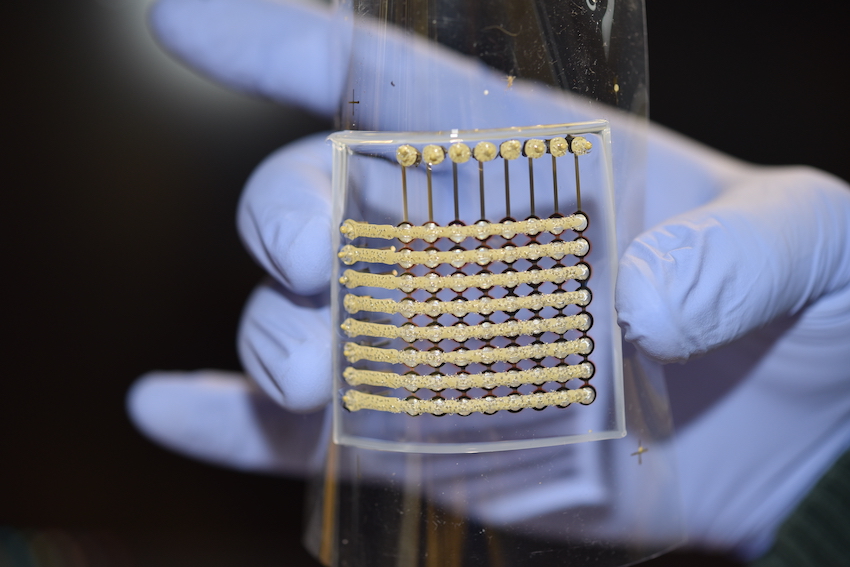

Researchers at the US University of Minnesota have succeeded in printing a flexible OLED screen. They used a custom-made 3D printer for this purpose. The production method can make OLED screens cheaper, among other things.
OLED is a display technology that converts electricity into light using an organic material. The technology is suitable for high-quality displays, which can be flexible, among other things. In this regard, OLED is suitable for large screens for televisions and monitors, among others. But also for smaller screens for devices such as smartphones. OLED screens are popular because of their weight, energy efficiency, thickness and flexibility, among other things. They also offer a wide viewing angle and enable high contrast.
Tailor-made 3D printer
However, the production of OLED screens is relatively expensive. "The production of OLED screens typically takes place in large, expensive, and super-clean manufacturing facilities," says Michael McAlpine, Kuhrmeyer Family Chair Professor of Mechanical Sciences at the University of Minnesota and lead author of the study. McAlpine and his team investigated whether they could produce OLED screens using a 3D printer. This would involve a custom-made machine costing about as much as a Tesla Model S.
The group also previously experimented with 3D printing OLED screens. However, then they ran into problems with the uniformity of the light-emitting layers. Other groups also previously succeeded in 3D printing OLED screens. However, they also used other techniques, such as thermal evaporation or spin coating.
Fully printed
This is not the case in the new research from the University of Minnesota. The OLED screen was produced exclusively using the custom-made 3D printer. The researchers combined two different printing modes in the production process. With this, a total of six layers were printed, forming a flexible OLED screen. The electrodes, interconnects, insulation and capsule were printed extrusion-based. The active layers were spray printed at room temperature using the same 3D printer.
Using these printing techniques, they created a 1.5-by-1.5-inch OLED screen. The screen has 64 pixels. The researchers report that each pixel functions properly and emits light. "The device gives a relatively stable output of over 2,000 bending cycles. This suggests that fully 3D printed OLEDs have the potential to be used for important applications in soft electronics and wearables," said Ruitao Su, University of Minnesota alumni and researcher at MIT.
McAlpine and Su, along with mechanical science researcher Xia Ouyang, Sung Hyun Park (now senior researcher at the Korea Institute of Industrial Technology) and Song Ih Ahn (now assistant professor of mechanical science at Pusan National University in Korea) were involved in the research.
Printing OLED screens with higher resolution
As a next step, the researchers plan to focus on 3D printing OLED screens with higher resolution and improved brightness. "The beauty of our research is that production is completely built-in. So we are not talking about 20 years away and a utopian vision," says Alpine. "This is something we are actually producing in the lab. And it's not hard to imagine that within a few years we can translate this into printing all kinds of displays ourselves at home or on the go on a small portable printer."
Further information is available in the team’s research paper, published in *Science Advances *.
Author: Wouter Hoeffnagel
Photo: McAlpine Group, University of Minnesota









