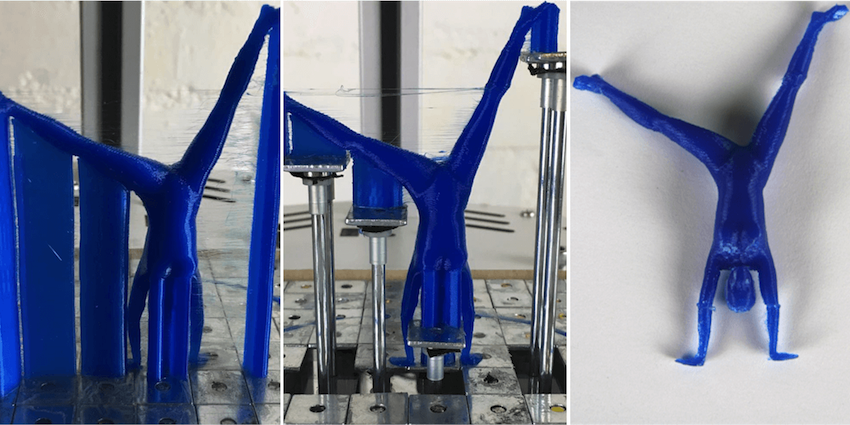

A new development could potentially make 3D printing more efficient, cheaper and more sustainable. It involves a special print bed equipped with extendable pins. These pins support the object and thus make printing traditional support structures unnecessary. The print bed was developed by the USC Viterbi School of Engineering.
Additive manufacturing is often seen as a promising manufacturing technology. It allows objects to be printed on site using additive manufacturing. This without, for instance, having to manufacture special moulds. This enables, among other things, short-run production and the manufacture of custom-made products. Prototypes can also be produced locally and much faster.
Fused deposit modelling
A well-known form of additive manufacturing is fused deposit modelling (FDM). An FDM printer is equipped with a static print bed, over which a print head moves. This print head prints an object layer by layer, each time printing a new layer of material on top of the previous layer.
However, the FDM technique has limitations. For instance, printing free-hanging objects is not possible. Therefore, do you want to print a teacup with an ear, for example? Then a support structure must be printed to support the ear. This structure ensures that the ear has sufficient support. And keeps its shape during curing.
Time-consuming and costly
However, printing support material is not ideal. For instance, the method increases filament usage, lengthens the printing process and increases costs. For instance, the material has to be removed after the printing process, which is usually done manually. This can also have an impact on the printed object. For example, the removal of support material can lead to rough surfaces or small deviations in dimensions. In many cases, in addition, the printed support material is not reusable. The used filament is therefore lost, which has an impact on the environment.
A new print bed developed by researchers at USC Viterbi School of Engineering offers a solution. It involves a team of researchers led by professor of industrial and systems science Yon Cheng and student Xang Xu. The findings were produced in Additive Manufacturing.
Extendable metal pins
The print bed is equipped with several extendable metal pins. These pins can be extended to the desired height to support prints in the right location. For example, do you want to print the aforementioned teacup with ear? Then the ear can be supported using one or more pins. These are extended to directly under the ear, making support material unnecessary.
Experiments by the researchers show that the technique is profitable. For example, the new print bed reduces the amount of filament used by 35%. Depending on the material used, the financial savings can add up. Thus, additive manufacturing is also increasingly used for printing biomaterials, for example for building tissues.
All pins driven by one motor
The concept is not entirely new. However, in previous developments, the pins were extended by individual motors. This required a relatively large number of motors, which entailed costs. However, the researchers have managed to drive all the pins with just one motor. This significantly reduces costs. The researchers expect that their development can eventually be adapted for use in larger-scale applications.
Author: Wouter Hoeffnagel
Photo by: Yong Chen









