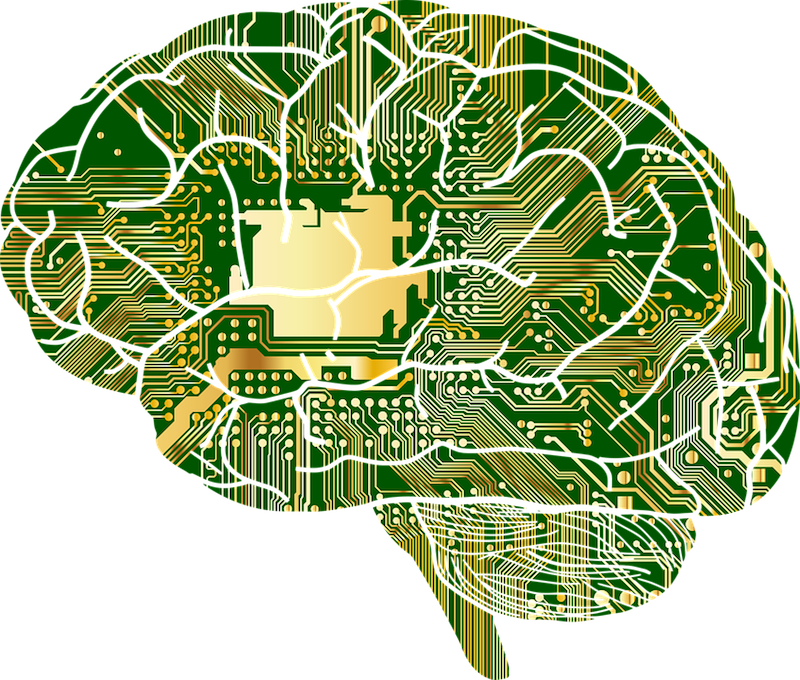

Computers, data centres and other electronics consume a lot of energy. The Netherlands is betting on wind farms, among other things, to meet this high energy demand. However, a new type of molecular switches can also contribute to this. The switches can learn from previous behaviour and enable 'brain-like computing'. Thus, they can contribute to making electronics more efficient.
The switches were developed by an international group of researchers led by Prof Dr Christian Nijhuis of the University of Twente. Instead of focusing only on realising renewable energy sources, Nijhuis also wants to focus on making electronics more efficient. "Our brains are the most efficient computers we know. They use ten thousand times less energy than the most economical computers," reports the professor.
Time-dependent pulses
The high energy efficiency of human brains is possible because brains process data in a completely different way. Computers process binary streams of information, consisting of zeros and ones. Brains, however, work analogously through time-varying pulses.
"Our brains process information from millions of nerve cells from all our senses without difficulty. In doing so, unlike traditional electronics, it uses only the brain cells and synapses where pulses pass," reports Nijhuis. As a result, in practice, our brains only consume energy during a pulse. This enables brains to efficiently process a large amount of data simultaneously.
Deep learning
Together with his team, Nijhuis developed molecules that can perform all the Boolean logic gate switching required for deep learning. "Deep learning is a form of machine learning based on artificial neural networks and is widely used in the automatic recognition of images and speech, but also in the search for new medicines and, recently, the creation of art. All things that are much more difficult for a computer than for our brain," Nijhuis explains.
For some time there have been all kinds of developments around software for artificial intelligence. With molecules, the research team now wants to bring hardware for artificial intelligence closer.
Adjusting behaviour based on previously received incentives
To mimic the dynamic behaviour of synapses at the molecular level, the researchers combined fast electron transfer with slow proton coupling limited by diffusion. This resembles the fast pulses and slow uptake of neurotransmitters from neurons in the human brain.
Molecules are capable of adjusting the power and duration of pulses. In doing so, they exhibit a form of classical conditioning, the researchers report. The molecules adapt their behaviour to stimuli they have previously received, which is a form of learning. In the future, such molecules should also be able to respond to other stimuli, such as light, according to the researchers.
Various applications
The researchers foresee a wide range of applications. For instance, according to the researchers, the discovery paves the way for the development of various adaptable and reconfigurable systems. These may in turn lead to new multifunctional adaptive systems that significantly simplify artificial neural networks. Nijhuis explains: "In doing so, we drastically reduce the energy consumption of our electronics." Multifunctional molecules that are also light-sensitive or can detect other molecules could in turn lead to new types of neural networks or sensors.
More information is available in the publication 'Dynamic molecular switches with hysteretic negative differential conductance emulating synaptic behaviour' in the scientific journal Nature Materials.
Author: Wouter Hoeffnagel
Photo: Gordon Johnson via Pixabay









