
Batteries will play a central role in the mobility of the future. That is why researchers around the world are working to improve battery technology. Scientists at Fraunhofer ILT in Aachen have recently developed two laser-based manufacturing technologies. This laser technology can save energy in manufacturing. In addition, the innovation makes it possible to make battery cells with higher power density and longer life.
One of the key steps in the production of lithium-ion batteries is the manufacture of electrodes with graphite. For these electrodes, a copper foil is coated with a graphite paste via the roll-to-roll process. They then go into a continuous oven at 160 to 180 degrees Celsius to dry. Gas furnaces not only consume a lot of energy. They also take up a lot of space. They are 60 to 100 metres long and dry up to 100 metres of film per minute when operating on an industrial scale.
Efficient drying with diode lasers
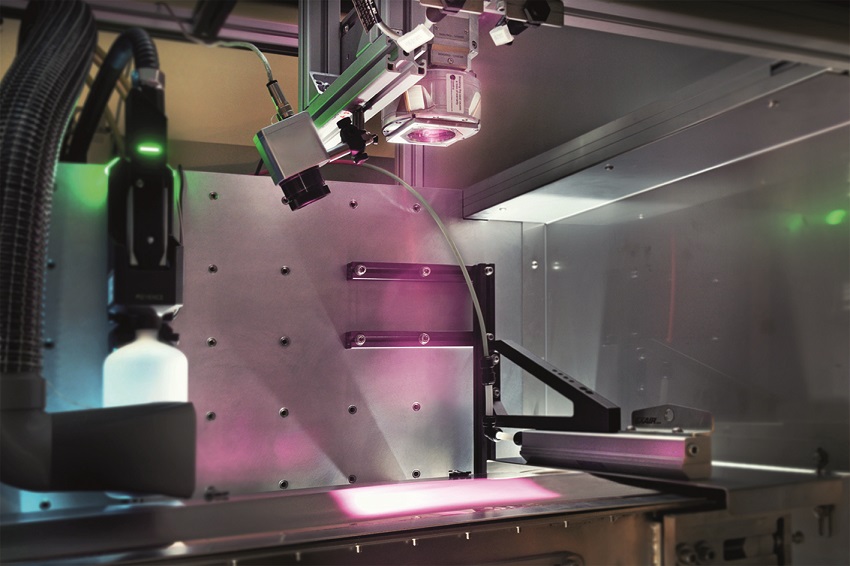
Researchers at Fraunhofer ILT have developed a system in which a diode laser carries out the drying process. To achieve this, they combined a laser with a wavelength of 1 micrometre with a special optical system that illuminates the electrode over a large surface area. Fraunhofer’s industry partner, Laserline, designed the optics specifically for the drying system.
Laser technology in a nutshell
Samuel Fink, group manager for Thin Film Processing at Fraunhofer ILT, explains the principle of laser technology. "Unlike hot-air drying, our diode laser projects a high-intensity beam onto the copper film. This is coated with graphite paste. The jet-black graphite absorbs the energy. The resulting interaction causes the graphite particles to heat up and the liquid to evaporate." The Fraunhofer technology offers a number of advantages. Compared to energy-guzzling continuous furnaces, the diode laser is very energy-efficient. And the system emits very little heat to the environment. Moreover, the laser drying system takes up much less space than conventional ovens. "Drying with the diode laser will reduce energy requirements by up to 50 per cent and space requirements for an industrial-scale drying system by at least 60 per cent."
Modified 3D electrode structure
In addition to these advantages, the Fraunhofer ILT team succeeded in improving the power density and lifetime of lithium-ion batteries. Once again, laser technology is in the spotlight. In this case, an ultra-short pulse laser (USP) with high power and 1 millijoule pulse energy introduces a hole structure, called channels, into the battery electrode. These channels serve as Li-ion shortcuts for the ions. They significantly reduce the distance the ions have to travel. And they shorten the charging process. At the same time, defects are prevented from occurring. As a result, the number of potential charging cycles increases. Ultimately, this extends the life of the battery.
Scalable process
Both the laser process for producing the hole structures and its positive effect on the battery cell are known in theory. The Fraunhofer researchers have taken the principles from the laboratory to a scalable process. This makes it ready for industry. "
Challenges laser technology
One of the challenges was to figure out how to apply this process to larger surfaces. This is needed to achieve the high throughput required in industrial production. The Fraunhofer team solved this problem by using a multi-beam setup for parallel process control. Four scanners, each with six beams, process the tape in parallel. They cover a width of 250 millimetres and process the graphite layer continuously. The multi-beam optics were developed and implemented in close cooperation with Pulsar Photonics GmbH, a Fraunhofer ILT spin-off founded in 2013.
Sustainability
Research by Fraunhofer ILT shows that laser technology can be used as a digital manufacturing process to improve the quality of battery cells and significantly increase sustainability during production. “The next step is to scale up the technology from the prototype to an industrial production line,” says Matthias Trenn. Laser technology is used in many fields, including the agricultural sector to control weeds without the use of pesticides.
Source: Fraunhofer, Photo: Drying with diode lasers: Thanks to special optics, the laser irradiates a larger area on the copper foil coated with graphite paste. The interaction between the graphite particles and the light energy generates heat and the liquid evaporates (Fraunhofer ILT)









