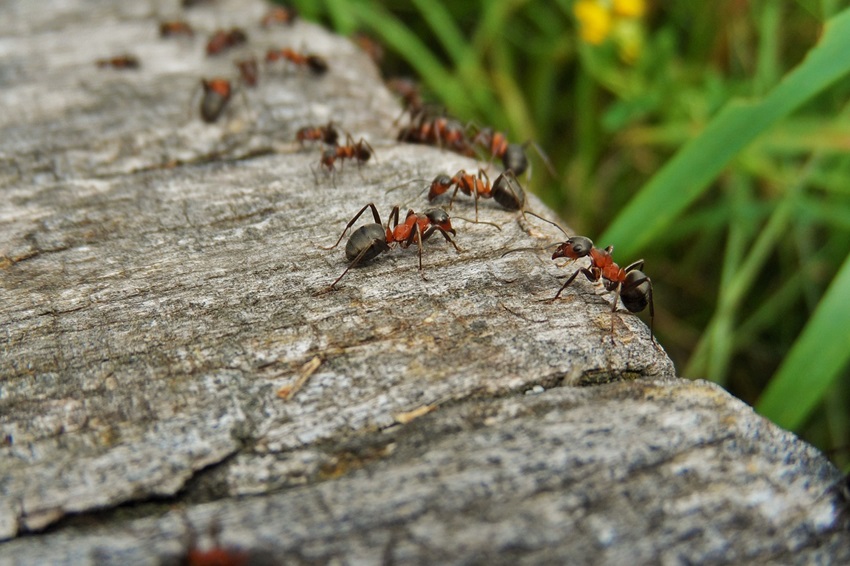

How can insects move so far from their home base yet always find their way back? Besides biologists, researchers specialising in AI for small autonomous robots are now looking for the answer. Drone researchers at TU Delft were inspired by biological research on how ants visually recognise their surroundings and carefully count their steps to get home safely. Armed with this insight, they created an insect-inspired autonomous navigation strategy for small, lightweight robots. With this robotic navigation, these robots simply get home after a long journey. And that with very little computing power and memory (1.16 kilobytes per 100 m). In the future, tiny autonomous robots could be used for a wide range of applications.
Small robots, weighing from tens to a few hundred grams, have numerous interesting practical applications. Their light weight makes them extremely safe, even if they accidentally bump into someone. And thanks to their small size, they don't shy away from small spaces either. Cheaply produced robots could be used en masse to quickly cover a large area, for example to detect pests or diseases early in greenhouses. However, autonomy is no easy task with these kinds of small robots, as they have limited resources compared to larger robots. A major obstacle is therefore robot navigation.
Remote infrastructure
These kinds of small robots need to be able to navigate themselves to perform their tasks. To solve this problem, robots can get help from external infrastructure. For instance, they can use GPS satellites outside or wireless communication beacons inside. However, it is often not desirable to depend on such infrastructure. Indoors, you don't have GPS, and in built-up environments like modern cities among tall buildings, it is often inaccurate. In contrast, the alternative of installing and maintaining beacons is quite expensive or simply not possible, for example in rescue operations.
Problems with current technology
The AI typically used for autonomous navigation with the sensors and computing power on the robot itself is basically designed for large robots, such as self-driving cars. These approaches rely on heavy, energy-guzzling sensors such as LiDAR rangefinders. This technology is not suitable for small robots. Another option is to use a highly energy-efficient vision sensor that provides rich information about the environment as the basis for highly detailed 3D maps. However, this requires a lot of computing power and memory, and the associated computing equipment is too large and consumes too much energy for such small robots. You can only equip small drones with very small processors with little processing power and memory. Autonomous robot navigation is thus a big challenge, as current AI for navigation requires a lot of computing power and memory.
Robotic navigation by mimicking nature
To meet this challenge, researchers at TU Delft decided to turn to nature. Insects are particularly interesting because they move over distances that could be relevant for many practical applications with very limited sensor and computing power. Biologists are gaining more and more insight into insect strategies. For instance, they learned that insects track their own movements, also known as odometry. They combine this with visually guided behaviour based on recognition of the environment.
Odometry
Odometry is increasingly well understood, even down to the neuronal level. Yet the exact mechanisms underlying visually guided behaviour have not yet been fully uncovered. There are, however, several competing theories about how insects use vision to navigate. One of the first theories assumes a model based on snapshots, or visual snapshots. According to this model, an ant, for example, takes regular snapshots of its surroundings. Later, when the ant approaches 'the same spot again, it compares its current environment with the snapshot. It moves until the differences are minimal. As a result, the ant finds its way back to a snapshot, also known as homing. At the same time, it counteracts the inevitable positional drift associated with odometry.
Hansel and Gretel
"Navigation based on snapshots is best explained using the fairy tale of Hansel and Gretel. When Hansel still marked his way with pebbles, he always found his way back easily. But when he used breadcrumbs, they were immediately eaten by birds. As a result, Hansel and Gretel got lost. Our snapshots are best compared to those pebbles," explains researcher Tom van Dijk. "A snapshot only works if the robot is close enough. If the visual environment differs too much from the snapshot, the robot may take the wrong direction and possibly get lost forever. It is therefore important to take enough snapshots. If Hans had only dropped one or two pebbles, it would never have managed to get home either. On the other hand, if you drop too many pebbles, you will run out of pebbles in no time. In a robot, all those snapshots take up already scarce internal memory. In previous studies, the snapshots were usually very close together, so the robot first visually navigated to one snapshot and then immediately to the next - which thus still consumed a lot of memory."
Snapshots
"The key insight underlying our strategy is that you can place snapshots much further apart if the robot uses odometry between them," says Guido de Croon, professor of bio-inspired drones. "Homing works as long as the robot comes out close enough to the location of the snapshot. That is, as long as the robot's odometric deviation falls within the snapshot. This allows the robot to take far fewer snapshots. In addition, it can also fly much further, because robots fly much slower when homing than when using odometry to go off consecutive snapshots."
CrazyFlie
The proposed insect-inspired navigation strategy enabled a 56-gram "CrazyFlie" drone, equipped with an omnidirectional camera, to cover distances of up to 100 metres with only 1.16 kB of memory. All calculations were done on a tiny computer, called a "microcontroller", found in many low-cost electronic devices.
Robot technology in practice
"Insect-inspired robot navigation is an important step towards the practical application of small autonomous robots," says Guido de Croon. "Although it does have a more limited strategy than the very latest navigation methods. For example, no map is generated and the robot can only return to a certain starting point. Still, this can be more than enough for many applications, To keep track of stock in a warehouse or monitor crops in a greenhouse, for example, drones can fly away, collect data and return to the base station. They can store application-specific images on a small SD card, which are then processed by a server but are not needed for the navigation itself."
Source: TU Delft
Image by Tworkowsky via Pixabay
Read also: BionicBee can fly autonomously in a swarm











