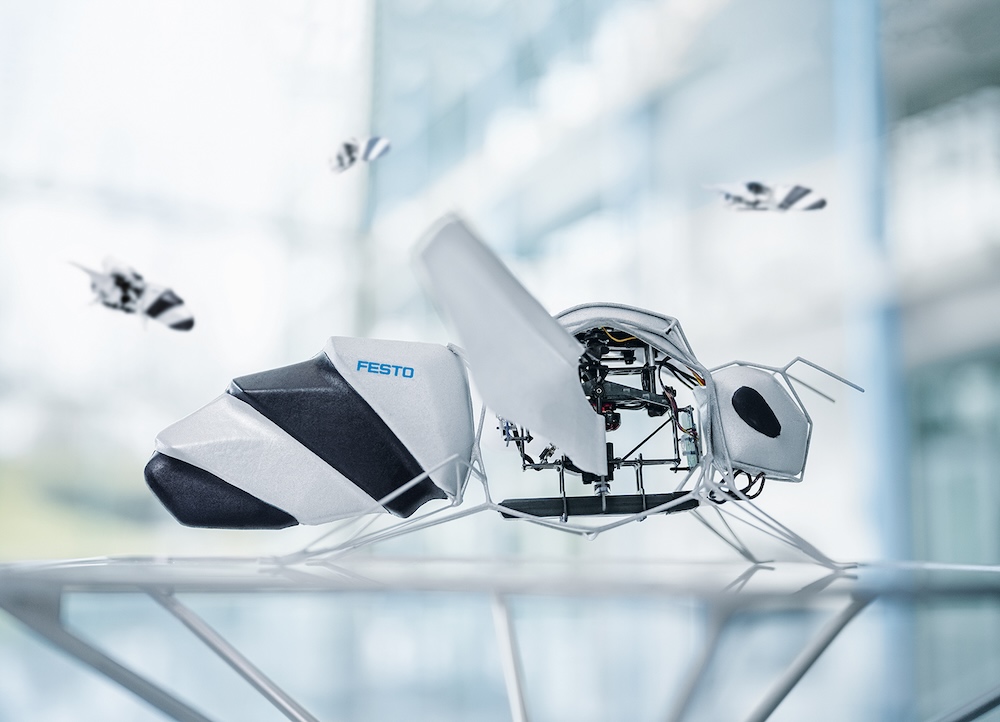

A new drone from the Bionic Learning Network is able to fly autonomously in a swarm with a large number of its peers. In doing so, it is possible to control the entire swarm as a whole.
The BionicBee is a development of the Bionic Learning Network. This is an international research network founded by Festo consisting of several colleges and institutes, development companies and private inventors. The drone can fly with a large number of its peers in a swarm in an indoor environment without colliding with each other. The control of the drones takes place in a central computer, which calculates its own path for each BionicBee.
Positioning with ultra-wideband technology
Accurate positioning of the drones is necessary for this process. The drones can use ultra-wideband (UWB) technology to calculate their own position. For this purpose, eight UWB transmitters have been placed in the test environment at two different altitudes. These UWB transmitters send signals to the individual BionicBees, which can use them to independently calculate their distance from the transmitters. These distance measurements then enable the BionicBee to determine their exact location.
The drones communicate their position to the central computer, which calculates the flight path. This is a complex process, where several factors have to be taken into account. For instance, the drones cause turbulence, which can affect flight behaviour. However, also consider small deviations in each drone, as each BionicBee is manufactured manually.
Algorithm compensates for anomalies
To compensate for these deviations, the BionicBee has an automatic calibration function. When using it, the drone makes a short test flight, and optimises its individual configuration based on measured values. In the process, an intelligent algorithm compensates for hardware deviations between drones.
The BionicBee is 220 millimetres long and has a span of 240 millimetres. The drone weighs about 34 grams. This makes the BionicBee the lightest flying object created so far by researchers at the Bionic Learning Network. Among other things, the lightweight construction is necessary for optimal manoeuvrability and flight time, reports Festo.
Many components in small body
Its small size also means that there is little space for the various components that make up the drone. For instance, the body of the bionic bee includes the flapping wing mechanism, communication technology and control components for wing flapping and wing geometry adjustment. However, consider also a brushless motor, three servo motors, the battery, the gearbox and various circuit boards.
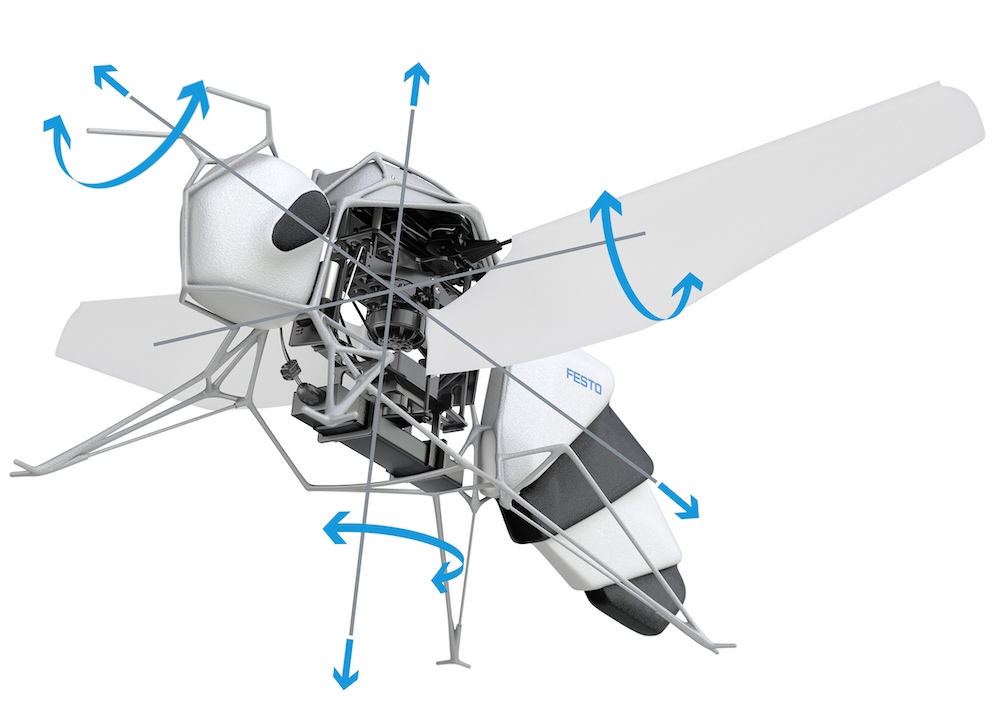
BionicBee flies at a flapping frequency of 15 to 20 herz, with its wings beating back and forth at a 180-degree angle. The higher the speed of the brushless motor, the higher the flapping frequency and lift. The three servo motors are located at the wing root, changing the geometry of the wing. This enables determination of effectiveness in certain wing positions and lift generated.
Bionic Learning Network
The following are participating in the Bionic Learning Network:
- Colleges and educational institutions: Among others, TU Berlin, Delft University of Technology, Universität Frankfurt, TU Ilmenau, Friedrich-Schiller-Universität Jena, Christian-Albrechts-Universität zu Kiel, Universität für künstlerische und industrielle Gestaltung Linz, Max-Planck-Institut für terrestrische Mikrobiologie Marburg, TU München, Hochschule Oslo und Akershus, Department of Product Design, University of Applied Sciences Ravensburg-Weingarten, ZeMA Saarbrücken, Universität Stuttgart, CIN Universität Tübingen, Universität Ulm and Fraunhofer IPA
- External companies: Among others, aeroix GmbH, Ebert Zobel Industrial Design GbR, Effekt-Technik GmbH, Evologics GmbH, JNTec GbR, Nnaisense SA and Sachs Engineering
The network has previously developed various other bionic animals. These include artificial swifts (BionicSwift), butterflies (eMotionButterflies), dragonflies (BionicOpter), birds (SmartBird) and flying foxes (BionicFlyingFox).
Further information about the Bionic Learning Network is available here. Read more about the BionicBee here.
Author: Wouter Hoeffnagel
Image: Festo











