
The demand for Autonomous Mobile Robots (AMRs) is rising fast. Companies in diverse sectors are deploying the robots. AMRs are also making rapid developments, including interoperability, propulsion and materials used.
This is according to a report by the International Federation of Robotics (IFR). AMR is a term that describes a broad category of robots. Briefly, it refers to any robot that can move independently through its environment, without receiving input from a human or direct supervision. The robots move freely through a production facility, for example, without requiring additional resources. This is in contrast to Automated Guided Vehicles (AGVs), among others, which use such aids as magnetic strips attached to the ground.
Demand is rising fast
Figures from the IFR show that demand for AMRs is rising fast. For instance, demand for logistics robots - which includes almost all AMRs - increased sixfold between 2014 and 2019. Between 2020 and 2023, the IFR predicts 31% growth in sales. The use of AMRs in public environments is also rising rapidly. The IFT foresees a growth of bijan 40% in sales of mobile guidance-information and telepresence robots between 2020 and 2023.
"Mobile robots traditionally operate in industrial environments for transporting parts in a factory or feeding machines," said Milton Guerry, president of the IFR. "AMRs today also operate in applications where contact with the general public is intended. They deliver information to shoppers, deliver room service orders in hotels or support police officers in patrolling urban areas. IFR's mobile revolution paper shows the main applications for mobile robots and their main impact."
Developments
The IFR points to rapid developments in hardware and software that enable new applications. These include developments in autonomous navigation. For instance, robots independently map their environment and navigate in it. However, think also of robot vision and sensor technology. In particular, the development of 3D vision systems makes a significant contribution to the development of AMRs.
Another example is fleet management. For instance, AMRs are often connected to other AMRs from the same manufacturer through fleet management systems. These systems enable central management of a fleet of AMRs. They often also allow the integration of other machines and hardware, such as a conveyor belt. Thanks to the integration, the fleet management solution can start it automatically if the AMR performs a certain operation.
Interoperability
Interoperability is another area where there are many developments. For instance, AMRs are increasingly interoperable with other manufacturers' AGVs and AMRs. This is important added value for users of AMRs. They can maintain existing investments in these technologies. Without being tied to a specific manufacturer. Currently, monitoring this interoperability can still be costly. However, the IFR points to developments that will improve this.
Connecting robots to edge or cloud servers to collect data can help improve the performance of robots. For instance, collected data can be used to analyse and then optimise robot operations. If it is a series of robots performing the same task, this optimisation can often be rolled out to all robots in a fleet at once. Algorithms for analysing patterns in data also play an important role here.
Drive
The IFR also predicts developments in the field of propulsion. Most AMRs are equipped with wheels. Although there are exceptions that actually propel themselves using legs. In most cases, AMRs with wheels are bi-directional. Another option are omnidirectional wheels. These offer more movement flexibility, but tend to be heavier. However, the IFR expects omnidirectional wheels to become increasingly lighter and consume less and less energy.
Finally, the IFR points to developments in the materials from which AMRs are made. These materials affect the size, weight and shape of AMRs, among other things. These characteristics, in turn, all affect the suitability of AMRs for specific applications. Traditionally, aluminium has been a commonly used material for building AMRs. Increasingly, manufacturers are opting to use new, lightweight and flexible materials. Consider carbon fibre, which is lighter than aluminium without compromising on rigidity. This development is also visible in robot motors; they are becoming lighter and lighter. Among other things, the lower weight leads to lower initial investments and a shorter payback period.
'Exciting developments on the way'
"Mobile robotics is a dynamic field of development and we expect exciting developments over the next decade," says Guerry. These include developments in both hardware and software. Mobile robots will become lighter and more flexible, predicts the IFR. AMRs and service robots will become more capable of navigating indoor and outdoor environments. Among other things, developments in sensors and software algorithms are contributing to this.
More information is available in the IFR's report 'A Mobile Revolution: How mobility is reshaping robotics'. You can request the report via the IFR's website.
Author: Wouter Hoeffnagel
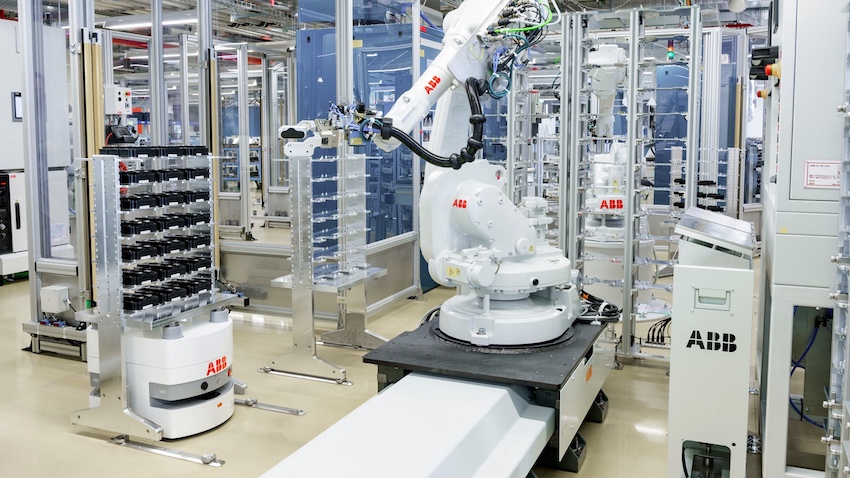
Photo: BlueBotics mini mobile robots at an ABB semiconductor plant in Lenzburg, Switzerland (source photo: ABB via IFR)









