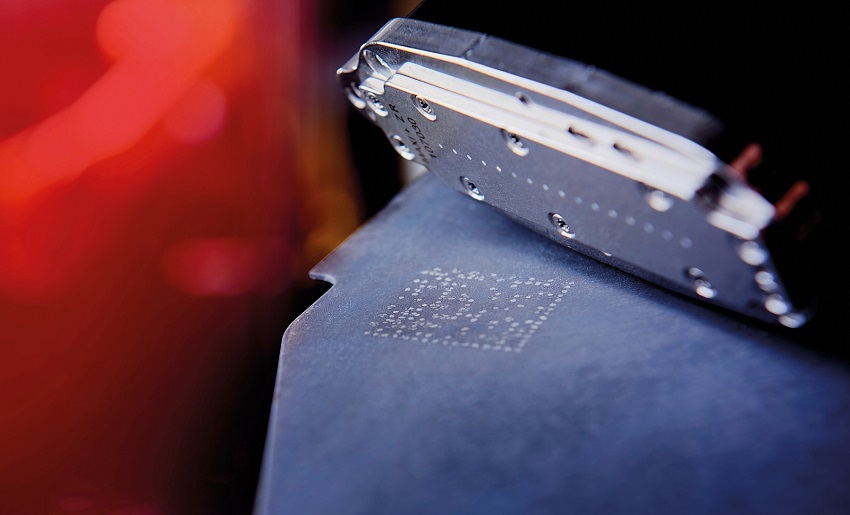

Fraunhofer researchers developed an extremely heat-resistant ceramic ink. This makes it possible to mark metal parts in, for example, the automotive industry at temperatures above 1,000ºC with a code. The code can be scanned and is linked to a database. This stores manufacturing parameters of the part in question.
Marking components is a key requirement for the digitalisation of processes in the manufacturing industry. It enables products to be tracked and traced individually. In the metalworking industry, efforts in this area have so far been unsuccessful. This is because many metal parts have to be heated during individual process stages. Codes printed using conventional methods are destroyed when heated. As a result, they can no longer be read. The development of heat-resistant ceramic ink is now set to change this.
Ceramic ink
Prof. Thomas Härtling is group manager for Optical Testing Methods and Nanosensors. He and his team at the Fraunhofer Institute for Ceramic Technologies and Systems IKTS have developed a special ink. This ink can withstand temperatures of over 1,000 ºC in the furnace without being damaged. The ink, named Ceracode, consists of heat-resistant ceramic particles and a glass component. In the furnace, the melting glass ensures that the marking is fixed to the metal whilst remaining clearly legible. For the first time, this ink makes it possible to apply a highly stable marking to metal components. This is particularly important for components that are subjected to heat during production in the automotive industry. To develop the technology, Fraunhofer researchers drew on their decades of experience with ceramics and ceramic-based materials.
Heat-resistant ink for metal
Why this could be groundbreaking? Take the following application scenario. During a sample inspection in a car factory, a worker discovers a defective metal part. The geometry does not meet specifications. The part is not shaped correctly. The part has a marking, called a data matrix code, that uniquely identifies it through a serial number. The employee can read this code with a scanner. A database then opens on the screen, showing all the parameters for the part's production process. These include temperature and dwell time in the furnace, geometric data and press pressure. It is now easy to identify the problem. For example, the press pressure was not high enough during a certain process step. With just a few clicks, the employee can view all other parts that were processed with the wrong press pressure and therefore defective. These are then quickly discarded. If necessary, a robot can do this fully automatically. The time-consuming work of inspecting all parts that might be affected and manually removing rejected parts is a thing of the past. This benefits the production process.
The digitisation of process chains
The combination of Ceracode ink and the standardised data matrix code widespread in the industry gives new impetus to the digitisation of manufacturing processes in the metalworking industry. "The quality of every part or workpiece can be recorded at any point in the value chain, and defects can be identified right at the start of production and rectified in a targeted manner. This not only saves companies energy. It also means they do not waste raw materials and can reduce their CO2 emissions," Härtling explains. Overall, this makes the production process significantly more efficient and cost-effective. The stored process data also makes it easier to set up adaptive process chains. If a manufacturer knows which physical parameters were used to make a product, it can flexibly adjust and optimise subsequent steps and processes.
Calculate greenhouse gas emissions
Depending on the application scenario, the user can fill the database with additional information as required. For example, think of data on power consumption and power source for each process step. These can then be used to calculate greenhouse gas emissions for each part. "More and more manufacturers are asking for this kind of functionality so that they can carry out transparent and resource-efficient production processes," Härtling explains.
Collaboration
The project is also the result of a successful collaboration. The Fraunhofer IKTS team developed the ink and is continuing to work on optimising it. Project partner Senodis Technologies GmbH from Dresden is responsible for programming the software and commercialisation. Senodis Technologies is a spin-off from Fraunhofer IKTS. It focuses on harnessing the broad potential of the ceramic-based ink to realise new applications for industrial customers and to drive forward the digitalisation of their value chains. The company primarily targets customers in the metal, automotive and ceramics sectors.
Data exchange via Catena-X
Fraunhofer IKTS' technology not only optimises production, but also paves the way for even more extensive information exchange between manufacturers, suppliers and subcontractors. In the automotive industry, these are already connected through a complex network. In the future, information will be exchanged through the Catena-X network platform, which is currently under development. It is a joint data ecosystem of the automotive industry. It aims to enable secure and easy exchange of data between manufacturers. In doing so, each participant retains sovereignty over its own data. Participating companies therefore share only the data they actually want to make public.
Detailed information
Ceracode allows users to record detailed information about the process parameters of metal components in the Catena-X network for the first time. Again, data that the manufacturer does not want to share remains protected in the company's internal network.
Available on the market
The system of heat-resistant ink and data matrix code has come of age. It is already available on the market through project partner Senodis Technologies GmbH. Manufacturing companies can easily install and commission the system. Even retrofitting existing machines is no problem. The data matrix printers and scanners used are compatible with existing industry standards.
Resistant to forgery
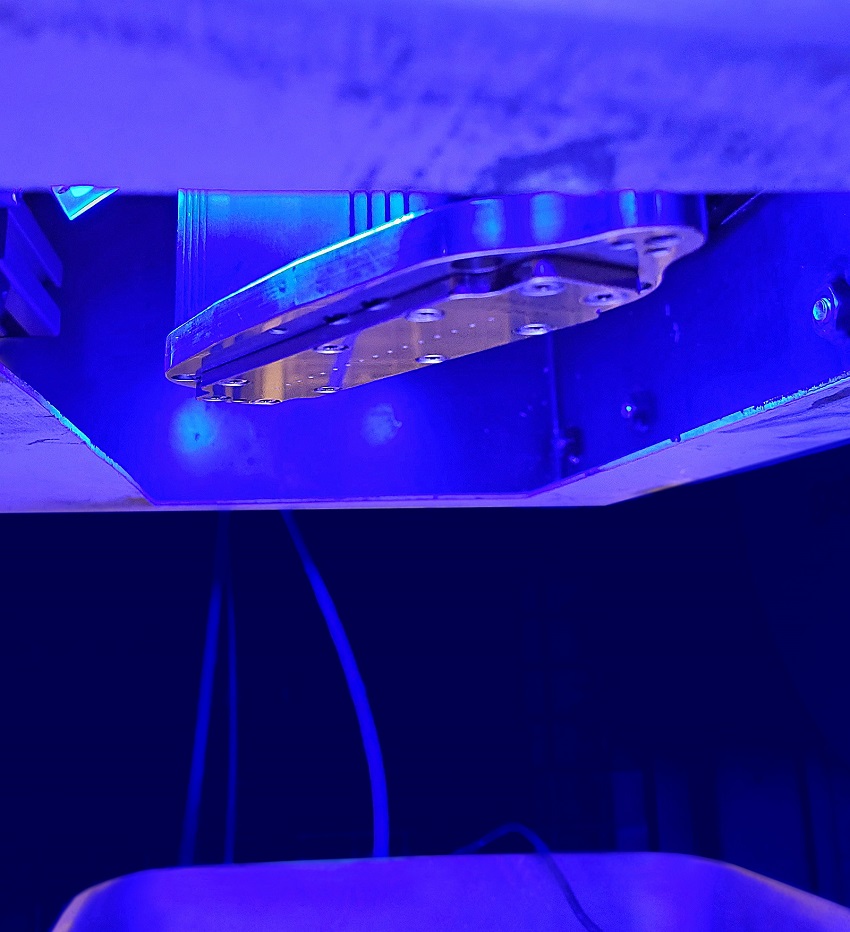
Moreover, ink technology can be extensively adapted to customer needs and application. One example is the protection of products against counterfeits. "For this, we add special pigments to the formula of the ceramic inks so that they light up in a certain colour under UV light. This is an interesting option for industrial customers who buy parts consisting of particularly expensive metal alloys or parts for security-related systems," explains Fraunhofer researcher Härtling.
Curved or shaped metal parts
As a next step, Fraunhofer researchers are investigating how to print curved or shaped metal parts. Further developed image recognition algorithms will then be able to read codes accurately even on irregular or curved metal surfaces.
Featured image: Data Matrix code on thermoformed sheet steel, printed using an industrial printer (Photo: Senodis Technologies GmbH)
See also: Electric cars: Production is more sustainable with green lasers










