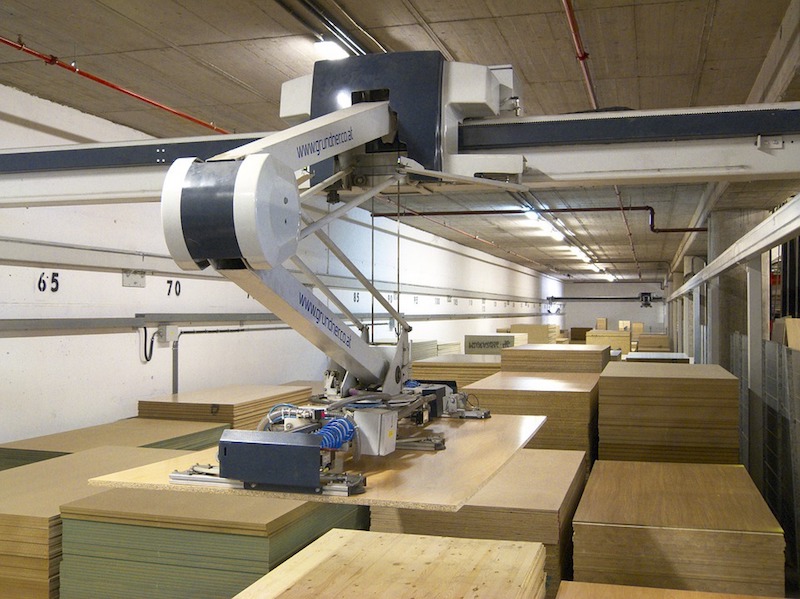

The use of industrial robots worldwide is up 10% by 2020. A total of three million are in use.
This is according to recent figures from the International Federation of Robotics (IFR). Sales of new robots increased slightly by 0.5%; a total of 384,000 new industrial robots were shipped in 2020. In particular, positive market developments in China are contributing to this. These offset tightness in other markets.

This is the third most successful year for the robotics industry, reports IFR. Only 2018 and 2017 showed even higher growth. "The economies in North America, Asia and Europe did not experience their lows at the same time through COVID-19," said Milton Guerry, president of IFR. "Orders and production in China's manufacturing sector swelled in the second quarter of 2020. The North American economy began its recovery in the second half of 2020. Europe followed a little later."

"Global robot installations are expected to recover strongly and grow by 13% to 435,000 units in 2021. With this, they surpass the record level of 2018″, says Guerry. "Installations in North America are expected to increase by 17% to nearly 43,000 units. Installations in Europe are expected to grow by 8% to nearly 73,000 units. Robotic installations in Asia are expected to cross the 300,000-unit mark and grow 15% over the previous year. Almost all Southeast Asian markets are expected to grow at double-digit rates in 2021."
Number of robot installations declines in Europe
The number of industrial robot installations in Europe fell by 8% to 67,700 units by 2020. This is the second year of decline, following a peak of 75,560 units in 2018. Demand from the automotive industry fell 20%. Demand from the general industry actually increased by 14%.
Germany is among the top five most important robot markets in the world, which further includes China, Japan, United States (US) and Korea. Germany accounts for 33% of total installations in Europe. Italy follows with 13% and France with 8%.
The number of robots installed in Germany in 2020 remained at around 22,300 units. This is the third-highest number of installations ever, which the IFR calls a remarkable result given the pandemic situation that dominated 2020. The German robotics industry is recovering, driven by strong overseas business. Demand for robots in Germany is expected to grow slowly, mainly due to demand for low-cost robots in general industry and outside manufacturing.
In the UK, industrial robot installations increased by 8% to 2,205 units. The automotive industry rose 16% to 875 units, accounting for 40% of installations in the UK. The food and beverage industry almost doubled its installations from 155 units in 2019 to 304 units in 2020 (+96%). The sector had a high proportion of foreign workers, mostly from Eastern Europe. The food and beverage industry is facing a huge labour shortage. The main reasons are persistent COVID-19-related travel restrictions and the Brexit. As a result, the demand for robots in the UK is expected to increase sharply by double-digit percentages in 2021 and 2022.
The modernisation of the UK manufacturing industry is being driven by a huge tax incentive. The number of newly installed units comes to 2,205 in the UK. This is about 10 times less than shipments in Germany (22,302 units). Relative to Italy, the UK figures are about four times lower (8,525 units). Relative to France, they are less than half (5,368 units).
Asia
Asia was also the main market for industrial robots in 2020. 71% of all newly deployed robots were installed in Asia in 2020. This percentage was 67% a year earlier. China is the main buyer here; the number of installations in China increased by 20% to 168,400 unit shipped. This is the highest figure ever recorded for a single country, reports the IFR.
The operational stock stood at 943,223 units, which is an increase of 21% from a year earlier. The IFR expects the 1 million unit mark to be broken in 2021. According to the organisation, this development is symbolic of China's rapid robotisation.
Japan is the second largest market for industrial robots after China. However, the Japanese economy has been hit hard by the COVID-19 pandemic. Thus, sales fell 23% in 2020 with 38,653 units installed. This was the second year of decline after a peak value of 55,240 units in 2018. Unlike China, demand from the electronics and automotive industries was weak in Japan. Japan's operating inventory stood at 374,000 units (+5%) in 2020.
The outlook for the 2021 financial year is positive, with GDP growth expected to reach 3.7 per cent. The Japanese robotics market is expected to grow by 7% in 2021. For 2022, the IFR forecasts growth of 5%. Regardless of the domestic robotics market, there is significant demand for Japanese robotics. A large proportion of production takes place directly in China. Nevertheless, 36 per cent of Japan’s robotics and automation exports were destined for China. A further 22 per cent of exports went to the United States.
South Korea is the fourth largest robot market in terms of annual installations, after Japan, China and the US. Robot installations fell 7% to 30,506 units by 2020. Operational inventory of robots was calculated at 342,983 units (+6%).
The export-oriented economy weathered the pandemic remarkably well so far. GDP fell by just 1% in 2020, and strong GDP growth of +4% and +3% is expected in 2021 and 2022. The electronics and semiconductor industries in particular are investing heavily. An investment support programme launched in May 2021 further boosts investment in machinery and equipment. Demand for robots from the electronics industry and automotive suppliers is expected to grow sharply. It will grow 11% in 2021 and average 8% per year in the coming years.
North America
The US is the largest user of industrial robots in the Americas, accounting for 79% of total installations in the region. The US is followed by Mexico with 9% and Canada with 7%.
New installations in the US slowed by 8% in 2020. This was the second year of decline after eight years of growth. The automotive industry purchased significantly fewer robots in 2020 (10,494 units, -19%). At the same time, installations in the electrical/electronic industry grew 7% to 3,710 units. Operating inventory in the US has increased by 6% CAGR since 2015.
The general outlook for the North American market is very positive. A strong recovery is currently underway. The IFR expects the US market to return this year to the number of robot installations before the COVID-19 crisis. Robotic installations are expected to grow by +17% by 2021. A post-crisis boom will provide additional growth at low double-digit rates 2022 and beyond.

Forecast
The IFR predicts that the rapid post-crisis recovery will slow down on a global scale in 2022. Medium single-digit annual growth rates are expected from 2021 to 2024. The 500,000 annualised installation mark is expected to be broken in 2024.
Author: Wouter Hoeffnagel










