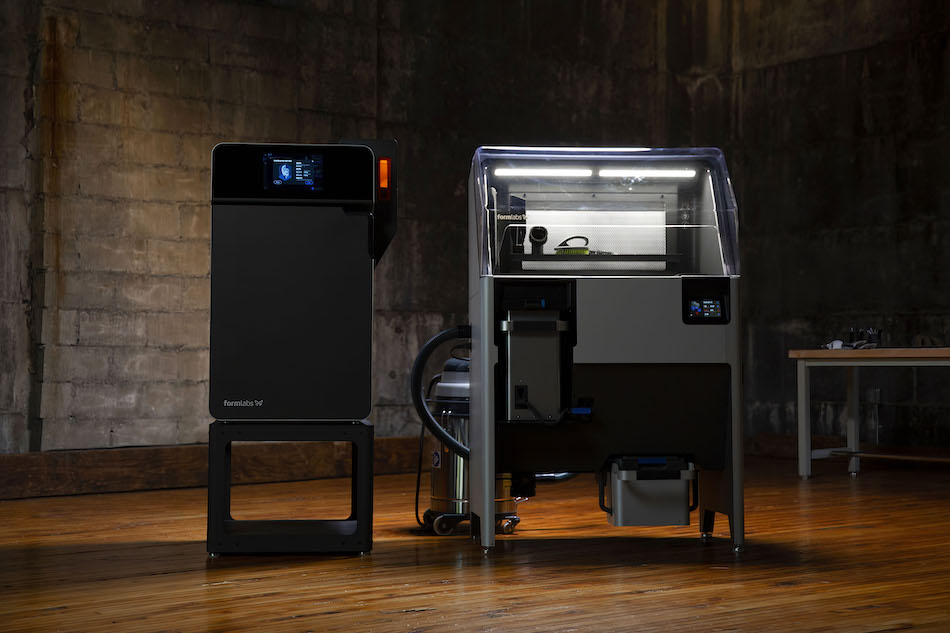

Formlabs is launching the Fuse 1+ 30W SLS 3D printer. The printer builds on the Fuse 1 3D printer the company launched in 2021. Among other features, the Fuse 1+ 30W features a 30W laser. This allows customers to process more materials and achieve higher production. Formlabs is also introducing a new material for SLS printers: Nylon 11 CF Powder.
The Fuse 1+ 30W is an industrial SLS 3D printer, which Formlabs aims to market at an affordable price. The printer features a more powerful laser than its predecessor. A new laser scanning system is also available, which allows scanning speeds of up to 12.5 metres per second.
Higher print speed
The print speed of the Fuse 1+ 30W is significantly faster than its predecessor. As an example, Formlabs cites a 350-gram bicycle saddle, which the printer prints in 2,101 layers in the company's Nylon 12 Powder material. The Fuse 1 could print this object in 18 hours and 22 minutes. However, the same printing process takes only 14 hours and 1 minute with the Fuse 1+ 30W. This amounts to a time saving of 24%.
For bulkier prints, the time savings increase further. Another example Formlabs mentions is a shaft coupling. This 3.96 kg object is printed in 2,669 layers. The Fuse 1 prints this object in 66 hours and 19 minutes, while the Fuse 1+ 30W prints the same object in 32 hours and 59 minutes. This represents a time saving of 52.2%.
Suitable for small and large manufacturers
With the new SLS 3D printer, Formlabs aims to make printing technology available to small and medium-sized manufacturers. This allows them to reduce their dependence on external parties, avoid waiting times and combat variations in their production supply chain.
However, with the Fuse 1+ 30W, the company is also targeting large manufacturers that have been deploying SLS for some time. They can use the SLS 3D printer to decentralise their 3D printing process without having to double investments in their traditional SLS systems.

Printing without oxygen
The Fuse 1+ 30W has some notable features. These include an optional feature that allows nitrogen to be pumped into the environment during printing processes. This eliminates the presence of oxygen. Printing objects in an oxygen-free environment reduces brittleness and improves the deformability of objects. This makes them more suitable for use in end-user components, especially in demanding environments such as the automotive or aerospace industries. Using this feature requires an external third-party nitrogen generator.
Also, the controlled printing environment makes sintering more efficient when using Nylon 11 Powder and the new Nylon 11 CF Powder. This by better protecting the unused powder from oxidation, so that more powder is reusable during subsequent print cycles. Combined with optimum pack density - a term that refers to the percentage of build volume the printed parts occupy - this enables a zero-waste print workflow.
Formlabs also shares figures on this. In a standard printing environment, Nylon 11 and Nylon 11 CF both have a refresh rate of 50%. In practice, this means using 50% recycled powder and 50% new powder when filling a new cartridge. Printing in an oxygen-free environment lowers this ratio to 30% for both materials.
No more engaging external service agencies
The manufacturer also points to time and cost savings possible with the SLS 3D printer by no longer engaging SLS service bureaus. As an example, Formlabs cites a manifold for a car. The Fuse 1+ 30W produces this part in 29 hours and 55 minutes. However, an SLS service bureau takes 5 to 7 working days to do this, according to Formlabs. The cost is also considerably lower. When printing the part yourself, these costs are around $45, while when using an SLS service bureau, this rises to over $590.
Also new is the print material Nylon 11 CF. This is a nylon-based material reinforced with carbon fibre. The material enables the printing of strong, lightweight components. Formlabs reports that the material can withstand repeated impacts and is suitable for metal parts, equipment that receives frequent impacts and functional composite prototypes, among others. The material has high stiffness and dimensional stability, combined with high resistance to vibration and impact as well as a high strength-to-weight ratio.
Author: Wouter Hoeffnagel
Photos: Formlabs









