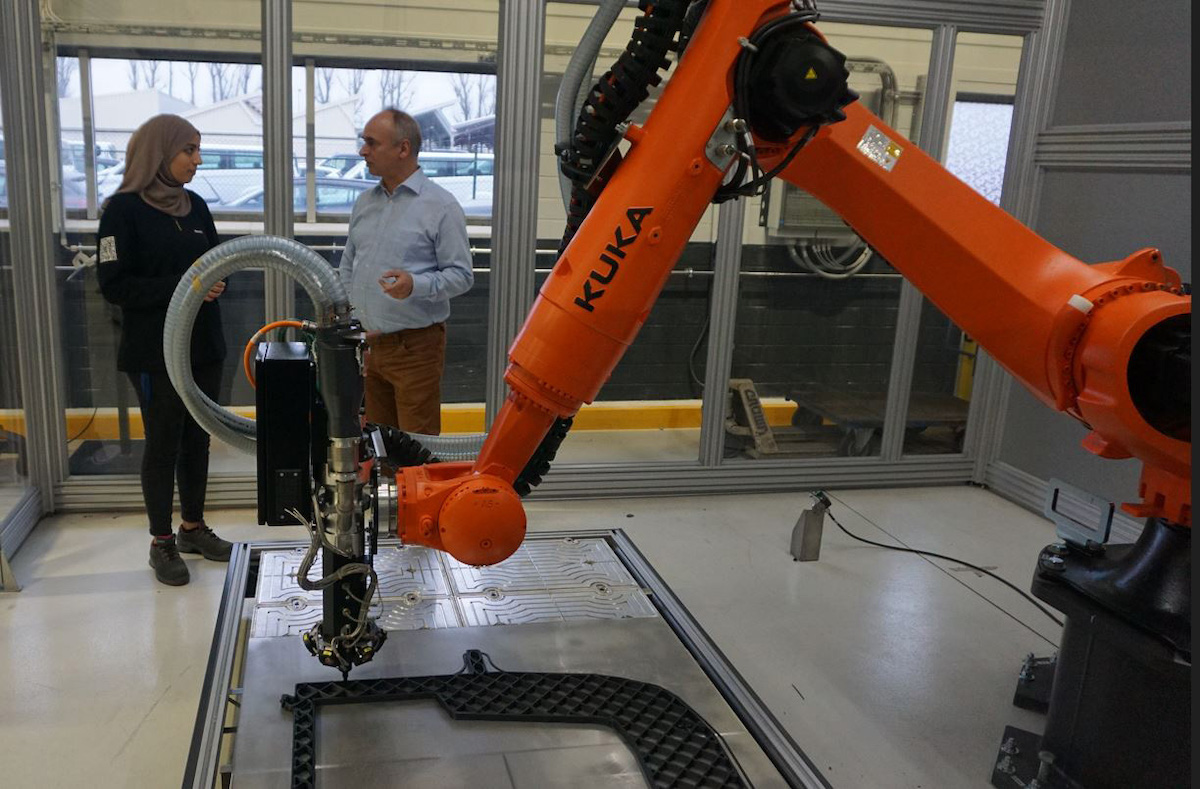

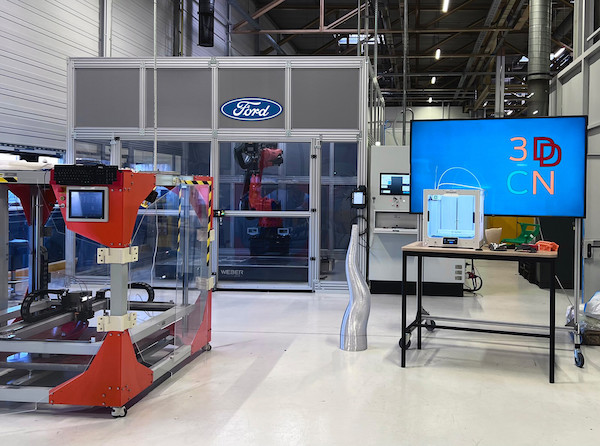
Ford opens 3D printing centre to support production of the first European-built electric Ford. The centre features twelve 3D printers, which manufacture tools and holders for car production in Cologne, Germany. Ford can also 3D-print parts for pilot and small-series cars.
The first all-electric model Ford produces in Europe is due to roll off the production line in Cologne at the end of this year. Ahead of this, Ford is opening a new 3D printing centre. Here, the company will use 3D printers to produce plastic and metal parts. The printers are capable of producing parts ranging from a few centimetres long and weighing 30 grams to 2.4 metres long, 1.2 metres wide and 1 metre high weighing 15 kilos.
'Every part can be completely unique'
"We mainly make tools and holders here for our manufacturing departments," explains Nurah Al-Haj-Mustafa, Ford 3D printing engineer. "Each part can be completely unique. But the quality and properties of each print are the same."
These include measuring instruments for checking dimensions, templates for applying the Ford logo and, in the future, huge gripping structures as attachments for robots in bodybuilding. Parts for pilot and small-series cars can also be printed at the new 3D printing centre.
Greater flexibility, cost savings and sustainability
The US car manufacturer expects to use 3D printing to gain greater flexibility while saving both time and money in small batch production, among other things. The savings here compared to the conventional injection moulding process can be up to 80%, according to Ford. The company points out that manufacturing the moulds required for injection moulding, in particular, is complex.
Ford also sees advantages in 3D printing in terms of sustainability. For example, less material is needed and the residual material created in the 3D printing process is reusable. The Manufacturing and Materials team at the Ford Research and Innovation Centre in Aachen is currently working on a pilot project around recycling the granulate used for 3D printing.
Low-threshold access
Ford points to the low-threshold access to the 3D printing centre. For example, any Ford employee can use an app to request parts they need or submit proposals for new parts. In doing so, they can also provide their own drawing of the desired part or a description of the purpose for which they need the component.
"We use a start-up approach with short lines and little bureaucracy," says Oliver Färber, manager of the engine plant and responsible for the department with the 3D printing centre. "The parts requested by employees are then specially designed by the 3D printing team and can therefore be produced very quickly."
Door edge protector
One example is a door edge protector, which Ford is currently testing in final assembly. The manufacturer may eventually want to use the tool at other stations within its production environments.
Another example is an ergonomically enhanced tool for installing airbags, which Ford is also currently testing. Ford is currently producing 1,800 impact protection aids for the new door transport system. The tools ensure that the doors are not damaged during transport to the line. In addition, Ford 3D-prints parts for the future production of the first electric model that will roll off the track in Cologne.
In the video below, Ford shows how it produces a holder for sheet metal samples at its 3D printing centre.
Ford has been experimenting with 3D printing for some time
3D printing is nothing new for Ford; back in the 1990s, the company opened a development centre in Merkenich, Germany, to 3D print parts for test vehicles and prototypes. The company also announced in 2017 that it was experimenting with 3D printing large car parts. At the time, it used a Stratasys Infinite Build 3D printer for this purpose.
Ford reported to have 3D printed several components for production vehicles in 2019. Ford manufactured these components using 3D printing technology from US company Carbon. In the same year, Ford also announced it had produced an aluminium intake manifold. This was used on the Hoonitruck, a modified 1977 Ford F-150. This pick-up truck was owned by the now deceased Gymkhana star and rally driver Ken Block.
Ford also reports that a catalogue of 5,000 printable parts has been assembled by a dedicated team at its plant in Valencia, Spain. These parts offer solutions for different stages of the manufacturing process at the Spanish plant. The department produced a total of some 20,000 3D printed parts in 2021.
Author: Wouter Hoeffnagel
Photo: Ford










