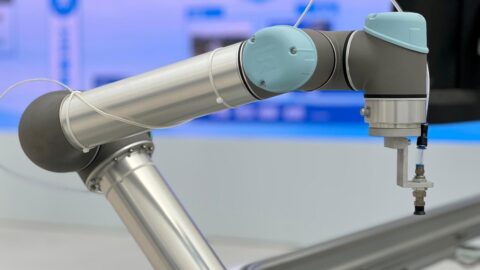
Researchers at US university UC Berkeley and Siemens have developed a solution that lets robots pick up objects unknown to them with great accuracy. This without the robots having to be trained in this.
Picking up unfamiliar objects is a simple task for a human. For robots, however, it is a major challenge. Not only do objects usually have a unique shape, but the way an object lies in a bin, for example, can completely change the way an object is best picked up. Traditionally, robots must therefore be trained to pick up a new object. This limits the deployability of robots.
Dex-Net 2.0
However, a system developed by researchers at US university UC Berkeley and Siemens offers a solution. Called Dex-Net 2.0 (Dexterity Network), the system enables robots to successfully pick up objects completely unknown to them in one go, without the robot having to be trained to do so.
This is possible thanks to a database containing thousands of 3D objects. These objects were analysed by Dex-Net 2.0 using deep learning, collecting 6.7 million data points. This database functions as a kind of basic knowledge that the robot can use to gather information on how best to pick up an unknown object.
Find object with similar shapes
Once a robot equipped with Dex-Net 2.0 is presented with an unknown object, the robot analyses it. This involves registering the shape of the object, after which the robot tries to find a 3D model of an object with a similar shape in Dex-Net 2.0's database. If this model is found, the robot has information available on how to successfully pick up this known object. The robot then tries to pick up the unknown object in the same way. This process takes only 0.8 seconds, according to the researchers.
The method yields promising results, the researchers report to MIT Technology Review. If, after analysis, the robot is more than 50% sure that an unknown object can be picked up successfully, in 98% of cases the robot can actually pick up the object without any problems. If the robot is less than 50% sure, the robot gives the object a push to change its orientation. The object is then analysed again and compared with 3D models of known objects in the database. After this extra step, the robot can pick up objects without any problems in 99% of cases.
Cloud-based database
The database used by Dex-Net 2.0 is cloud-based and accessible via the internet. This is a significant advantage, as it eliminates the need to store the database locally on robots. In addition, this simplifies updating the information in the database, allowing the database to be updated without robots using Dex-Net 2.0 having to receive an update themselves; they simply retrieve the new information from the database.
The researchers expect Dex-Net 2.0 to be implemented in industrial robots in the near future given the results of their experiments. They expect this to revolutionise both the manufacturing industry and the supply chain. More information about the project is available in the paper 'Dex-Net 2.0: Deep Learning to Plan Robust Grasps with Synthetic Point Clouds and Analytic Grasp Metrics', published on in the arXiv scientific publications database.
By: Wouter Hoeffnagel
Source: UC Berkeley
Source: MIT Technology Review