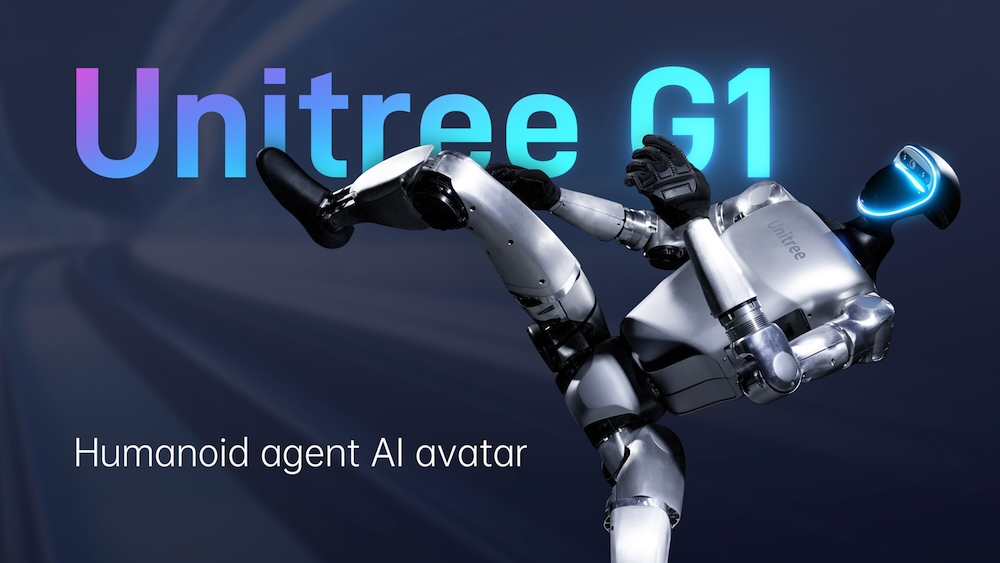

China's Unitree Robotics is launching a new humanoid robot: the Unitree G1. The robot moves around on two legs just like a human, offering a very wide range of motion thanks to its flexible joints. The G1 is aimed at both commercial and educational applications.
With the G1, Unitree is targeting use in both commercial and educational applications. Depending on the application the customer has in mind, it is therefore possible to equip the G1 with an optional force-controlled robotic hand with three fingers. This can accurately mimic the action of the human hand, manipulating various objects.
This allows the robot to pick up and manipulate very fragile objects such as eggs, as well as lift heavy objects. Other examples Unitree mentions include cracking walnuts and folding chairs. The possibilities are wide; for example, the robot can also dance, cook or solder. This makes the robot usable for a wide range of activities.
Two versions available
The humanoid robot is available in two versions: the G1 for commercial applications and G1 EDU for educational applications. Both versions are 1.27 metres high, 45 centimetres wide and 20 cm thick. Both versions of the G1 weigh about 35 kilograms. The arms are about 45 centimetres long.
The commercial version offers a total of 23 degrees of freedom. In doing so, each leg offers six degrees of freedom, each arm five degrees of freedom and the waist one degree of freedom. In the education version, the total number of degrees of freedom has been increased to 43. This includes two additional degrees of freedom available at the waist, while each hand offers seven degrees of freedom.
A lot of flexibility
This gives the robots great flexibility. For example, the knee joints can flex from 0 to 165 degrees, while the waist joint rotates to around 155 degrees. The maximum load on the knee joint is about 90 Nm on the G1, while it is 120 Nm on the G1 EDU.
The robots include Intel RealSense D435 and LIVOX-MID360 3D lidar. These give the G1 360-degree vision and enable the robot to map its surroundings. The robot can be active for about two hours on a battery charge.
Running AI models
The G1 EDU is optionally available with an NVIDIA Jetson Orin module. This hardware is designed to run artificial intelligence (AI) and enables, amongst other things, autonomous machines such as robots. Unitree is also making the co-creation platform UnifoLM available, which stands for Unitree Robot Unified Large Model. With UnifoLM, users can create intelligent AI agents for the G1.
The G1 is available for $16,000. No fixed prices have been announced for the G1 EDU; Unitree states that it will calculate the price on a bespoke basis depending on the customer’s requirements. Further information is available here.
Author: Wouter Hoeffnagel
Image: Unitree









