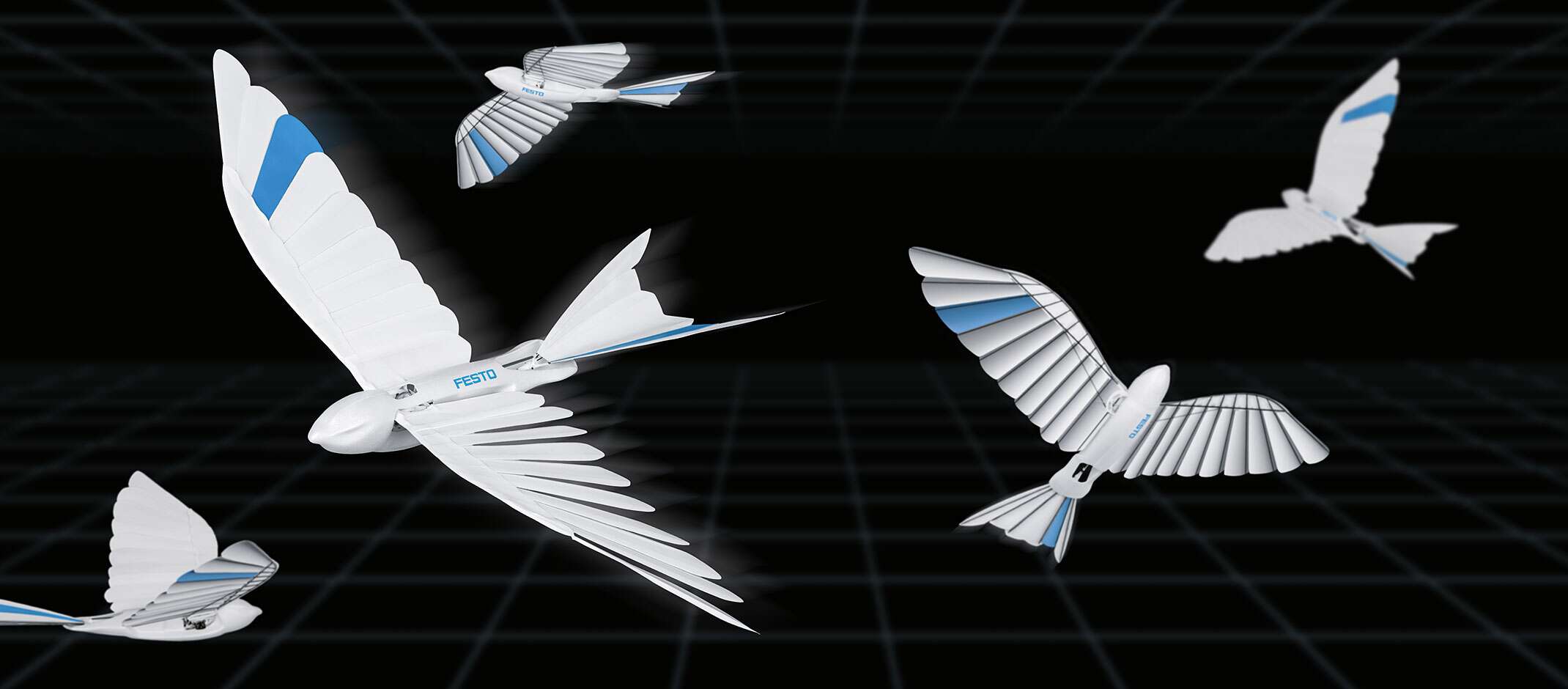

They are agile, very light and small and can even fly loops and sharp turns: Festo's BionicSwifts. The five artificial swallows can move in a coordinated and autonomous manner in a given airspace by communicating with a radio-based indoor GPS.
When designing the robotic birds, the focus was on using lightweight structures, just like their biological counterparts. Because in engineering, the same principle applies as in nature: the less weight that needs to be moved, the lower the material usage and energy consumption. And so, with a body length of 44.5 centimetres and a wingspan of 68 centimetres, the bionic birds weigh just 42 grams.
Aerodynamic plumage for efficient flight
To perform flight manoeuvres as faithfully as possible, the wings are modelled after the plumage of birds. The individual lamellae are made of an ultra-light, flexible but very robust foam and lie on top of each other like roof tiles. They are connected by a carbon spring and are attached to the actual hand and arm wings as in real birds.
During the wing's upstroke, the individual slats fan out to allow air to flow through the wing. As a result, the birds need less force to pull the wing up.
During downstroke, the slats close to allow the birds to generate more flight power. This faithful replica of the wings gives the BionicSwifts a better flight profile.
Lots of technology and the smallest spaces
The bird body contains the compact structure for the wing flap mechanism, the communication technology, the control components for wing flap and lift, the tail. A brushless motor, two servo motors, the battery and several circuit boards for radio, control and localisation are all installed in a very small space.
Through the intelligent interaction of motors and mechanics, the frequency of the wing beat and the angle of attack of the lift, for example, can be precisely adjusted for different manoeuvres.
Coordinating flight manoeuvres via GPS
Radio-controlled indoor GPS with ultra-wideband technology (UWB) enables the coordinated and safe flight of the BionicSwifts. To do this, several radio modules are installed in one room. These beacons then locate each other and determine the controlled airspace. Each robotic bird is also equipped with a radio beacon. This sends signals to the other beacons, which can then locate the bird's exact position and send the collected data to a central master computer, which acts as a navigation system.
This can be used for route planning, so that pre-programmed routes give the birds their flight path. If the birds deviate from their flight route due to sudden changes in environmental influences such as wind or thermals, they immediately self-correct their flight route and intervene autonomously in this situation. Radio communication enables precise position detection even if visual contact is partially obstructed by obstacles. The use of UWB as a radio technology guarantees safe and trouble-free operation.
New impetus for intralogistics
The intelligent network of flight objects and GPS routing provides a 3D navigation system that can be used in the networked factory of the future. The precise localisation of the flow of materials and goods could, for example, improve process sequencing and foresee bottlenecks. Moreover, autonomous flying robots could, for example, be used to transport materials and thus optimise the use of space within a factory with their flight corridors.
Source: Festo Corporate









