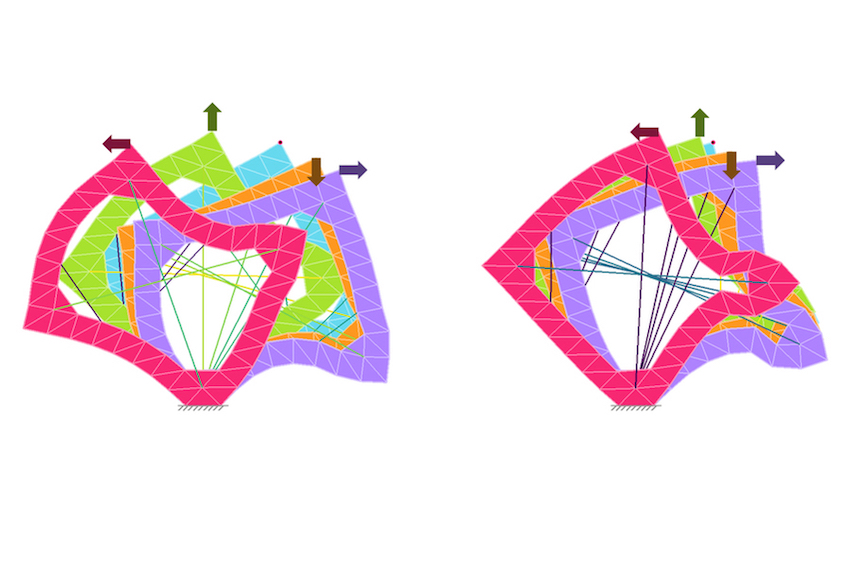

Image: James Bern and Daniela Rus from CSAIL MIT
Most robots feature a rigid housing. For some applications, however, this is not ideal and designers opt for a soft housing. While such a soft robot can interact more safely with humans, for example, they sacrifice strength and accuracy, for example. Thanks to a development by MIT, this may not be necessary in the future.
A new concept developed by researchers at MIT allows robots to be equipped with a soft casing that can become rigid on command. The researchers argue that this will enable a new generation of robots that combines the best of both worlds: the strength and accuracy of a rigid robot with the fluidity and safety of a soft robot.
"It's the first step in our attempt to get the best of both worlds," says researcher James Bern, postdoc in MIT's Computer Science and Artificial Intelligence Laboratory (CSAIL) and lead author of the paper the researchers wrote on the subject. Bern will present the research at the IEEE International Conference on Soft Robotics next month. Besides Bern, CSAIL director Daniele Rus was also involved in the research paper.
Controlling soft robots is complex
A key challenge with soft robots, according to researchers, is control. Whereas robots with rigid bodies can often be controlled automatically, this is more challenging with soft robots. Until now, most soft robots have therefore been manually controlled, which limits their applications.
In 2017, however, Bern and colleagues developed an algorithm that changed this. This algorithm uses a simulation to control a cable-controlled soft robot. This simulation allows the algorithm to calculate how much it needs to pull on each string to reach a position specified by the researchers. A similar process takes place in our bodies the moment we want to achieve something. For example, a target position for our hand is translated into contractions of the muscles in our arm, MIT reports in a news release.
The algorithm presented in 2017
Making soft housing rigid
The researchers are now also using this algorithm to make a robot's soft casing rigid. For example, tightening the biceps in an arm flexes the elbow, while tightening the triceps actually stretches the arm. By simultaneously tightening both muscles, however, the arm can be locked in a position. The researchers are applying this same principle to robots.
By providing a soft robot with multiple cables, it is possible to make the robot become rigid and move simultaneously. Here, some cables are used to make the robot bend and rotate, for example, while other cables are used simultaneously to determine the robot's rigidity.
Prototype in development
Bern has only tested the functioning of the system during simulations. The researcher is now working on a prototype robot to test the method in practice. In time, Bern hopes for applications of the technology outside the lab. "Interacting with humans is definitely a vision for soft robotics," Bern said. Among other things, he foresees applications with healthcare robots. The robot's soft casing increases safety, while the robot can become rigid if, for example, a patient needs to be lifted.
Author: Wouter Hoeffnagel









