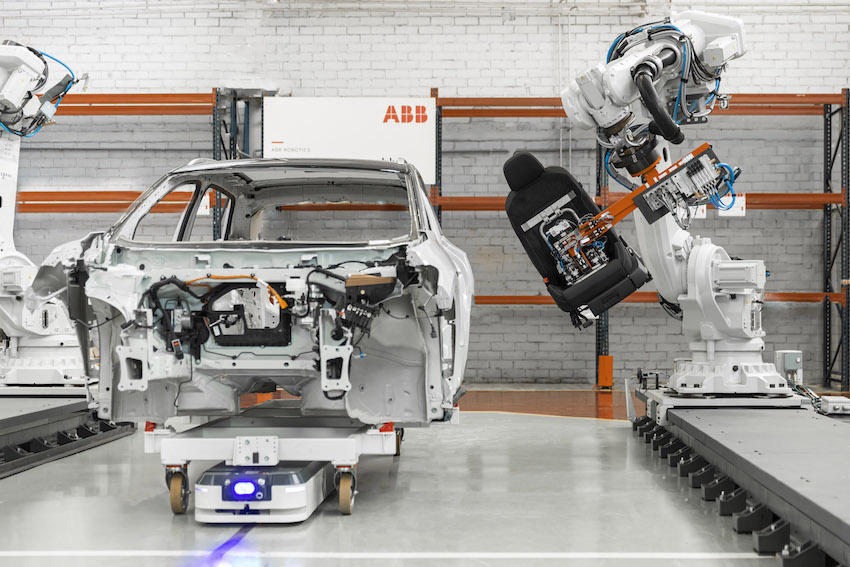

ABB acquires ASTI Mobile Robotics Group (ASTI). This company specialises in the development of Autonomous Mobile Robots (AMRs). These robots can independently navigate through production sites and warehouses, among others. Financial details of the acquisition were not disclosed.
ABB is a Swedish-Swiss multinational known for energy products and systems, (process) automation, telecommunications and robotics, among other things. The company was formed from a merger of Sweden's ASEA and Switzerland's Brown, Boveri & Cie in 1988. Today, the company has over 110,000 employees across 100 countries. It is headquartered in Zurich, Switzerland.
ASTI is a manufacturer of AMRs with headquarters in Burgor, Spain, and some 300 employees in Germany, France and Spain. The company serves a broad customer portfolio using its AMRs. These include customers from the automotive, logistics, food and beverage and pharmaceutical industries. The company has been growing for years. Since 2015, the company has been experiencing 30% year-on-year growth. The company expects sales of around $50 million over 2021.
Autonomous robots
ASTI's robots can autonomously navigate industrial locations such as production sites and warehouses, where they transport goods and products, for example. Practical applications include fulfilment centres, where the robots drive goods to employees who eventually package the products. However, the robots can also support production flows.
In many cases, AMRs operate in environments where humans are also active. ASTI's robots are therefore equipped with various safety systems. These include an emergency button, which allows a robot to be stopped. Or laser scanners, safety bumpers, sensors and warning systems. These systems ensure that the robots can safely operate autonomously.
Navigation
The AMRs support various navigation methods. These include a magnetic strip on the floor, which uses a kind of magnetic antenna to guide the robots along the correct route. Another option is optical navigation, where the AMR follows painted lines on the floor using a camera. Also available is laser navigation, where reflectors are present at strategic locations in the facility. The AMR can pick up three reflections of laser beams from anywhere in the facility and use them to determine its position.
QR navigation are also possible. This system uses QR codes affixed to the floor. Using a built-in camera, the AMR scans these QR codes, which enables it to know its location and pick up instructions on how to continue its route. Another option is natural navigation. In this, the AMR uses its own sensors and cameras to map its surroundings and find its way. The last option is dual navigation, which consists of a combination of different navigation systems. Here, the AMR can use the most appropriate method depending on its location in the facility.
Flexibility
ABB points out that AMRs offer a high degree of flexibility, making them widely deployable. These include manufacturing, logistics, intralogistics and fulfilment in both retail and healthcare environments. ABB and ASTI both want to support customers in replacing their traditional linear production lines with flexible networks. Here, intelligent AMRs autonomously transport materials, parts and manufactured products between workstations in factories, logistics centres, laboratories, shops and hospitals.
CEO of ASTI Veronica Pascual Boé: "ABB's vision aligns perfectly with us as we both support our customers' flexibility and competitiveness for accelerating automation in the workplace. This is the next phase of our journey and together we will accelerate our innovation plans, expand both our global customer service, partner network, production capacity and execution capability and benefit from ABB's access to the global market and especially China. I am excited to join the expanded robotics management team and lead the AMR business in realising this ambitious growth plan."
'Gamechanger for our customers'
"With this acquisition, ABB is the only company to offer a complete automation portfolio with AMRs, robots and solutions for machine automation from manufacturing to logistics and consumption. This is a gamechanger for our customers as they adapt to the individualised customer and seize the opportunities presented by significant changes in customer demand," said Sami Atiya, President of ABB's Robotics & Discrete Automation business.
ABB will integrate ASTI's solutions and technology into its own portfolio. This portfolio includes robots, machine automation, modular solutions and software. The company sees opportunities in the market for AMRs and therefore wants to increase its focus on it. For instance, ABB expects global revenue from AMR sales to reach USD 14 billion by 2025. This represents a compound annual growth rate (CAGR) of 20%. ABB plans to expand its AMR sales and service to 53 countries.
Spanish headquarters to be retained
ASTI's Spanish headquarters will be retained after the acquisition. The location will become ABB's AMR headquarters and will be headed by current ASTI CEO Pascual Boé. ABB is investing in the site and further expanding its production capacity. The company aims to support its European and US plans in this way. ABB is also setting up an AMR hub in Asia to support its operations in the Asian market, including China.
Author: Wouter Hoeffnagel









