
So-called thermoelectric generators convert ambient heat into electricity. They can be used to supply power to a wide range of applications. From portable devices and sensors to remote electronics systems such as satellites. But for these applications to be practical, they need to meet a number of conditions. The generators must be flexible, and available in many different forms. Moreover, they must be relatively easy to produce. Materials researchers at KU Leuven have addressed these requirements by developing an innovative manufacturing process.
A temperature difference of a few degrees is enough to produce a usable amount of electric current. For example, to light a lamp or operate a portable device or sensor. Materials that convert heat into electricity are called thermoelectric generators. They can be made of metal or semiconductor material and are usually small in size. This allows these generators to harness the ambient heat available all around us. Even on our bodies - which, of course, are constantly producing heat. The big advantage of thermoelectric generators? They can power appliances without power wires or batteries.
Thermoelectric generators
But before such devices can be built without wires or batteries, the right thermoelectric generators must first be available. Flexibility and versatility are key here. Thermoelectric generators need to be made in a lot of different shapes and be flexible. The latter in particular is currently still a considerable challenge: existing thermoelectric generators are often very stiff or rigid and break at the slightest deformation.
Metal powder on a plastic film
But that is not the case with the generators developed by Francisco Molina-Lopez's group. Molina-Lopez is a lecturer in the department of materials science at KU Leuven. The materials researchers devised a new method to produce thermoelectric generators quickly and relatively easily. To do this, they melt metal powder on a plastic film by layer production using laser light. The thermoelectric generators are thus 'printed' in the form of flat strips. The strips can be applied with adhesive tape to surfaces that give off heat. Because they are pliable, those surfaces may also be curved.
Coffee mug
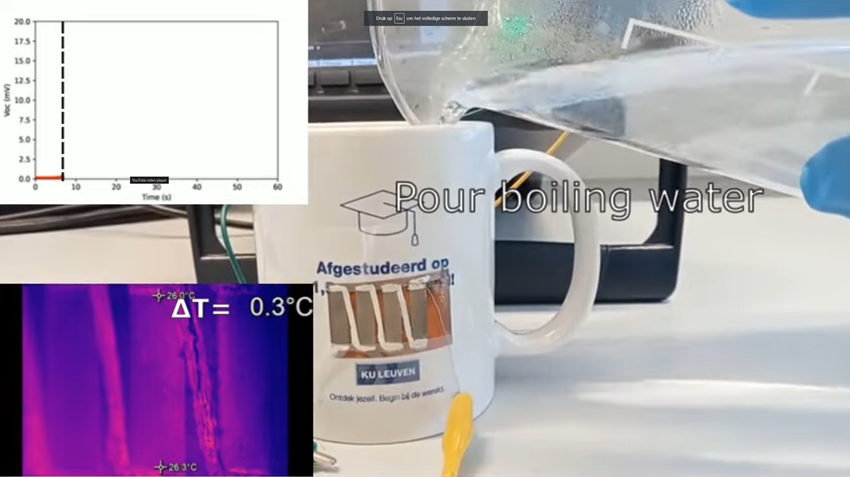
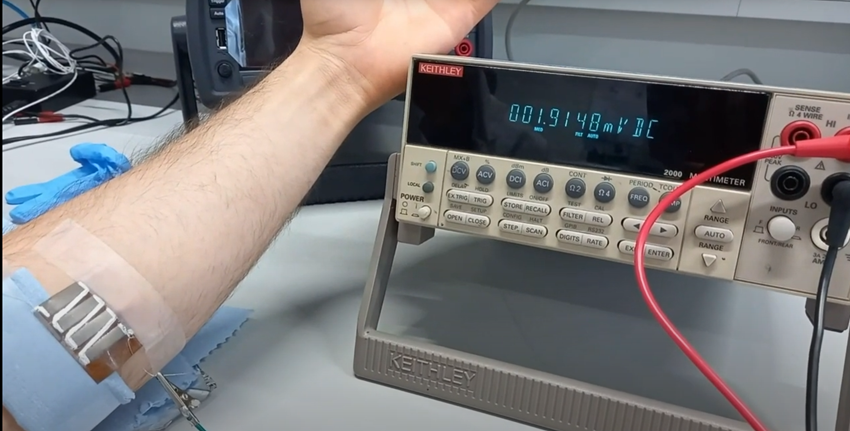
The researchers demonstrated this by sticking their thermoelectric generators on a coffee mug. Its contents gave off enough heat to produce several microwatts of electricity. The amount is enough to power a calculator, an electronic watch or an RFID tag. In another demonstration, a researcher applied strips to his arm and then generated his "own" electricity.
Material with thermoelectric properties
The strips are made of bismuth telluride, a material known for its thermoelectric properties. 'We use this material as a standard,' Molina-Lopez explains, 'because it is by far the best for room-temperature thermoelectric generators. But we hope to extend the production process to other materials in the future.' One of the advantages of the new process is that large pieces of thermoelectric material can be printed in a relatively short time.
Reuse
Moreover, the remaining printed material on the plastic film can be reused. 'So we don't waste this precious material during the production process.' Molina-Lopez and his colleagues showed that they can reuse the leftover material several times without performance loss. In the next step, they plan to improve their method and design to also recycle the material from decommissioned thermoelectric generators.
Source and photos: KU Leuven











