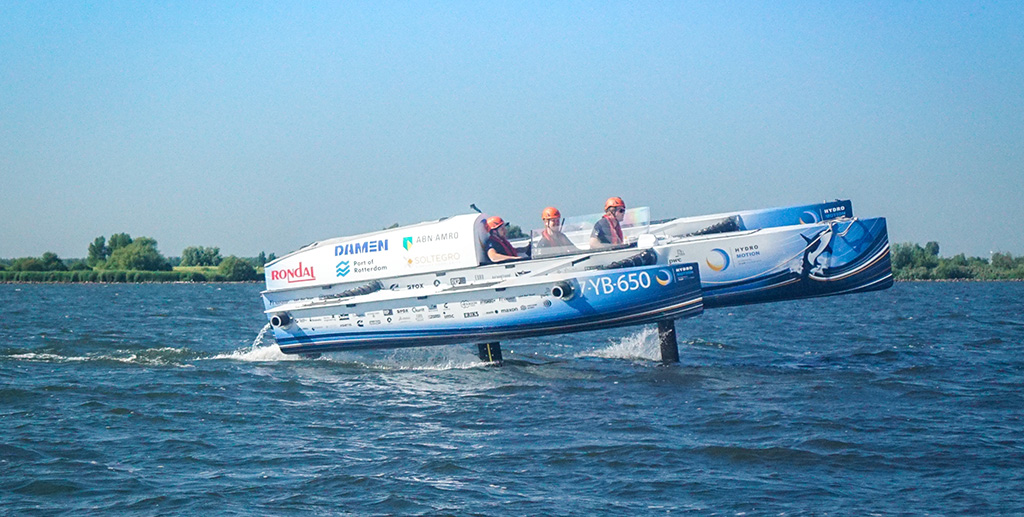

The world's first flying hydrogen boat is a fact! The TU Delft Solar Boat Team has spent a year working towards their dream: realising the first flying hydrogen boat with their project Hydro Motion. At a speed of 22 kilometres per hour, the hydrofoils cause the boat, a trimaran weighing over 1,000 kilograms, to fly above the water. The team is competing this week at the World Open Sea Championships in Monaco, where they will compete against other sustainably powered boats.
It turned out to be a huge task to build the boat within a year. Rick van Wilsem, Chief Engineer, says enthusiastically: “We’ve done it – we can say that with certainty. The entire boat has been launched. As a team, we are very proud to have built the world’s first foiling hydrogen-powered boat!” From 8 to 10 July, the student team will compete for the world title in Monaco. The students will be competing in the Open Sea Class of the Monaco Energy Boat Challenge. They are aiming for victory in the long-distance race. In doing so, they hope to demonstrate the potential of hydrogen-powered boats.
Exciting competition
It’s set to be an incredibly exciting competition, with formidable opponents from all over the world – students as well as companies. Electric and hydrogen-powered boats will compete in three categories: manoeuvrability, the sprint and, most importantly, the long-distance race. The team has set its sights on that final race. The hydrogen-powered boat has therefore been optimised to take on this challenge: sailing for 6 hours on the open sea without refuelling. The team that covers the greatest distance is the winner. You can follow the race via the website and social media channels of the TU Delft Solar Boat Team.
The Hydro Motion hydrogen boat
The boat the team worked on this year is an impressive sight: a seaworthy trimaran, over 8 metres long, equipped with a complete hydrogen system. On board, the smartest electronics and all the components to powerfully propel the boat. And, of course, the strongest hydrofoils. The boat is piloted by three pilots and reaches speeds of up to 40 kilometres per hour. Inside the boat, hydrogen gas is stored under high pressure in a tank. The fuel cell combines this hydrogen with oxygen from the air to generate electricity. This powers the engine.
Three super strong hydrofoils are attached under the boat. These work under the water surface in a similar way to the wings of an aircraft. At the take-off speed of 22 kilometres per hour, they lift the weight some 40 centimetres above the waves, a spectacular sight. When the hulls of the boat fly above the water, they experience drastically less drag than in the water. In this way, the boat uses very little energy. Efficiency is key during the challenging long-distance race that awaits the team in Monaco.
The team's mission
The TU Delft Solar Boat Team is a multidisciplinary team consisting of 20 students. All of them put their studies aside for a year for the Hydro Motion project. The students are working on this project with an important mission. They want to inspire the maritime industry, currently a major consumer of fossil fuels, towards a green future.











