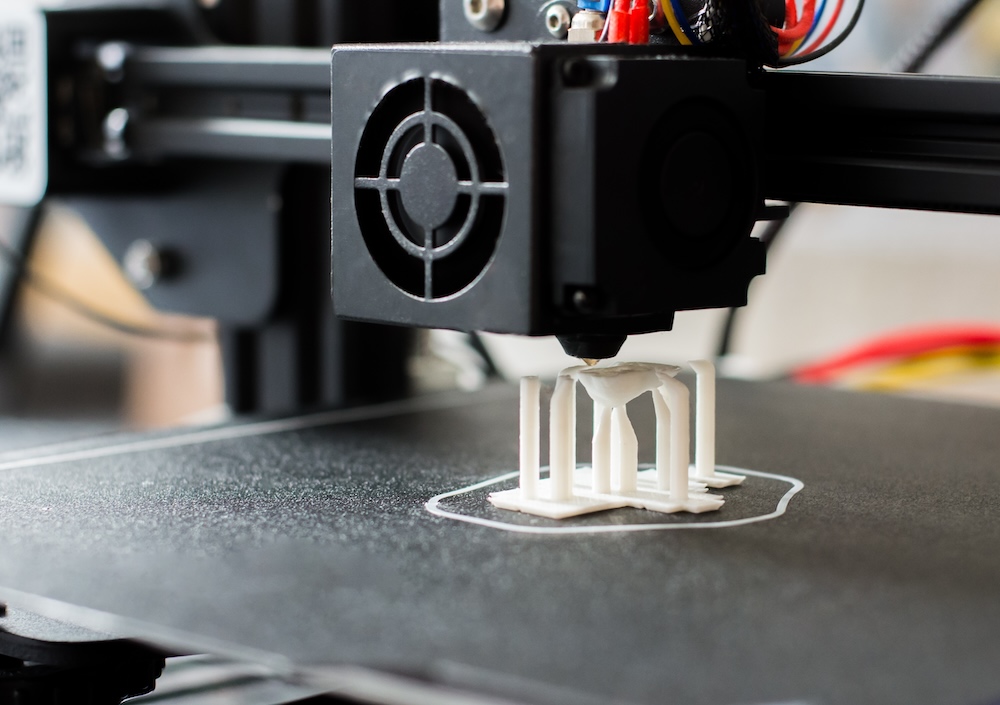

A new 3D printing technique enables high-resolution printing of surface structures and colour transitions. This requires the use of only one material.
The technique was developed by TU Delft researchers at MIT. It involves Speed-Modulated Ironing. The technique uses two nozzles: one nozzle for 3D printing and a second nozzle for reheating the printed material at different speeds. This allows the colour and texture of temperature-sensitive materials to be defined in detail.
Multiple colours or properties
3D printing has an increasing number of applications. To print objects with multiple colours or properties, it now often requires the use of different materials. This limits the possibility of creating smooth transitions and fine gradients in printed objects.
A key challenge for researchers has therefore long been 3D printing with multiple features in one print and with one material. Speed-Modulated Ironing offers this possibility. The technique exploits the temperature sensitivity of filaments such as Woodfill, Corkfill and foam filaments.
Two nozzles
Speed-Modulated Ironing uses 3D printing with a two nozzle system. One nozzle applies the material, twerijl a second nozzle - which is empty - moves over the printed layer and 'irons' it. In doing so, the second nozzle maintains a constant temperature, but moves at different speeds.
Ironing the material at lower temperatures activates the material more, while faster ironing activates the material less. This makes it possible to influence the appearance of the print. Think of colour shades, translucency and tactile textures.
"When we investigated temperature changes, we realised that varying the speed of a nozzle is much more accurate and direct than changing the temperature of the nozzle," says lead researcher Mehmet Ozdemir. Marwa AlAlawi, PhD student at MIT, adds: "This is key to our fine-grained control of the applied heat." However, every material reacts differently to ironing. Therefore, the researchers established a theoretical model to predict the expected activation of the material. "Our model was essential to understand the operation of Speed-Modulated Ironing and to fine-tune the process."
Design tool
A design tool has been developed by researchers that brings together the Speed-Modulated Ironing workflow. In this tool, users can assign specific visual and feel properties to 3D models, and send the files to the 3D printer. The design tool is open source. Doga Dogan of MIT explains, "By making the design tool open source, we want to give the 3D printing and maker communities the opportunity to experiment and further develop with this method."
Speed-Modulated Ironing allows 3D-printed parts to include features such as text, images, logos and QR codes without having to change materials. "This is an interesting new way to create textures in 3D prints, which further broadens the possibilities of FDM printing," reports Ultimaker's Paul Kuiper. The 3D printing company supported the project.
Less use of materials
Zhenja Doubrovski, assistant professor at TU Delft: "We believe that this technique is an important step towards less use of materials and more versatile and expressive printing results. We are curious to see how this technology can lead to new innovations in 3D printing."
The research was presented last week at the ACM Symposium on User Interface Software and Technology (UIST). Further information is available here.
Author: Wouter Hoeffnagel









