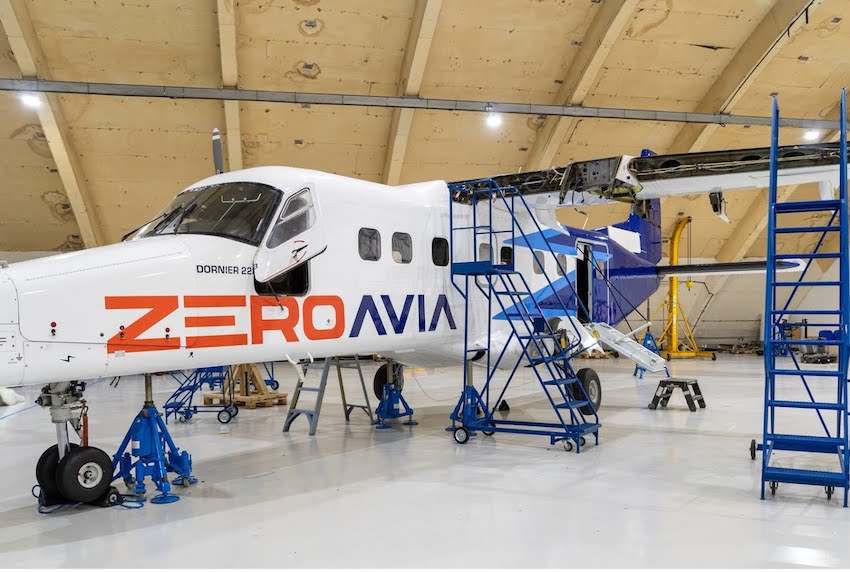

Several partners from the aviation sector are collaborating on the first emission-free commercial aviation route with a 19-seater aircraft between Rotterdam The Hague Airport (RTHA) and London. This will involve flying an all-hydrogen aircraft developed by ZeroAvia.
ZeroAvia, Royal Schiphol Group, Rotterdam The Hague Innovation Airport Foundation and the airport recently signed a cooperation agreement for the realisation of the aviation route. The parties hereby create a schedule for the launch of the emission-free air route. The parties involved talk about "potentially the world's first international commercial operation with a hydrogen-powered aircraft". This should enable emission-free flights.
Emission-free flying could be a huge win for reducing CO2 emissions worldwide. For example, figures from ZeroAvia show that air transport accounts for 12% of total emissions. If current trends continue, emissions are expected to double by 2050 compared to today. Half of these emissions come from relatively short flights of less than 1,600 kilometres. This is therefore a key focus of the company.
In talks with airlines
ZeroAvia and Royal Schiphol Group are currently in talks with airlines to find an operator for the planned route. The parties report that these talks are at an "advanced" stage.
Together, ZeroAvia and Royal Schiphol Group are also working on setting up a hydrogen fuelling infrastructure at Rotterdam The Hague Airport. And integrating this infrastructure into existing airport processes. The parties are also focusing together on commerce, infrastructure and regulation.
ZeroAvia
ZeroAvia is a British/American company focused on developing a hydrogen-powered electric aircraft. The company was founded in 2017 by current CEO Valery Miftakhov. ZeroAvia specifically focuses on developing a hydrogen-powered powertrain for conventional propeller-driven aircraft. In doing so, the company aims to enable flights without harmful emissions and with lower noise production.
The powertrain features hydrogen fuel cells. These are used to power electric motors. The only emissions created in the process are water vapour at manageable temperatures. Besides easing the burden on the environment, this approach has more advantages. For instance, ZeroAvia points to lower costs, which can make routes more attractive to airlines, airports and passengers alike. On its website, ZeroAvia states that flights of up to 800 kilometres are possible for half the cost of a traditional flight. The company attributes this cost reduction to lower fuel and maintenance costs, among other things.
Electrolysis
The hydrogen used by the planes is generated using renewable energy and a so-called electrolyser. This produces green hydrogen using a process called electrolysis. Aircraft then refuel the hydrogen via a ground-based refuelling infrastructure.
The company expects to launch its first products in 2024. ZeroAvia then aims to operate flights of up to 800 kilometres using aircraft with up to 20 seats. In the same year, the company also aims to achieve its first commercial flight. By 2026, the same 800-kilometre range should be possible with eighty-seat aircraft. In the long term, the company is aiming to fly aircraft with more than two hundred seats.
Dutch entity
ZeroAvia recently established an entity in the Netherlands. The company thus aims to take advantage of commercialisation and cooperation opportunities with airports, manufacturers and/or airlines. This involves cooperation in the Netherlands, but also in the rest of the European Union.
"This deal means you should be able to board a flight in just three years and make the one-hour journey between the UK and the Netherlands without worrying about climate impact. Together with partners like Royal Schiphol Group, we will create truly emission-free flights for passengers in the first half of this decade," said Sergey Kiselev, Head of Europe at ZeroAvia.
Ron Louwerse, CEO of Rotterdam the Hague Airport, added: "Boarding an emission-free flight from Rotterdam to London is just the beginning of sustainable aviation and is made possible by pioneering and driving innovation in the sector. With the Netherlands as a testing ground for aviation, we are strengthening its competitive and knowledge position as well as its business climate."
Author: Wouter Hoeffnagel
Source photo: ZeroAvia











