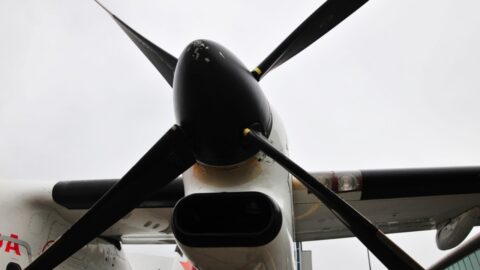
A test flight of a hydrogen-powered passenger plane has been successfully conducted by Universal Hydrogen. The plane can accommodate forty people and made a 15-minute test flight from Grant County International Airport in the US state of Washington.
Universal Hydrogen is a Hawthorne-based company in the US state of California. It focuses on using hydrogen to power aircraft. In doing so, it aims to make significant contributions to putting the aviation sector on track to meet the Paris climate commitments.
'The only scalable and clean fuel for aviation'
The company calls hydrogen the only scalable and actual clean fuel for the aviation sector available in the short term. It points to several advantages of the fuel. These include its high energy density; hydrogen comprises three times more energy per weight that paraffin. Hydrogen is also completely CO2 neutral; the only emission is water.
Universal Hydrogen also foresees financial benefits. Initially, the company expects the cost of hydrogen to be about the same as paraffin. However, it predicts that over time the cost will decrease exponentially and the fuel cost of hydrogen-powered flights will be lower than today. Finally, Universal Hydrogen points to safety. According to the company, using hydrogen in aircraft is significantly safer than using paraffin.
Modular hydrogen capsules
To enable hydrogen-based flights, Universal Hydrogen is working on a flexible, scalable and cost-effective approach to hydrogen-based logistics. The company transports hydrogen using modular capsules through existing transport networks. These networks should transport the modules from sustainable production sites to airports worldwide.
Once at the airport, personnel load the hydrogen modules using existing cargo handling equipment on board aircraft. Therefore, using the modules does not require any new infrastructure. The modules are lightweight and designed for placement at the rear of the aircraft's fuselage.
Conversion kits
In addition, the company wants to make existing aircraft suitable for flying on hydrogen. It is therefore developing conversion kits for converting existing models to a hydrogen fuel cell-based powertrain.
It is initially targeting two aircraft models here: the ATR72 and the De Havilland Canada Dash-8. Universal Hydrogen will equip these aircraft with a fuel cell-based electric powertrain using its conversion kit, replacing the current turboprop engines. Universal Hydrogen expects to operate the first hydrogen-based passenger flights in 2025. A short time later, the company also plans to operate hydrogen-based cargo flights.
New hydrogen-based aircraft models
As mentioned, Universal Hydrogen places its hydrogen modules at the rear in the fuselage of the aircraft. It points out that most of the CO2 emissions from aircraft come from so-called single-aisle aircraft, which are relatively thin and have one-aisle paths. Popular models include the Boeing 737 and Airbus A320. But expectedly, these manufacturers are also betting on single-aisle aircraft for future models.
Unsurprisingly, Universal Hydrogen's hydrogen modules are designed, among other things, for these single-aisle aircraft. "A hydrogen-based single-aisle does not have to be a radical new design. Carrying enough hydrogen for transatlantic range without sacrificing passenger capacity would add 9 metres to the length of a conventional A321 fuselage, yet remain shorter than the 757-300," the company writes on its website.
eVTOL aircraft
Incidentally, Universal Hydrogen is also focusing on other types of aircraft. These include so-called Urban Air Mobility or electric vertical take-off and landing (eVTOL) aircraft. Many such aircraft currently under development use an electric powertrain. In practice, this involves a hybrid powertrain with a fuel cell and batteries, where the fuel cell provides the energy and the battery supports the fuel cell. Universal Hydrogen also sees opportunities here for its modular hydrogen-based fuel cells. One reason is that no fixed infrastructure is needed to place the hydrogen modules on aircraft. This lowers the barrier to switching to the fuel.
Four weeks ago, Universal Hydrogen already successfully conducted its first taxi tests. It was also awarded a special certificate of airworthiness by the US Federal Aviation Association (FAA). This paved the way for the recent test flight carried out by the company.
Several deals closed already
The company previously struck deals with Air New Zealand, DAT and Everfuel, among others. The parties want to bring hydrogen-based flights to New Zealand and Denmark, respectively, through these collaborations.
The company also struck a deal with Canadian aircraft leasing company Avmax Aircraft Leasing. This company will order twenty hydrogen-powered aircraft for regional flights from Universal Hydrogen. Universal Hydrogen will also supply the hydrogen these aircraft need to fly. The agreement also provides scope for Avmax to become a maintenance and repair partner of Universal Hydrogen for the North American market.
Investors in Universal Hydrogen include GE Aviation, Airbus Ventures, Toyota Ventures, JetBlue Ventures and American Airlines.
Author: Wouter Hoeffnagel