

The global market value of industrial robot systems has reached a record US$16.5 billion. Future demand will be driven by a number of technological innovations, market forces and new industries. The International Federation of Robotics reports on the top 5 trends for the robotics industry for 2025.
Trend 1 - Artificial intelligence - Physical, Analytical, Generative
The trend towards artificial intelligence (AI) in robotics is growing. By using different AI technologies, robotics can perform a wide range of tasks more efficiently. Analytical AI enables robots to process and analyse large amounts of data collected by their sensors. This helps manage variability and unpredictability in the external environment, in 'high mix/low volume' production and in public environments. For example, robots equipped with vision systems analyse past tasks to identify patterns and optimise their operations for greater accuracy and speed.
Simulation
Robot and chip manufacturers have recently been investing in the development of special hardware and software that simulate real environments. This so-called Physical AI allows robots to train themselves in virtual environments and operate based on experience rather than programming.
Generative AI
These Generative AI projects are aimed at creating a "ChatGPT moment" for Physical AI. This AI-driven simulation technology for robots will be used in traditional industrial environments as well as in applications for service robots.
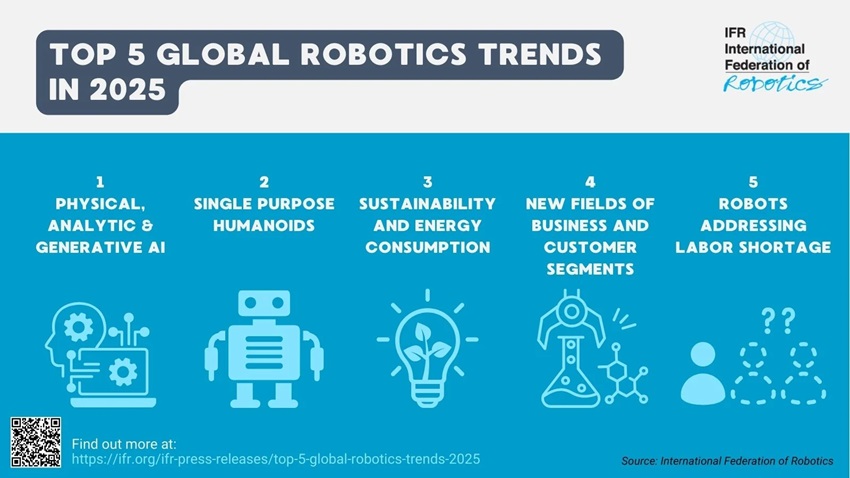
Trend 2 - Humanoids
Robots shaped like human bodies have received a lot of media attention. Vision: Robots are becoming multifunctional tools that can independently load a dishwasher and work elsewhere on an assembly line. Start-ups are working on these humanoid robots for general use.
One goal
However, industrial manufacturers are focusing on single-purpose humanoids. Most of these projects are carried out in the automotive industry. This sector has played an important role in pioneering robotic applications in the history of industrial robotics, and in the warehouse sector. However, from the current perspective, it remains to be seen whether humanoid robots can provide an economically viable and scalable business case for industrial applications, especially when compared to existing solutions. Nevertheless, there are many applications that could inherently benefit from the humanoid form and therefore offer market potential for robotics, for example in logistics and warehousing.
Trend 3 - Sustainability - energy efficiency
Compliance with UN environmental sustainability goals and corresponding regulations around the world is becoming a key requirement for inclusion on top supplier lists. Robots play an important role in helping manufacturers achieve these goals.
Cost-effective manufacturing
In general, their ability to perform tasks with high precision reduces material waste and improves the output-input ratio of a manufacturing process. These automated systems ensure consistent quality, which is essential for long-life products with minimal maintenance. In the production of green energy technologies such as solar panels, batteries for electric cars or recycling equipment, robots are crucial for cost-effective production. They enable manufacturers to scale up production quickly. This allows them to meet growing demand without sacrificing quality or sustainability.
Energy-efficient robots
At the same time, robot technology is being improved to make robots themselves more energy efficient. For example, the lightweight construction of moving robot parts lowers their energy consumption. Different sleep modes put the hardware into an energy-saving sleep mode. Advances in gripper technology use bionics to achieve high gripping force with almost no energy consumption.
Trend 4 - New customer segments
The manufacturing industry still has a lot of potential for robot automation. Most manufacturing companies are SMEs. The adoption of industrial robots by SMEs is still hampered by high initial investments and total cost of ownership. Robot-as-a-Service (RaaS) business models enable companies to benefit from robot automation without the need for fixed capital. RaaS providers specialising in specific industries or applications can quickly offer advanced solutions. In addition, low-cost robotics applications are interesting solutions for potential customers who feel that a powerful robot is too big for their needs. Many applications have low precision, payload and lifetime requirements. Low-cost robotics targets this new "good enough" segment.
Construction, laboratories, warehousing
Interesting new customer segments outside manufacturing include construction, laboratory automation and warehousing. Demand in all sectors is being driven by the fact that recent crises have led to political awareness of domestic production capacity in strategically important industries. Automation allows manufacturers to move production to nearby locations without sacrificing cost efficiency.
Trend 5 - Robots address labour shortages
According to the International Labour Organisation (ILO), the global manufacturing industry continues to face a labour shortage. One of the main causes is demographic change, which is already putting pressure on labour markets in leading economies such as the United States, Japan, China, the Republic of Korea and Germany. Although the impact varies from country to country, the cumulative effect on the supply chain is a concern almost everywhere.
Workers will be given different tasks
The use of robotics significantly reduces the impact of labour shortages in manufacturing. By automating dirty, boring, dangerous or delicate tasks, human workers can focus on more interesting tasks with higher value. Robots perform tedious tasks such as visual quality inspection, dangerous painting or heavy lifting. Technological innovations in robotics such as ease-of-use, collaborative robots or mobile manipulators help fill gaps where and when needed.
Source and image: International Federation of Robotics
See also: Intelligent antenna skin for more accurate communication in robotics











