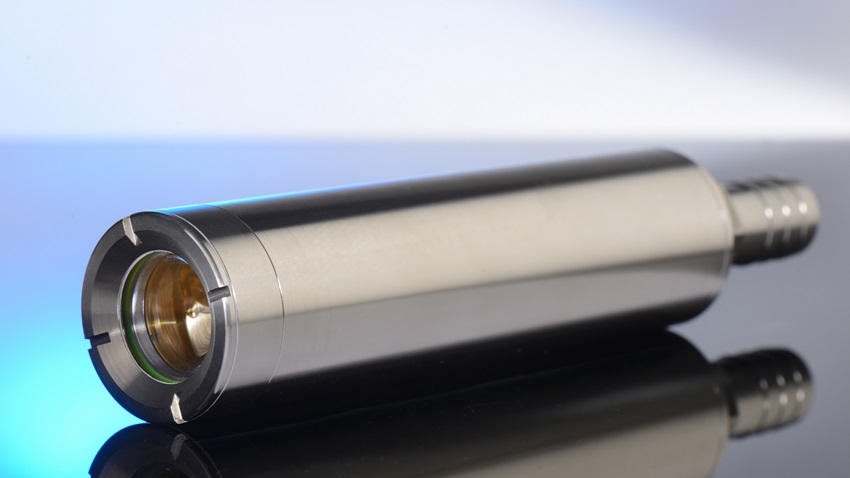

A new type of immersion probe based on laser technology. The Fraunhofer Institute for Laser Technology ILT in Aachen is currently investigating the possibilities. The innovation could pave the way for continuous inline monitoring of water treatment processes in wastewater treatment plants.
To monitor water treatment processes in wastewater treatment plants, operators have until now relied on 24-hour composite samples. These are collected continuously throughout the day and then analysed in the laboratory. Consider analysis of total organic carbon (TOC), dissolved organic carbon (DOC) or the amount of oxygen consumed by the complete aerobic degradation of biological substances (biological oxygen demand; BOD). However, in view of the increasing population density in urban areas and the varying composition of wastewater, this 24-hour grid is reaching its limits. Not only with regard to the quality of treated wastewater, closer monitoring is desirable. In addition, it is desirable for operators to be able to track how measured values change during the ongoing treatment process. This would allow them to control their plants more efficiently based on this real-time data. Smart inline monitoring should provide the solution.
New immersion probe
A research team at Fraunhofer ILT is currently laying the technological foundations to make this kind of data-driven water treatment a reality. At the heart of this is a new type of immersion probe based on laser beams. The technology brings water analysis directly from the laboratory to the treatment plants. “We make use of the phenomenon whereby substances relevant to water quality fluoresce when excited by specific wavelengths of light. Our immersion probe excites these fluorophores using different wavelengths within the UV and visible spectral ranges and detects the emitted fluorescence signals.” Speaking is Dr Christoph Janzen. He is a specialist in bioanalysis and is responsible for the research project at Fraunhofer ILT.
Wavelength
Targets for inline 2D fluorescence analysis include the amino acids tryptophan (TRP), tyrosine (TYR), phenylalanine (PHE) and the group of humic acids (HS). Because the wavelengths for their excitation range from 260 nanometres for PHE to 350 nanometres for HS, the team couples the probe to a tunable light source. "This can excite all target substances with their specific wavelength. If they are present in the wastewater, they emit their characteristic longer-wavelength fluorescence signal," he says. If a sensitive spectrometer is used, a fluorescence spectrum can be recorded for each excitation wavelength.
2D maps
This results in 2D maps that record the excitation wavelengths together with the corresponding light emission. These so-called excitation-emission matrices visualise the detected fluorescence signals. And they give operators accurate information about the organic contamination in the wastewater at each stage of the treatment process. "This 2D fluorescence measurement makes it possible to record the characteristics of the wastewater directly inline during the treatment process. Until now, conventional processes can only do this offline in the laboratory," explains Janzen. To validate the measurements, it is also possible to record transmission spectra with the immersion probe in addition to the fluorescence data.
Handy immersion probe
The project team took advantage of the Fraunhofer ILT's extensive expertise in optical design and measurement technology. This made it possible to implement the complex inline measurement process in the form of a handy immersion probe. The Aachen research team developed the probe itself. It did so in the EU-funded project "Fluo-Monitor - 2D fluorescence probe for inline water and wastewater monitoring". The team did this with a medium-sized measurement technology supplier, a water management research institute and a regional water board.
Continuous inline measurements
The current BMBF-funded AIX-Watch project will further develop and test the 2D fluorescence measurement methodology under real-world conditions. "The medium-term goal is to optimise the control and regulation of wastewater treatment plants using continuous inline measurements."
Smart, adaptive water treatment with AI and inline sensors
When the laser-based immersion probe is combined with inline sensor technology and artificial intelligence (AI), despite fluctuating wastewater compositions, users could use only the amount of energy and expensive operating substances such as ozone that is actually needed to meet regulatory limits. "Because we are working with mathematical models here, we have yet to substantiate this with conventional offline analyses," Janzen stresses.
Promising technology
However, machine learning models represent a promising approach to adaptive wastewater treatment. This approach is based on in-line measurements and tailors operational strategies to the current state of the water and its composition. To prepare the process for widespread use, the Fraunhofer ILT team is continuing to develop the probe in parallel. According to Janzen, one approach is to use more cost-effective LEDs instead of the tunable xenon plasma light source. In the context of data mining and AI, it is particularly important to expand the database rapidly. More cost-effective immersion probes are one way of moving closer to this goal.
Featured image: The 2D fluorescence probe developed at Fraunhofer ILT is the key component for inline water and wastewater monitoring (photo: Fraunhofer ILT, Aachen)
You may also be interested in: Innovative sensor measures oxygen levels in breath











