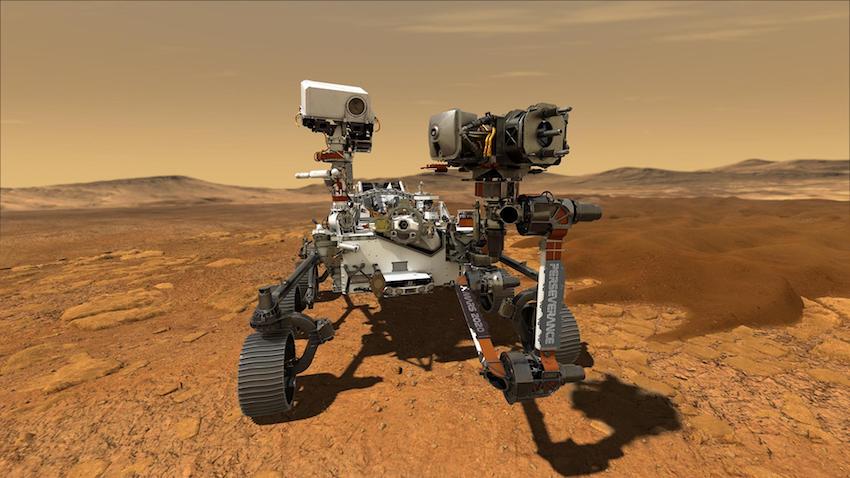

US space agency NASA's Mars rover Perseverance landed on Mars last Thursday evening at 21:55 Dutch time. The landing took place in the Jezero crater on the red planet. The Mars lander has been en route to the red planet since 30 July; this is NASA's ninth mission to Mars.
"Missions as part of NASA's Mars Exploration Program have shown that Mars was once very different from the cold, dry planet it is today," NASA writes in a fact sheet about the mission. For instance, there is evidence that Mars experienced wet conditions billions of years ago. These conditions would have been present long enough to support microbial life.
Signs of (ancient) life
As part of the Mars 2020 mission, NASA is therefore conducting a reconnaissance mission on Mars with the help of the Mars rover Perseverance. The aim is to search for signs of (ancient) life on the planet, looking specifically for rocks on the planet. NASA also wants to collect samples of both rock and regolith (broken rock and soil). These samples will be taken back to Earth if possible. Perseverance is also investigating the extent to which Mars has been habitable in the past.
Mars rover is based on its predecessor: the Curiosity. The Perserverance rover is about the size of a car, and excluding its arm is about three metres long, 2.7 metres wide and 2.2 metres high. At 1,025 kilograms, Perserverance weighs about 126 kilograms more than Curiosity.
Mapping minerals
Perseverance is equipped with several instruments. These include Mastcam-Z, an advanced camera system with panoramic and stereoscopic capabilities combined with a zoom function. NASA aims to use Mastcam-Z to map minerals present on the surface of Mars, among other things, as well as to support the Mars rover.
Another example is SuperCam, an instrument for remote imaging, chemical composition analysis and mineralogy enhanced. An X-ray-based fluorescence spectrometer and a high-resolution camera are being deployed to investigate the elemental composition of surface materials on Mars. Among other things, this should enable a much more detailed picture of the chemical elements present on the planet. Also present is Scanning Habitable Environments with Raman & Luminescence for Organics and Chemicals (SHERLOC), a spectrometer that can provide detailed images and deploys a UV laser to image mineral and organic compositions.
Producing oxygen on Mars
NASA also wants to test a technology to produce oxygen from the CO2-rich atmosphere on Mars. If the Mars Oxygen In-Situ Resource Utilisation Experiment (MOXIE) technology proves successful, it could play an important role in future Mars missions. For instance, the oxygen could be used to ignite rocket fuel for the return flight to Earth.
Another instrument on board is the Mars Environmental Dynamics Analyzer (MEDA). This is a set of sensors that will measure temperature, wind speed and direction, air pressure, relative humidity and the size and shape of dust particles, among other things. Finally, a ground penetrating radar called Radar Imager for Mars' Subsurface Experiment is present to map the geological structure of the soil at centimetre level.
Testing technology for the future
NASA is also testing technology during the mission that could play an important role in future missions to and on Mars. This includes an autopilot system developed for automated hazard avoidance. The system is called Terrain Relative Navigation. Another is a set of sensors called Mars Entry, Descent and Landing Instrumentation 2, which collects data during landing. An autonomous navigation system that should allow the rover to navigate faster in challenging terrain is also being tested.
Not the only spacecraft near Mars. Last week, vessels from the United Arab Emirates and China already arrived at the planet. The al-Amal (Arabic for "hope") arrived at the red planet on 9 February. The space probe was launched from Japan's Tanegashima space base in June 2020. The al-Amal will spend two years mapping Mars' atmosphere and weather.
Just two days later, the Tianwen-1 (Chinese for 'Quest for Heavenly Truth') also arrived at the planet. The Tianwen-1 consists of a satellite and a rover. The satellite has been placed in orbit around the planet. In May, the rover will be disconnected and is due to land on Mars, where it is due to drive around for about three months looking for traces of water and signs of life.
Author: Wouter Hoeffnagel
Photo: NASA/JPL-Caltech










