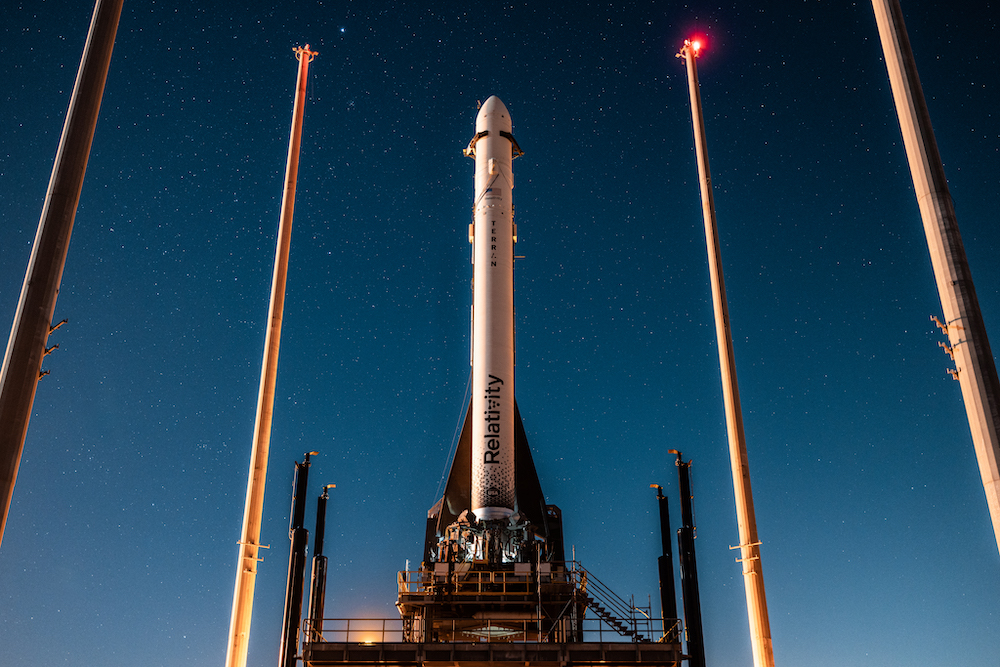

A 3D-printed rocket from US space company Relativity Space was launched after all last week. The company speaks of a success, although the Terran 1 rocket did not get higher than 16 kilometres due to an engine failure.
This reports Reuters news agency. The Terran-1 consists of 85% 3D-printed parts. The rocket is composed of two stages and an intermediate stage. The Terran-1 is to carry payloads of up to 1,250 kilograms to space. The maximum payload depends on the orbit around Earth that customers want to reach. For instance, for a low Earth orbit at a distance of 185 kilometres, a payload of 1,250 kilograms is possible. For a heliosynchronous orbit is up to 500 kilometres from Earth, the rocket can carry a payload of 900 kilograms. At a distance of 1,200 kilometres from Earth, a weight of 700 kilograms can be carried.
Among other things, the rocket's engines were fully 3D-printed. These include the so-called Aeon-thrusters, which are placed at the bottom of the rocket. These provide higher reliability, according to Relativity Space. This is partly due to the limited number of parts in the combustion chambers, ignition, turbo pumps, so-called reaction control thrusters and pressure systems.
Launch postponed several times
The launch of the Terran-1 had been scheduled several times, but had to be postponed each time. For instance, the first launch attempt was scheduled on 8 March. However, this attempt was called off due to an abnormal temperature of the liquid oxygen used by the second stage.
A second launch attempt was scheduled for Saturday 11 March. This attempt was initially rescheduled due to high altitude winds. The postponed attempt then failed because the rocket's nine Aeon 1 engines failed again almost immediately after ignition. Relativity Space then spoke of a 'corner case' in the automation of the rocket stages' decoupling system. This term describes a problem that occurs only outside normal operating parameters.
A new attempt was scheduled for 16:00 on 11 March. However, this too failed; the launch was aborted before the engines were ignited. Relativity Space later reported that the upper stage of the Terran 1 rocket had too low fuel pressure.
Success despite limited altitude
On Thursday 23 March, Relativity Space managed to launch the rocket after all. However, the rocket only reached an altitude of 16 kilometres. At this altitude, the rocket's second stage had to ignite. This seemed to happen successfully at first. However, the second stage did not provide enough thrust, preventing the rocket from reaching orbit.
Despite the setback, Relativity Space sees the launch as a success. For instance, the rocket managed to accelerate to a speed of 1,999 kilometres per hour, meeting a key objective of the mission. In a livestream, Arwa Tizani Kelly stated, "Although we didn't quite make it today, we collected enough valuable data to show that flying 3D printed rockets is possible."
Author: Wouter Hoeffnagel
Photo: Relativity Space










