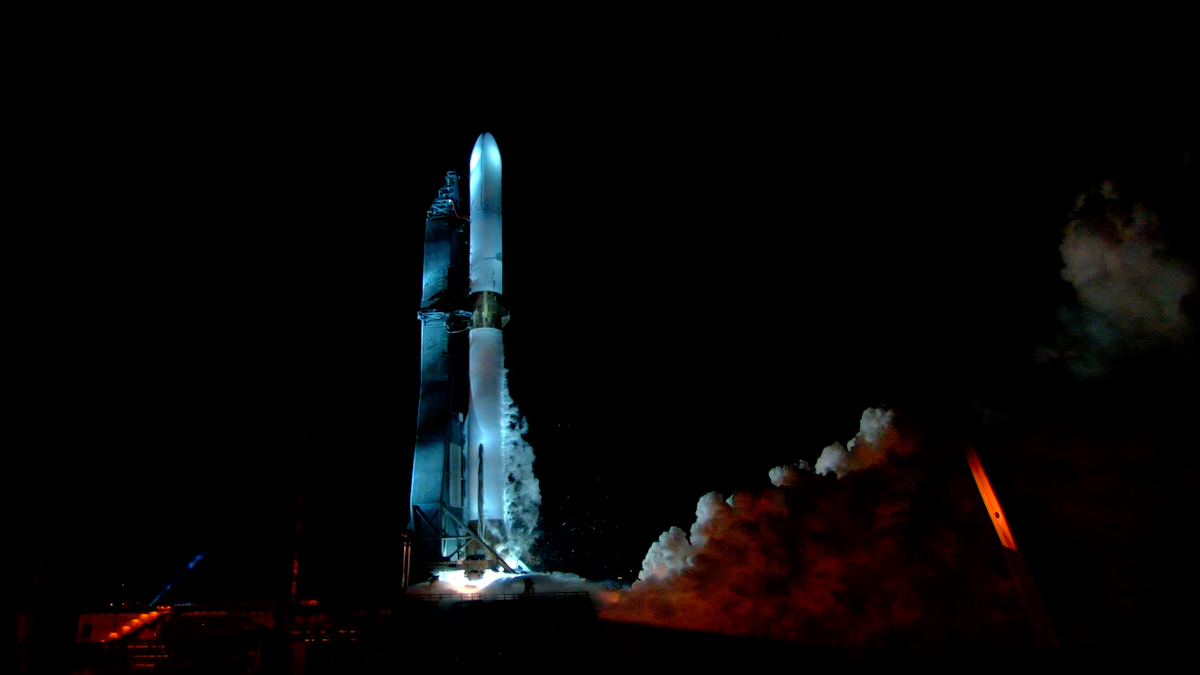

Both SpaceX and Blue Origin launched rockets this week. At SpaceX, it involved Starship, while Blue Origin launched its New Glenn rocket. In both cases, the launch did not go smoothly. For instance, SpaceX lost contact with Starship's upper stage after it reached space, while Blue Origin lost its lower stage.
What is Starship?
Starship is a spacecraft from SpaceX. The spacecraft consists of two parts: the Starship spacecraft and the Super Heavy rocket that serves as its first stage. The whole should form a fully reusable transport system that can carry both people and cargo into space. In doing so, SpaceX aims to carry cargo not only into orbit, but also to the Moon and eventually Mars.
The spacecraft has a diameter of 9 metres and is 123 metres high. It is designed to carry 100 to 150 tonnes of cargo or up to 100 people per flight. For these purposes, the first stage is equipped with 33 Raptor engines, providing a total thrust of some 98,066 kN. The second stage is additionally equipped with three Rapter-2 and three RVac-2 engines, with a total thrust of 26,478 Kn.
A core feature of Starship is that the spacecraft should be fully reusable. SpaceX also wants Starship to refuel in space, with the aim of being able to land on the Moon or eventually Mars.
What is New Glenn?
New Glenn is a rocket that is also composed of two stages. A feature of New Glenn is the reusable first stage. After launch, the stage has to land in the sea on a specially designed platform called Landing Platform Vessel 1. In this way, the first stage should be able to perform at least 25 flights.
Blue Origin, incidentally, wants to eventually make its second stage reusable. It has been working on this since 2021 under the code name Project Jarvis. Currently, however, New Glenn is still equipped with a second stage that is not reusable. New Glenn can handle loads up to 7 metres in diameter. It can carry up to 45 metric tonnes (MT) in low-Earth orbit (LEO), or up to 13 MT in geostationary orbit.
The rocket's first stage features seven BE4 engines, which Blue Origin designed and manufactured in-house. The total thrust delivered by these motors is 17,000 kN. The second stage is additionally equipped with two BE-3U motors, which are optimised for use in space.
Lost contact with Starship after eight minutes
A prototype of Starship was launched last night in Boca Chica in the US state of Texas. The spacecraft successfully managed to reach space. Here the rocket should have spent some time, after which it should have made a controlled landing in the Indian Ocean after an hour.
However, SpaceX lost contact with the prototype eight minutes after the launch. The company speaks on X of a "rapid unplanned disassembly" in flight.
With that, a number of test satellites that carried Starship's prototype were also lost. The spacecraft was supposed to carry these satellites into orbit.
Seventh flight
It was Starship's seventh flight and the first test flight of 2025. SpaceX's team points out on X that "success comes from what we learn", and that this test flight helps with further improvement of Starship. The company also reports the test flight is a 'reminder that development testing can, by definition, be unpredictable'.
Starship's lower stage, incidentally, did manage to land successfully on Earth. This 'Super Heavy booster' returned to Earth, slowed down during its fall using its engines and was eventually successfully grabbed by grapples from Mechazilla. Mechazilla is a platform built specifically for this purpose.
New Glenn in orbit
Blue Origin launched New Glenn from the US state of Florida on 16 January and successfully managed to put it into orbit.
On board was, among other things, an experimental platform designed to put satellites into their own orbit. This platform is called Blue Ring Pathfinder. It can move itself in space to different orbits and locations and release satellites here.
landing the rocket's first stage failed; the first stage was lost. "We lost the booster during descent. We knew it was ambitious to land the first stage on the first attempt. We will learn, refine and apply that knowledge at our next launch in the spring. We are extremely happy with today's result," Blue Origin writes about it.
Author: Wouter Hoeffnagel
Main photo: Blue Origin's New Glenn (image: Blue Origin)










