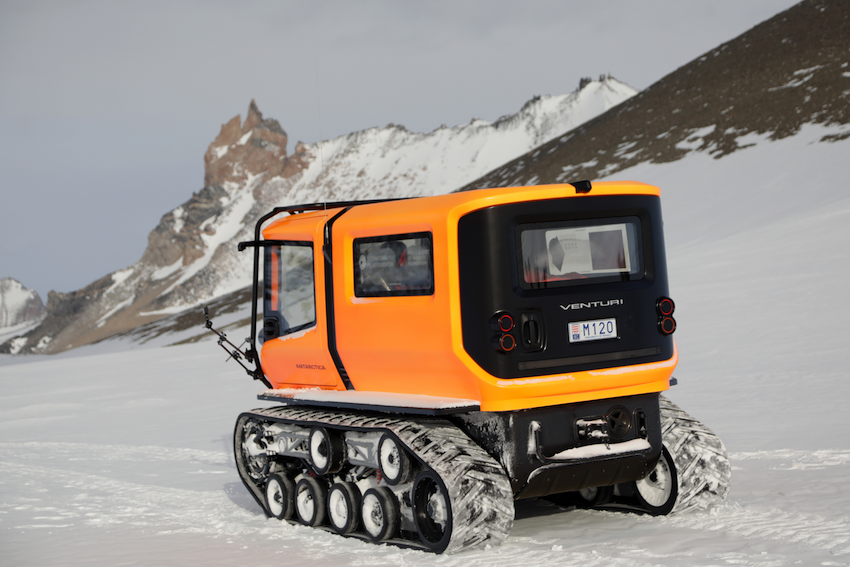

The Princess Elisabeth Base, a Belgian scientific base in Antarctica, has had the first all-electric exploration vehicle for the polar region since 10 December. It is a Venturi Antarctica.
The Belgian Princess Elisabeth Base is a scientific base in Antarctica built during the International Polar Year 2007-2008. The site was completed in 2008-2009 and has been in use since 15 February 2009. It is a 'zero emission' station, with the ambition of using only renewable energy. Thus, the base runs on solar panels and wind turbines, among other things. All waste from the base is also recycled.
Emission-free transport of people and goods
The Venturi Antarctica was built by Monegasque company Venturi Antarctica. After H.S.H. Prince Albert II of Monaco returned from a trip to the Princess Elisabeth base in 2009, the prince contacted Gildo Pastor, director of Venturi. The Prince Albert II Foundation asked Venturi for an emission-free solution to transport passengers and goods to and from scientific research sites.
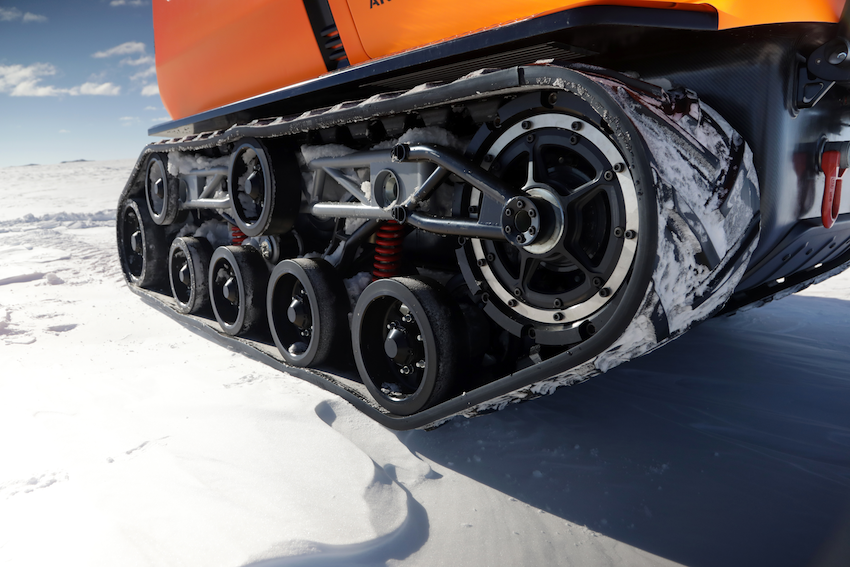
Following this mission, Venturi developed a trio of vehicles. The latest version is now operational at the Princess Elisabeth base. The vehicle's body was developed by designer Sacha Lakic. The design was largely determined by technical constraints. These include thermal insulation, battery size and the tubular structure of the chassis.
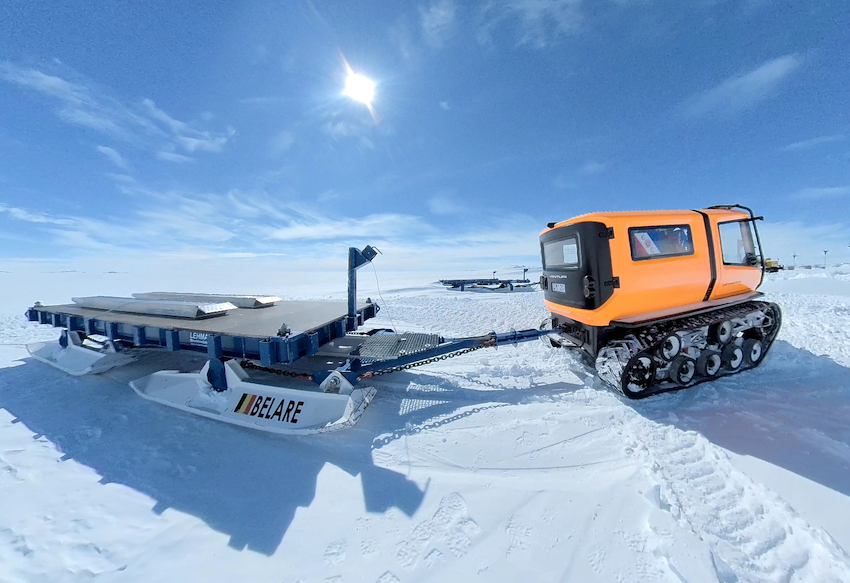
The Venturi Antarctica is equipped, among other things, with folding benches. This allows the vehicle to transport six people, equipment and a second battery to and from research sites. This second battery doubles the range from 50 kilometres to 200 kilometres. This range is maintained down to temperatures of -50°C.
Prototype tested by Prince Albert II
A prototype of the vehicle was tested by Prince Albert II during a 42-kilometre trek through the mountains between Dease Lake and Telegraph Creek, both in the Canadian province of British Columbia.
So now the vehicle has actually been put into service at the Princess Elisabeth base. In its first week, the vehicle has been used, among other things, to carry out scientific missions on the ground. These included carrying out maintenance on various automated weather stations. Maintenance was also carried out on a new Belgian atmospheric observation station at an altitude of 2,300 metres on the Antarctic Plateau. The Venturi Antarctica made it possible to reach this station without disturbing the environment.
Temperature measurements
During its trips, temperature measurements of the snow were also taken using the reconnaissance vehicle. These measurements are used to validate satellite measurements. A simulated rescue operation was also carried out, in which someone had to be rescued from a glacier crevasse.
"It is almost 12 years since H.S.H. Prince Albert II of Monaco returned from a trip to Antarctica and told me that the scientific research stations did not have clean vehicles. Through the Prince Albert II of Monaca Foundation, Venturi was entrusted with the task of providing a zero-emission solution that would enable new areas of scientific research. In 2009, no technology was available that allowed such a vehicle to operate in rough terrain at -50°C. The third version of the Antarctica is now optimal. My teams and I are proud to deliver that vehicle to the International Polar Foundation," said Gildo Pastor, Venturi Group managing director.
Conducting emission-free research
Alain Hubert, founder and director of the International Polar Foundation: "Our work with Venturi shows that any organisation can identify a range of solutions to climate problems. The mission of our foundation and Belgium's Princess Elisabeth Base is very clear: to allow scientists to carry out their research in Antarctica from a first-class base that is emission-free. The Venturi Antarctica is fully consistent with this vision. It opens up a new era of logistical operations in Antarctica within the framework of the Madrid Protocol, signed in 1992. This environmental protocol invited parties to the Antarctic Treaty to continuously improve the environmental management of operations."
Hubert added: "The tests carried out so far have been very convincing. We are delighted to remain involved in improving the energy performance of this vehicle that serves science."
Author: Wouter Hoeffnagel











