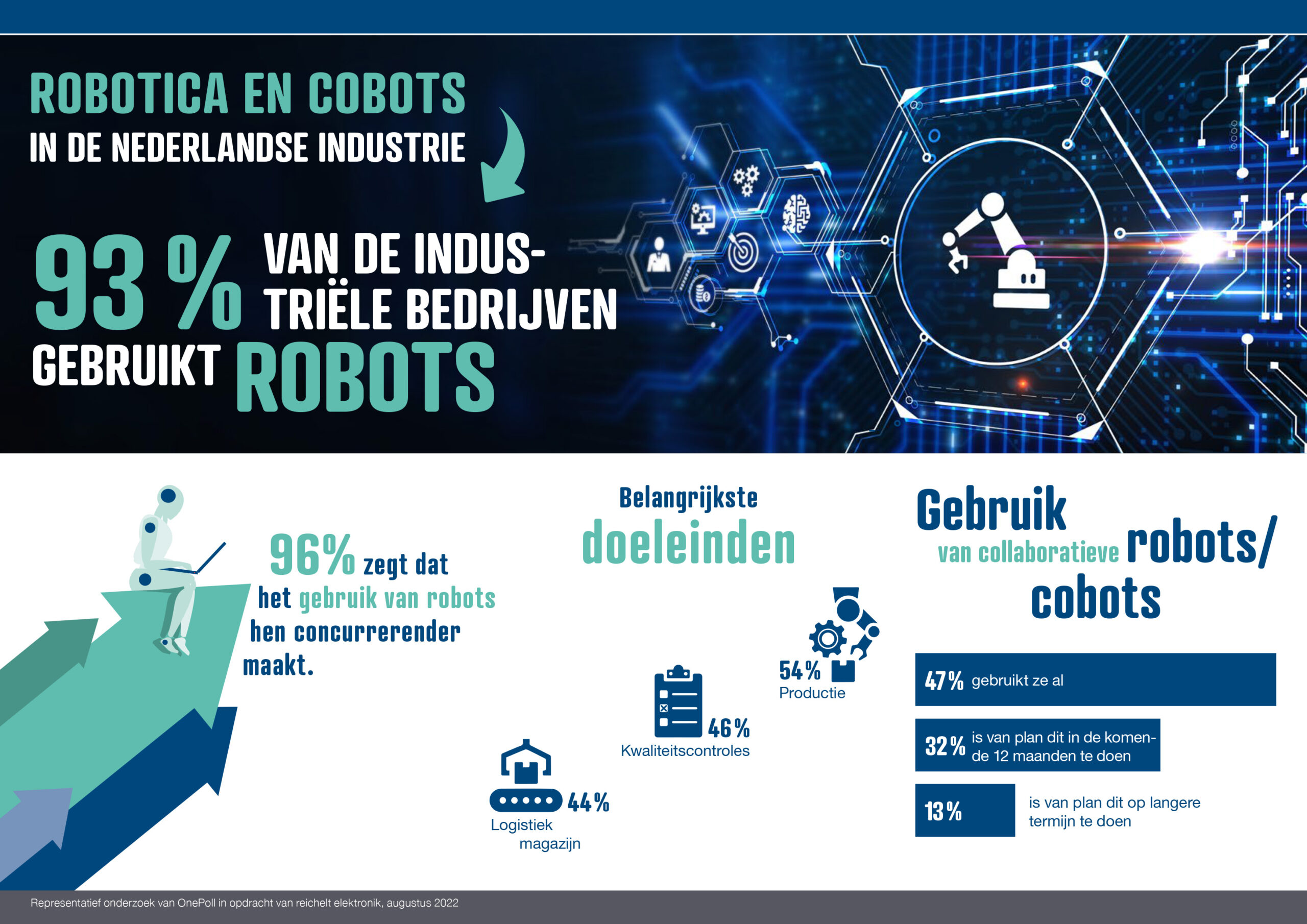

Robots and smart helpers have long since ceased to be a rarity in Dutch companies. Robots are now also becoming affordable and attractive to small and medium-sized enterprises. Yet it seems that the full application potential has not yet been fully exploited.
Market research firm OnePoll surveyed more than 1,500 European industrial companies - including 250 in the Netherlands - for online retailer Reichelt elektronik. The aim was to find out more about their views on and experiences with cobots.
Robots are needed on the shop floor
Robots are needed on the shop floor. On that, at least, the companies surveyed agree. More than 96 per cent agree that the use of robots contributes to a better competitive position. Against this background, it is not surprising that 93 per cent of the companies surveyed deploy robots in their operations. Even among smaller and medium-sized companies, almost 80 per cent are already using robots.
Production and manufacturing
With 63 per cent, production and manufacturing are cited as the main areas of work where robots are used. Warehouse logistics (56%) is also mentioned at a wide distance. The main task of robots is therefore to relieve the burden on workers. More than half (53%) of the companies surveyed have their robots perform physically difficult or challenging tasks. Furthermore, they are used for testing purposes (49%), dangerous tasks (47%) and repetitive, uniform tasks (44%).
Specific tasks include: 46% packaging tasks, 42% assembling or loading machines, 42% palletising, stacking and removing items, and 40% joining operations (pressure bonding, gluing, sealing, roll hemming)
Biggest stumbling blocks
Although robots are becoming increasingly popular in Dutch companies, the areas of application are clearly defined. Only 3 per cent of those surveyed want to automate all tasks in production, while 18 per cent want only a small number of tasks performed by robots. Moreover, one of the biggest stumbling blocks to introducing robots is that the purchase cost is too high (53%). An equally large obstacle (53%) is the great effort required for installation.
Collaborative robots
To make the introduction of robots a success, Dutch companies particularly want people with knowledge and skills of robotics. 88 per cent consider the presence of professionals willing to learn new skills in robotics important. Similarly, more than a third (41%) of respondents consider it crucial for success to have sufficient budget and financial planning that takes into account unexpected expenses.
Flexibility and versatility
Flexibility and versatility are the particular advantages of cobots. They are designed so that people can work and interact with them. In industry, they are embracing this concept with enthusiasm. Almost half of industrial companies say they already work with cobots and almost a third plan to purchase them in the next 12 months. A clear trend to invest more in cobots can be seen especially among medium-sized companies.
Scope of cobots
According to respondents, the majority (54%) of collaborative robots are also used in production and manufacturing. However, at 46%, they are significantly more often used for quality inspection of products than other robots (29%). This is probably due to the fact that companies trust a human-machine team more when it comes to the quality of their products than fully automating this task.
Smart helpers
The vast majority of Dutch companies already work with robots. However, the scope has so far focused mainly on manufacturing and production. Companies' experiences with existing robots are unchangingly positive. For instance, 91 per cent of those surveyed find the smart helpers easy to operate. Training existing or new staff to operate the new robots in the company also often goes without a hitch (81 per cent).
Developments
"Robots have made huge strides in their development in recent years. They have become smaller, more compact, smarter and more versatile. Even in smaller companies, cobots convince with their flexibility. In doing so, they continue the triumph of robotics and help companies of all sizes to increase productivity and produce reliably," concludes Ulf Timmermann, CEO of reichelt elektronik. "In cooperation with people, cobots offer special opportunities to solve challenges with production."
Photo: Reichelt











