
The accumulation of large supercooled water droplets on aircraft can pose a challenge to flight operations. Ice formation due to supercooled large droplets (SLD) can form in places where ice protection systems cannot reach. Moreover, this ice tends to grow faster than other types of 'icing', such as from smaller water droplets. The EU project SENS4ICE (SENSors and certifiable hybrid architectures for safer aviation in ICing Environment) investigated new technologies to detect SLD ice formation.
During the five-year project, researchers developed ten technologies to directly detect in-flight icing. They then successfully tested these in wind tunnels for icing in conditions with both small droplets and SLD icing. One of these new technologies is the Local Ice Layer Detector (LILD), developed by the DLR Institute of Lightweight Systems. This technology can be integrated into aircraft structures such as wings or tail surfaces. The LILD analysed how ice formation in aircraft affects ultrasonic waves, i.e. how they change when ice gets on the aircraft. Other researchers developed sensor technologies for aircraft based on thermal, optical and electrical principles, while some methods investigated the identification of SLD conditions using satellite data. Doit would also improve weather forecasts.
New software
Scientists at the DLR Institute of Aircraft Systems developed a new approach to determining icing and its impact based on aircraft performance. They developed software with a monitoring algorithm. This algorithm continuously analyses the aircraft's performance. From it, it deduces icing. Ice accretion causes deviations from the normal flight condition. This allowed the ice to be detected indirectly. Particularly innovative was the project's hybrid approach. By combining different detection technologies, they benefited from individual technological advantages such as precision and fast detection. But they also got more robust overall results. "Hybrid ice detection is a promising approach for reliable and early warnings in case of rare SLD icing." So concludes Carsten Schwarz, project coordinator at the DLR Institute of Flight Systems.
Ice formation
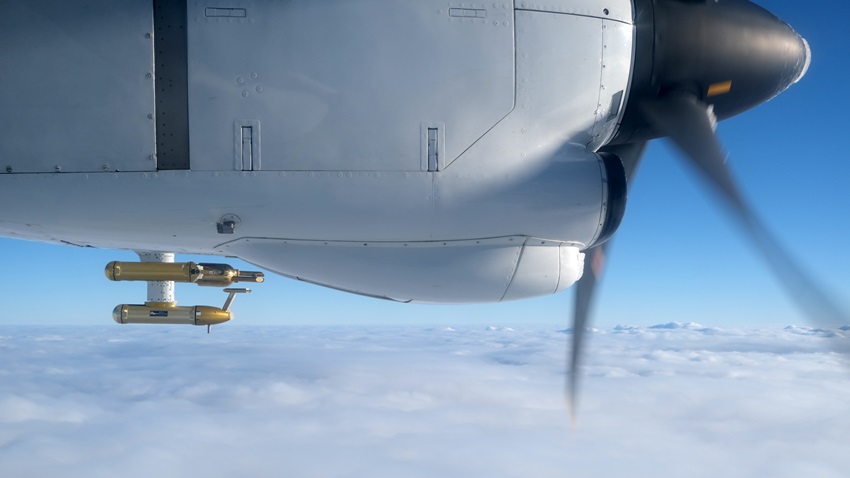
Researchers conducted two in-flight test campaigns. They did this by flying through clouds of super-cooled large droplets while flying. However, these conditions are rare and difficult to predict. The DLR Institute of Atmospheric Physics therefore coordinated a team of meteorologists and scientists. They provided essential support by predicting the weather before the flight tests and especially in real time. For both flight campaigns, atmospheric conditions were measured with special high-precision microphysical instruments. These data constitute the reference material used to evaluate new ice detection technologies.
Flight test campaigns
An Embraer Phenom 300 light jet carried out 15 flights in North America, totalling 25 flying hours. In Europe, the ATR 42 environmental research aircraft operated by SAFIRE (the French aerial research facility) also carried out 15 flights in the south of France, totalling around 50 flight hours. Together, the two campaigns flew for more than 14 hours in icing conditions and more than two and a half hours in SLD conditions. During these test flights, data was collected to successfully test the technologies.
Lots of potential
The proven sensors and systems open up potential applications. Not only for the certification and safe operation of future commercial aircraft and to meet the challenges of future energy-efficient and sustainable aviation. It is also suitable for new aircraft types, such as UAV (unmanned aerial vehicle) or UAM (urban air mobility). "The best results were achieved by combining the detection of atmospheric icing with the identification of actual icing on the aircraft, additionally supported by the monitoring of aircraft performance," Schwarz concludes. "The data and experience collected made it very clear that further research into the specific SLD icing conditions is needed to gain a deeper understanding. It is already clear that understanding not only the atmospheric conditions and icing on the aircraft, but especially the effects on flight characteristics are crucial for safe flight operations."
Photo: DLR (CC BY-NC-ND 3.0) Source: DLR
Also read: Drones protect wind turbines from ice