
Moist, cold conditions are the enemy of wind power. If a layer of ice forms on the rotor blades, it can lead to imbalance in rotation and thus increased wear. In such cases, turbines often have to be shut down for several days, leading to huge losses for operators. Now, for the first time, a Fraunhofer team has succeeded in using drones to protect rotor blades from ice. The project was named: "TURBO - Temporary coating using drones".
Until now, operators who wanted to protect their wind turbines from ice had to dig deep into their pockets. Heating mats that can be integrated into the blades are extremely expensive. Systems to pump hot air into the rotors also carry a high price tag. And using helicopters to spray de-icing fluid on the turbines is also pricey. "Drones used only when needed offer a cost-effective alternative," says Andreas Stake, project manager at Fraunhofer IFAM.
Conditions
But to use drones to prevent ice, a number of conditions must be met. The coating materials must not only be environmentally friendly. They must also have good adhesion and be sufficiently durable. It is important that they stay on the rotors for weeks and protect them from ice. The spray system used must also be highly accurate, but at the same time lightweight. And finally, the drones must have a high payload capacity. And allow very precise control.
TURBO
The Fraunhofer researchers working on the TURBO project have succeeded in developing a prototype that meets all these requirements. The coating material designed by the scientists at Fraunhofer IFAM in Bremen is made of urea and wax. It is environmentally friendly and has good adhesion. This material can be applied quickly and easily with a spray technique and also dries quickly. The coating was tested in an ice chamber at the institute. This is done by the researchers to confirm that it reliably protects against frost formation.
Coating application
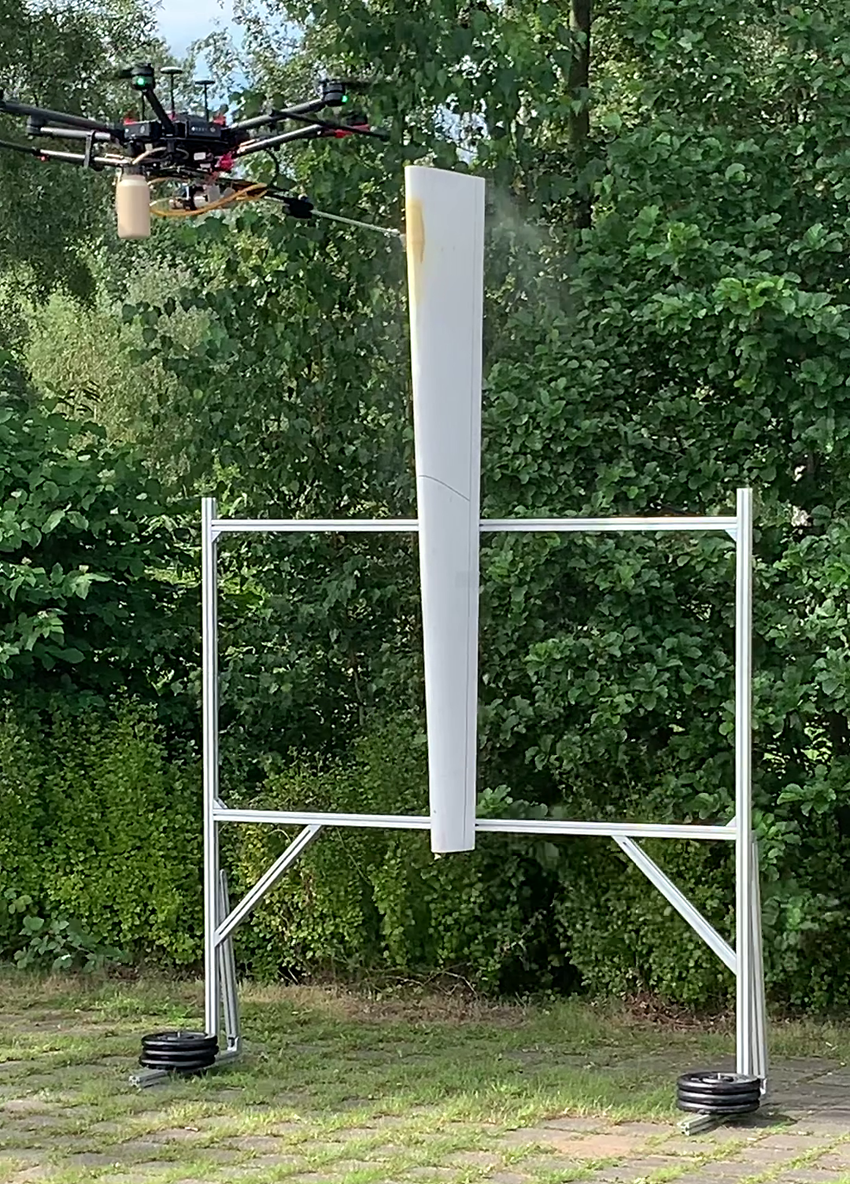
The team at Fraunhofer IPA built the equipment to apply the coating. It consists of a small pump that forces the liquid urea/wax mixture under high pressure into a long, thin lance. At the end is a nozzle with a diameter of only 0.3 millimetres. This airless pumping system is capable of producing droplets 100 micrometres in diameter. Even at wind speeds of 35 kilometres per hour, these droplets can still be sprayed precisely onto the edges of the rotor blades. There, they will then solidify. The edges are especially important because this is where the icing process begins when wet, cold air hits the turbine.
Success assured with simulations
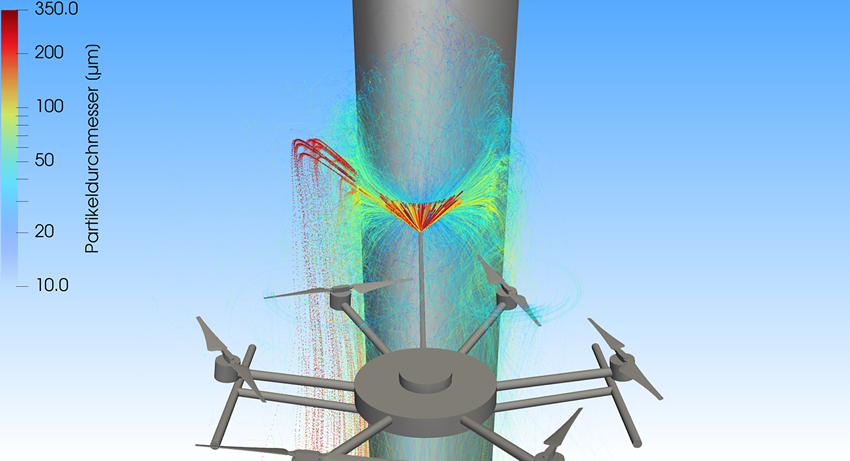
Dr Oliver Tiedje, project manager at Fraunhofer IPA, and his team determined the technical parameters using fluid dynamics simulations. These included the required pressure, an efficient atomisation method and the optimal droplet size. "Our decades of experience in modelling coating processes really helped us. We were able to draw on this expertise," says the physicist. "However, we had to adapt the process parameters to the complex geometry of the wind turbines."
Collaborating with industry
The researchers now want to collaborate with industry partners. They want to do this to further develop the technology and make it ready for series production. There are numerous applications where drones could be useful to apply coatings. Think not only of ice protection for wind turbines. Deployment can also be useful for overhead lines in rail transport or while refurbishing buildings. For example, repairing defects in plaster on parts of buildings that are difficult to reach.
Support
The project "TURBO: Temporary coating using drones" was supported by 19 companies. These are manufacturers of coatings and raw materials, manufacturers of coating equipment and drones, and operators of wind turbines. The project was submitted to the German Federation of Industrial Research Associations (AiF). It is funded by the Federal Ministry of Economics and Climate Action.
Source: Fraunhofer
Featured image: Simulation of coating application by a drone under the influence of wind (photo: Fraunhofer IPA)
See also: Testing the effectiveness of black blades using sensors, cameras and radar











