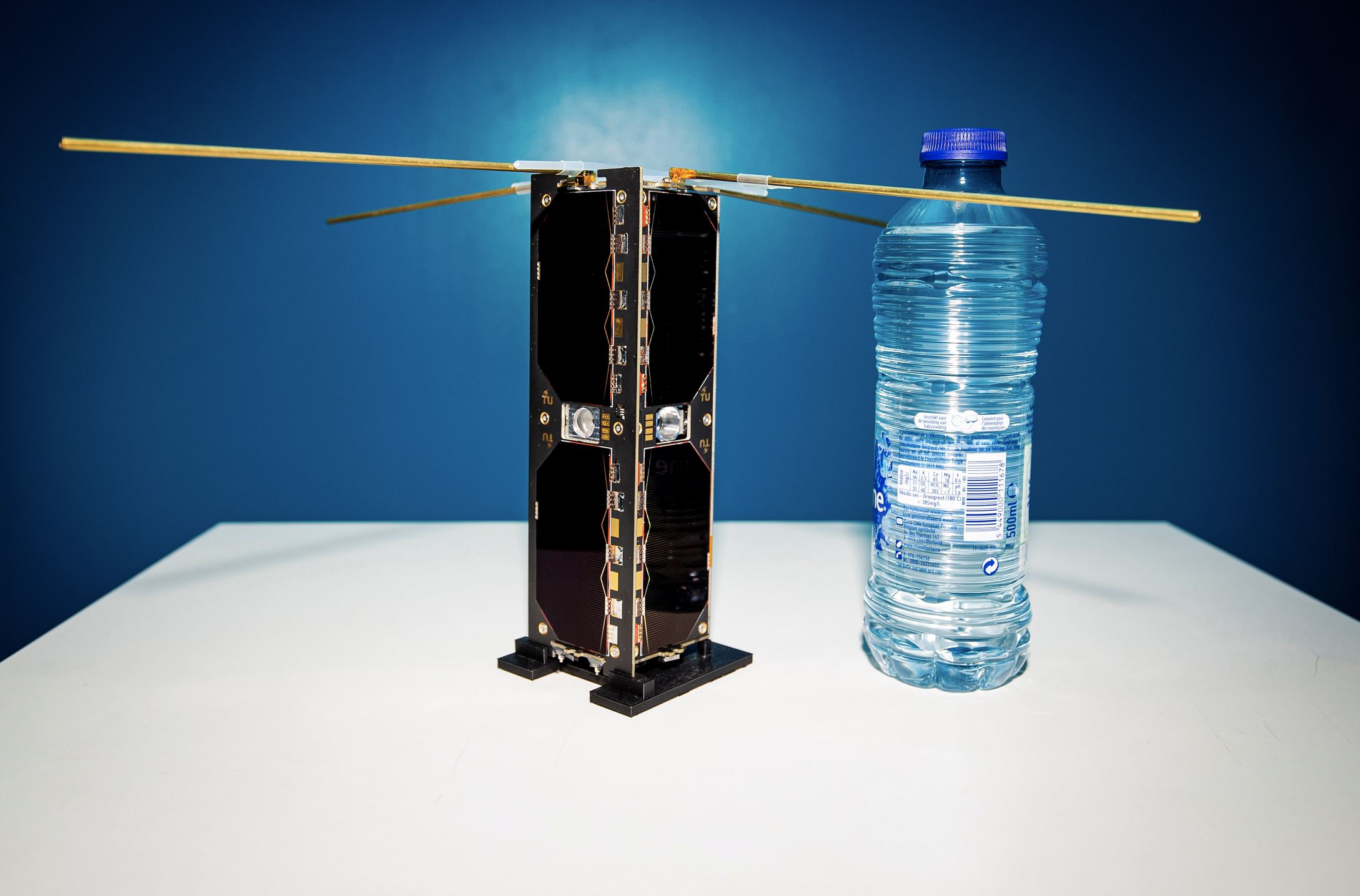

SpaceX launched a Falcon 9 from Cape Canaveral on 13 January 2022. In this transporter-3 mission, SpaceX sent 105 satellites into space. Also travelling with them was a small Delft satellite: the DelfiPQ. This is one of the smallest satellites in the world.
TU Delft satellite researchers Alessandra Menicucci, Stefano Speretta and Sevket Uludag designed and built satellite DelfiPQ themselves. Part of their aim was to be able to demonstrate that technology on such a small scale can actually function in space. Swarms of these small satellites are better able to observe the earth than today's large satellites. They can play an important role in monitoring climate change and high-speed wireless broadband connections, among other things.
Small and functional
The DelfiPQ satellite measures 5x5x18 centimetres, making it one of the smallest satellites in the world. In fact, TU Delft is a leader in space miniaturisation. According to the satellite researchers, it was a huge challenge to build everything so small. Every piece did not exist before while all systems on board ensure that the satellite can function in space. Think antennas, altimeters, and power supply. Everything is smaller than a normal satellite. "Therefore, we also had to make everything ourselves: from circuit boards to micro propulsion system, from reflectors to communication system," says Sevket Uludag. DelfiPQ needs to answer another important technical question: will such a small satellite be distinguishable from Earth from a piece of space debris?
Mini satellite
The main advantage of mini-satellites, compared to traditional satellites, is that they can take measurements together in a swarm that large ones are not capable of. Small satellites cost much less, allowing you to launch dozens or even hundreds of them. They can make observations from multiple locations and collect and process data together. Stefano Speretta, associate professor of Space Systems Engineering: "Such swarms are ideal for Earth observation, including to map climate change." Satellite swarms may even be able to establish superfast wireless broadband connections in the future.
An exciting launch
DelfiPQ is TU Delft's third satellite to actually go to space. DelfiC3 was the first. This satellite has now been in space for more than 12.5 years and is still very much alive. DelfiN3xt was launched in 2013. Contact was recently re-established with this satellite. University lecturer and project leader Alessandra Menicucci: "Making contact with the DelfiPQ is particularly exciting." On 14 January at 11.21 am, it succeeded.
Build faster
The mini-satellite has 14 systems while three people built it. By Covid-19, construction continued not only in the laboratory at the university but also at home, sometimes up to 12 hours a day to meet the deadline. Construction is expected to be faster in the future. Menicucci: "We could also have this kind of mini-satellite built by students. We did this project for all the Aerospace Engineers of the future."
Source: TU Delft
Image: Pocketcube DelfiPQ (photo: Guus Schoonewille)










