
Maastricht Aachen Airport joins PowerUp initiative for electric flying. Within this initiative, the airport is collaborating with Eindhoven Airport, Rotterdam The Hague Airport, Groningen Airport Eelde to gain knowledge on the feasibility, potential and handling of electric flights.
Eindhoven Airport, Rotterdam The Hague Airport and Groningen Airport Eelde announced a test of electric flying in April as part of the Power Up initiative. Royal Schiphol Group and NLR - Royal Netherlands Aerospace Centre are supporting the trial. The parties want to jointly gain knowledge about electric flights. The test results will be used to research scheduled flights with electric aircraft within Europe. The first flights with electric passenger flights between Dutch airports are expected to take place within five years.
Technically and economically feasible
Recent research by M3 Consultancy shows that connecting regions with electric flying is technically and economically feasible. Initially, this will involve distances of up to around 500 kilometres, with potential distances of up to around 1,000 kilometres over time.
The PowerUp initiative is initially trialling aircraft with 4 to 9 seats. In the long term, plans include the development of a dense European network and flights using larger aircraft. Roel Hellemons, CEO of Eindhoven Airport, said in a statement that he was delighted that Maastricht Aachen Airport was joining the initiative at such an early stage.
Connecting regions makes it very attractive for Maastricht Aachen Airport, as a regional airport, to take part in the trial, says CEO Jos Roeven. Roeven points out that organisations in Limburg have long expressed a desire for a connection to an international hub abroad. Electric aviation offers opportunities for this in the future.
Cooperation with industry
The initiative seeks cooperation with innovative companies and start-ups. Brainport Development and the Brabant Development Company (BOM) are supporting the trial. "Power Up offers economic opportunities for the regions and businesses by entering into innovative collaborations. These include opportunities in battery technology, electric aircraft engines and charging systems and opportunities in hydrogen technology and infrastructure," Power Up writes on its website.
Retrofitting existing aircraft
There have been developments in the field of electric flying for some time, including within the Netherlands. For example, TU/e's Falcon Electric Aviation student team is working on converting existing aircraft into electric variants. This specifically involves vehicles with fewer than 30 passengers. The team is developing conversion kits that allow the powertrain of aircraft to be converted to an electric powertrain.
The Falcon Electric Aviation 1 (FEA-1) is the first prototype, and is based on the Cessna 150 platform. The internal combustion engine and fuel tanks have been replaced in the model by an electric motor, powered by batteries.
Living Lab Electric Flight
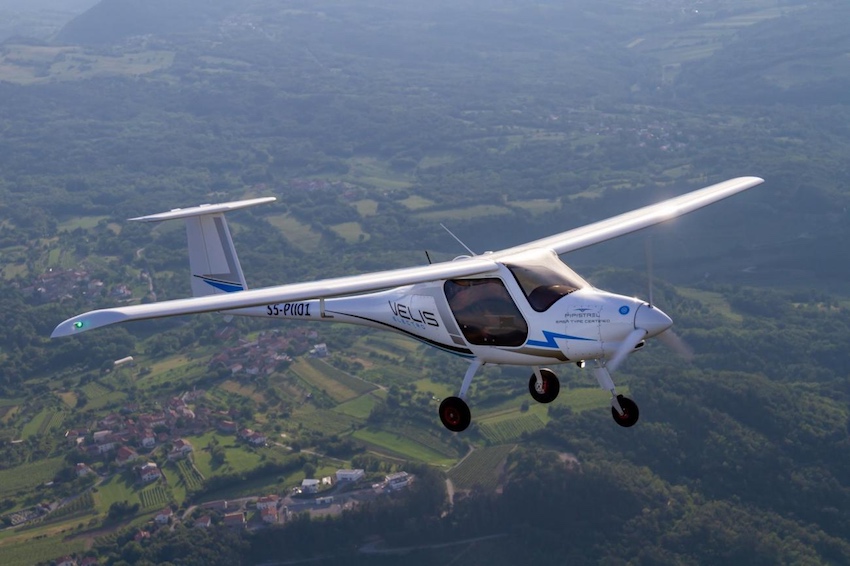
The Netherlands Aerospace Centre (NLR), which supports the PowerUp initiative, also opened a research centre for electric aviation back in 2018. This comprises research facilities and offices covering an area of 18,000 m² in Marknesse. At the centre’s opening, PwC donated a Pipistrel Velis Electro, which is being used as a research aircraft in NLR’s Living Lab Electric Flight. This aircraft arrived in the Netherlands on 9 November 2020.
In June 2020, the European Aviation Safety Agency (EASA) granted type certification for Pipistrel’s Velis Electro. This makes it the first fully electric aeroplane to receive type certification. It is a two-seater propeller aeroplane capable of flying for up to fifty minutes on a single battery charge, plus reserve. The aircraft produces 60 dBa, making it, according to its Slovenian manufacturer, considerably quieter than other aircraft. Furthermore, thanks to its electric propulsion, it produces no emissions.
Author: Wouter Hoeffnagel
Source photo: www.pipistrel-aircraft.com










