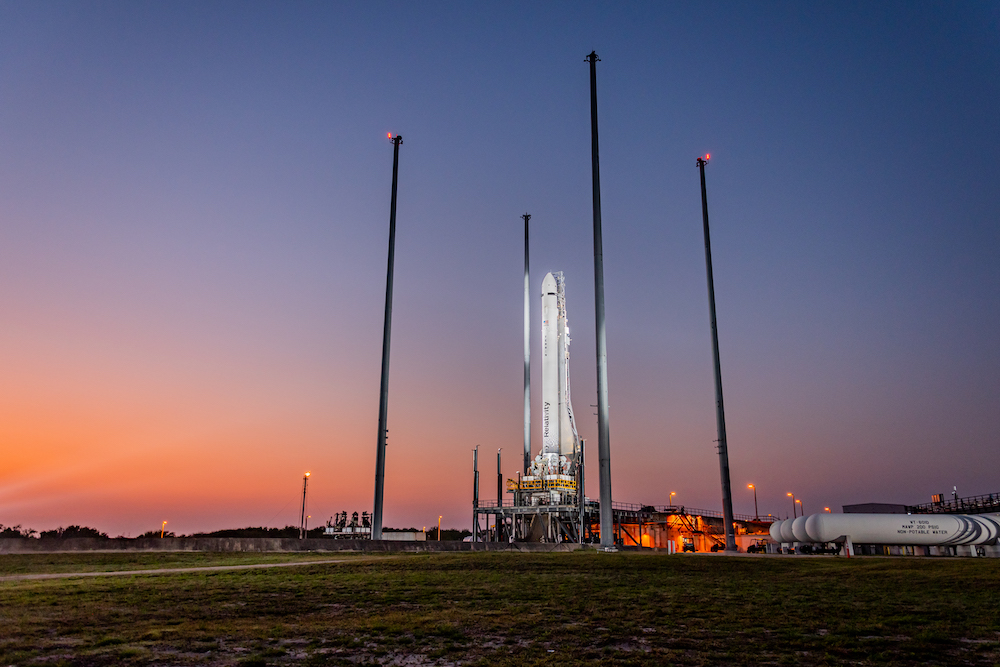

The launch of a 3D printed rocket was called off at the last minute last week. Due to various problems, the launch of Relativity Space's Terran 1 rocket could not take place.
The Terran-1 is a rocket made of 85% 3D printed parts. The different stages of the rocket were placed on top of each other in February as a test. The launch of the rocket was actually scheduled for 8 March. This attempt was then called off due to an anomalous temperature of the liquid oxygen used by the second stage.
Strong winds at high altitude
A new launch attempt was scheduled for Saturday 11 March. However, this attempt too did not go well. The launch was initially scheduled to take place Saturday at 13:45 local time. However, this launch was postponed by an hour in view of strong winds at high altitude.
However, this postponed first attempt failed. This time because the nine Aeon 1 engines failed almost immediately after ignition. Relativity Space speaks of a so-called 'corner case' in the automation of the rocket stage decoupling system. A corner case describes a problem that occurs only outside normal operating parameters.
Fuel pressure too low
A second attempt took place at 16:00, also on Saturday 11 March. However, this third attempt also failed. The launch was aborted even before the engines were ignited. Relativity Space reports that the reason was an insufficient fuel pressure on the upper stage.
A third attempt could no longer take place on Saturday 11 March. This as the launch window was coming to an end. A new date for another launch attempt has not yet been announced by Relativity Space.
A feature of the Terran 1 is that 85% of the rocket's components are 3D printed. Relativity Space sees major advantages to this method of operation. For instance, the company claims to be able to manufacture the Terran 1 - and its other rocket Terran R - from raw materials to rocket in just 60 days.
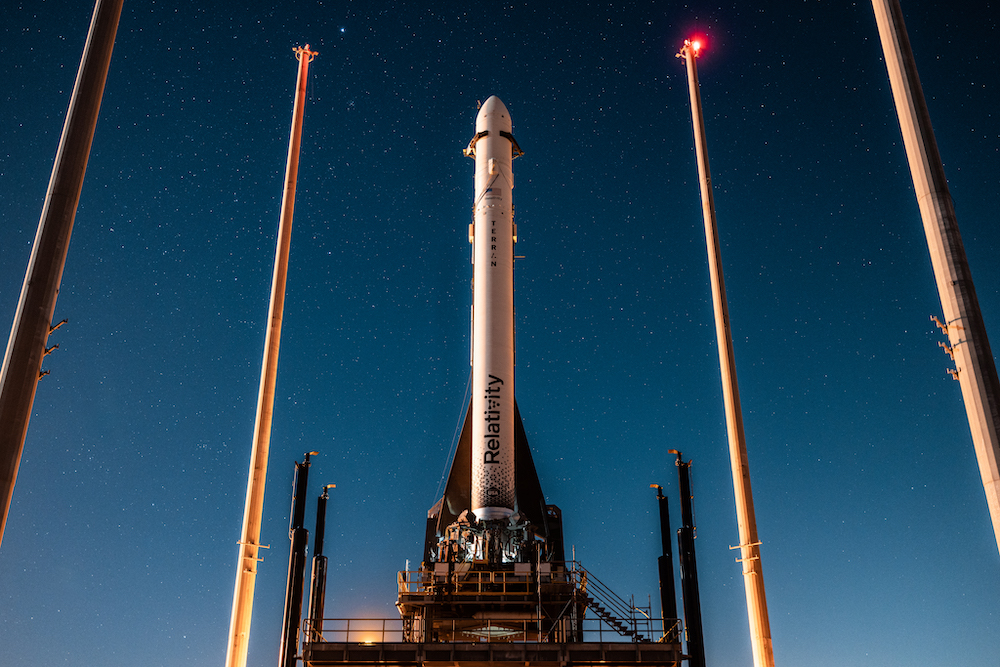
The Terran 1 is composed of two stages and an intermediate stage. The rocket is capable of carrying payloads of up to 1,250 kilograms to space. The maximum payload of the rocket depends on the orbit around Earth that customers want to reach. For instance, a low Earth orbit at a distance of up to 185 kilometres is possible with a payload of 1,250 kilograms. For a heliosynchronous orbit, a payload of 900 kilograms (up to 500 kilometres from Earth) or 700 kilograms (up to 1,200 kilometres from Earth) is feasible.
Aeon-thrusters
The rocket uses nine Aeon thrusters, which are placed on the underside of the rocket. These thrusters were 3D-printed. This used a design that should ensure higher reliability. The engines include a relatively small number of parts in the combustion chambers, ignition, turbo pumps, so-called reaction control thrusters and pressure systems.
These thrusters use a combination of liquid oxygen and liquefied natural gas as fuel. This fuel, according to the rocket company, is not only optimal for powering rockets, but also the most easily producible fuel on Mars.
Terran R
Relativity Space is also working on a second rocket: the Terran R. Reusability is central to this design; both the engines, first stage, second stage and nose cone are reusable after a launch. The Terran R should be able to put more than 20,000 kilos into low-Earth orbit. More information on the Terran R is available here.
Author: Wouter Hoeffnagel
Source photos: Relativity Space










