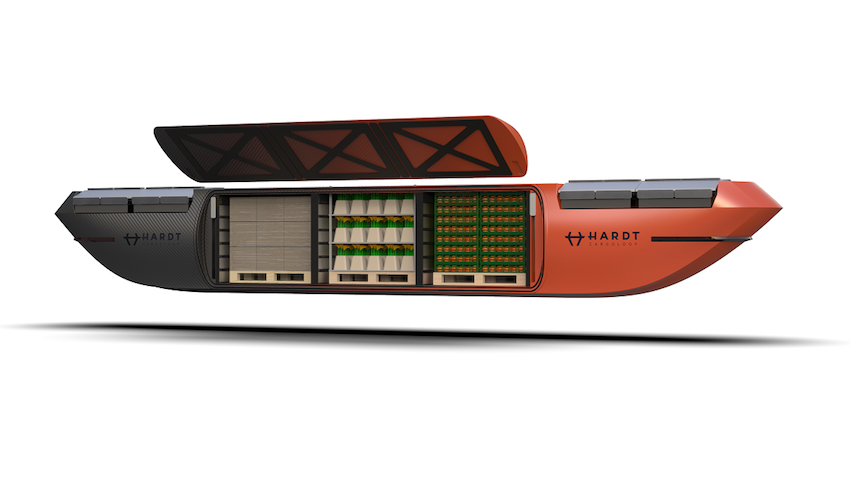

The deployment of a hyperloop between Amsterdam and Rotterdam could offer interesting benefits. For instance, the means of transport can significantly increase the competitiveness of companies in the region. The hyperloop could also reduce CO2 emissions by 600,000 tonnes by 2050, even if CO2 emissions during construction are included.
This emerges from research by Hardt Hyperloop, Antea Group Netherlands, @Balance - Advies, Projecten, Interim, Royal HaskoningDHV and SCenergy into the feasibility of a hyperloop connection between Amsterdam and Rotterdam. In their research report, the parties list some of the features of the hyperloop:
- High capacity with over 20,000 passengers or 20,000 pallets of cargo per hour in each direction at a speed of 700 km/h.
- High speeds possible with speeds ranging from 100 km/h for local connections to 700 km/h for international connections.
- Low energy consumption with 38 Wh per passenger per kilometre at a speed of 700 km/h, and 15 Wh per tonne per kilometre at 200 km/h.
- Low maintenance requirements thanks to the use of frictionless magnetic levitation and both propulsion and coupling with no moving parts with minimal wear.
- No operational emissions due to its electric drive based on renewable energy.
- Minimal infrastructure footprint by using elevated infrastructure, allowing the hyperloop to be rolled out alongside existing infrastructure and integration with existing transport hubs.
- Lower costs than any other comparable transport method.
Busiest freight corridor in the Netherlands
The stretch between Amsterdam and Rotterdam is the Netherlands' busiest freight corridor. For instance, the A4 is consistently one of the top three busiest highways in the Netherlands. Motorways around Rotterdam and The Hague are consistently in the top 10.
In 2020, for example, between The Hague and Amsterdam on an average weekday, 12,000 trucks were travelling northbound, while 10,000 were travelling southbound. Around Rotterdam, the figures are similar. On motorways around The Hague, 10,000 trucks drove northbound and an equal amount southbound on an average weekday in 2020.
1,100 fewer trucks a day
Rolling out a hyperloop corridor between Rotterdam and Amsterdam is enough to reduce the number of trucks per weekday by almost 1,100 on the A4, according to the study. If the network is expanded further, the hyperloop could replace over 2,500 trucks daily by 2050. The network could also provide a sustainable alternative of flights within Europe.
The Cargo Hyperloop Holland project aims to address several challenges:
- Reducing the amount of road traffic and congestion on the A4 between Amsterdam and Rotterdam by providing an alternative mode of transport.
- Reduce CO2 and other transport-related emissions and thereby contribute to achieving regional and national sustainability goals.
- Achieve future economic growth for North and South Holland by improving accessibility and connectivity between logistics and industrial centres in the region.
- Initiating the development of a European hyperloop network to implement a pilot hyperloop project.
- Improving transport reliability and transport times for shippers in North and South Holland.
- Achieve savings and improve the efficiency of other transport infrastructure planned in the region.
Reduce congestion
The Cargo Hyperloop Holland is an initiative of Hardt Hyperloop. The company sees great opportunities for the logistics sector in the use of the hyperloop. Dominik Härtl of Hardt Hyperloop led the Cargo Hyperloop Holland study and explains: "We approached this study differently from previous hyperloop studies by directly involving future users and other key stakeholders. We set up a partnership with 35 stakeholders from the private and public sectors, including some of the largest Dutch exporters from the horticulture and food industry. They not only provided crucial input on the product requirements, but also contributed to the choice of hub locations and the route. The project largely follows the A4 motorway, which connects cities such as Amsterdam, The Hague and Rotterdam. The A4 is crucial for the region's economy, but is also among the most congested motorways in the Netherlands. The solutions currently proposed will only partially solve this problem. Hyperloop could increase capacity and thus reduce congestion on this stretch while increasing connectivity and productivity."
Besides reducing CO2 emissions, the deployment of the hyperloop offers other benefits, according to Hardt Hyperloop. For instance, it can reduce many negative side effects of the logistics sector. "Think of fewer accidents, less noise, and fewer traffic jams when not all transport has to go on the motorway anymore," Härtl explains.
Major economic benefits
Setting up such a hyperloop involves a substantial investment. However, Hardt Hyperloop expects these costs to be recouped quickly thanks to the major economic benefits. Härtl: "The cost of the project is estimated at around 1.5 billion euros. This is a lot less than the infrastructure investments made and planned in the region in the recent past. However, the economic benefits are huge. Industry will get a big boost and it will provide jobs for at least 13,000 people. Together with the CO2 reduction and improved and reliable transport times we can achieve with this project, that makes the hyperloop a very good investment."
To fully exploit the potential economic benefits, the study recommends the construction of the full Cargo hyperloop Holland corridor. This corridor calls at a total of 12 hubs in North and South Holland. Optimising logistics processes and introducing transport services on the hyperloop could bring total benefits of around EUR 3.2 billion to the project. The project offers a net present value of almost €2 billion and a benefit-cost ratio of 2.62. If passengers are also transported within the same infrastructure, the benefits could be even higher.
Pilot project
The study also looked at a suitable location for a pilot project. According to those involved, the connection between the Greenports is "particularly promising" for this purpose and also shows strong economic performance as a stand-alone route. Härtl: "A Greenport route could very nicely serve as a technological demonstration model where all the commercial possibilities of the hyperloop could also be shown. In turn, this route could help create public support and also get people excited about travelling with the hyperloop as a demonstrably safe means of transport."
Author: Wouter Hoeffnagel











