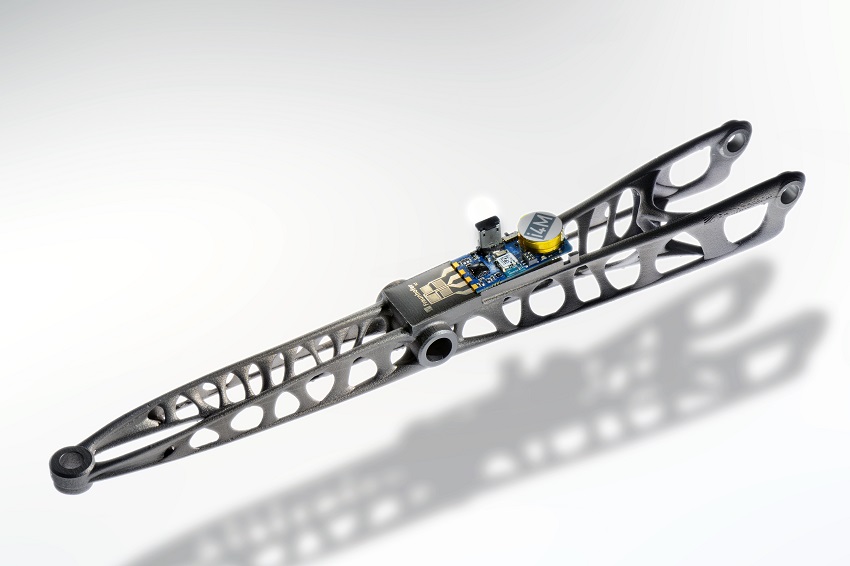

The Fraunhofer Institute for Laser Technology ILT will present its latest research findings in the field of additive manufacturing technology in early November. Among other things, the Aachen-based engineers will show sensors printed directly on components that can provide real-time data for predictive maintenance. A new process allows sensors to be seamlessly inserted into a component during the printing process.
Trends such as Industry 4.0 make accurate recording of the condition of machines and components increasingly important. In collecting sufficient data, however, there are a number of challenges. Fraunhofer Institute for Laser Technology ILT developed a sensor infrastructure for smart industrial applications. Sensors can be implemented using additive manufacturing.
Integration of sensors
Usually, sensors are manually applied to the surface of components. With the newly developed process, it is possible to integrate sensors directly into components. In this way, important characteristic data can be collected about the load within the component.
Accuracy
Manual placement of sensors is often not accurate enough. After all, the sensors must record vibrations, accelerations or the smallest deformations in the µm range. Samuel Moritz Fink, Group Leader Thin Film Processes at Fraunhofer ILT says: "Manual placement of sensors is in many cases too imprecise and not reproducible. Moreover, users increasingly demand processes that can be automated."
Printed sensors for greater precision
From 7 to 10 November 2023, the Fraunhofer Institute for Laser Technology ILT will be showcasing a cross-member for passenger cars featuring a 3D-printed sensor at the joint Fraunhofer stand at formnext in Frankfurt am Main. “The force sensor we have printed onto the cross-member is less than 200 µm thick, including the insulation and protective layer and the electrical connections,” says Fink.
Monitoring changes in force
"We can determine the forces acting in the application at any time". The sensor continuously measures the change in force during e.g. cornering and warns of defects before they occur. "The force sensor records the smallest cracks that occur before they lead to component failure," says Fink.
Various sensors
Besides a force sensor, other sensors can also be applied to a component, for example to detect temperature, vibration or noise, pressure or acceleration, light, voltage, various gases and liquids. Special polymers for the insulating and protective layers can withstand temperatures up to 300 °C.
Predictive maintenance
The application possibilities of this process are enormous. Especially as it provides reliable real-time data for predictive maintenance: "For example, it can be used to monitor battery cells individually, optimise maintenance intervals for offshore wind turbines or improve processes in machine and plant construction," continues Fink.
Multi-stage production process of smart components
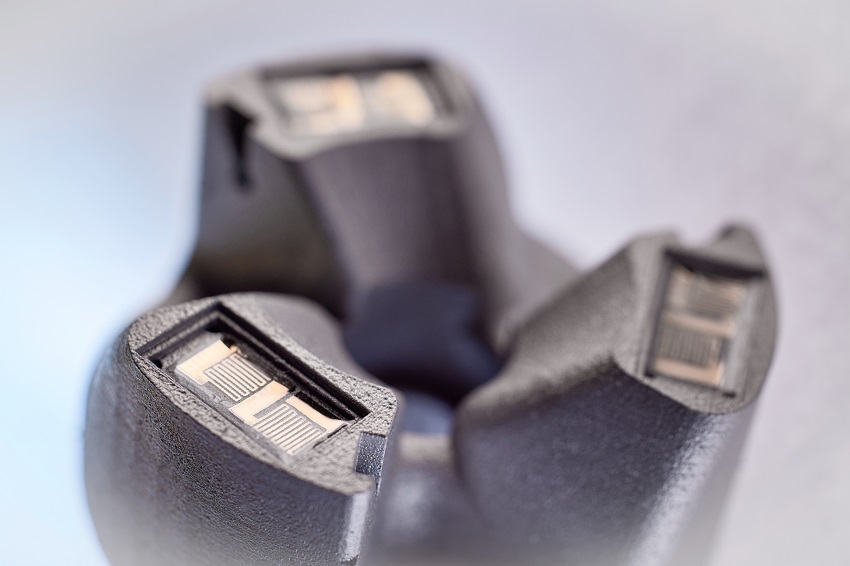
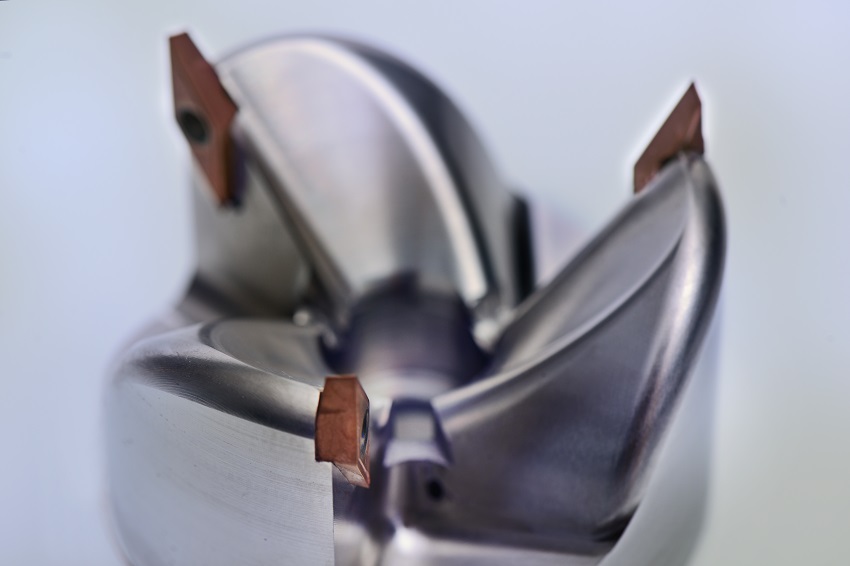
Another notable innovation from Fraunhofer ILT is the seamless integration of sensors during the additive manufacturing process. Using 3D structural printing processes such as laser powder bed fusion (LPBF), it is possible to integrate printed sensors directly into components during production. Fraunhofer researchers will demonstrate this technology with a 3D printed milling head. The structural printing process with LPBF is interrupted. This makes it possible to integrate strain gauges using a digital functional printing process and laser-based thermal post-treatment. The structural printing process is then continued to complete the smart part.
More benefits
The researchers are combining structural and functional printing with laser-based post-processing. In doing so, they demonstrate that components with integrated sensor technology can be printed in their entirety. This not only enables them to position sensors precisely for advanced condition monitoring, but also to protect these sensors from mechanical environmental stresses.
Geometry
"The geometry of the sensors can be adapted to the part. In the future, even additional functional elements such as integrated heaters are conceivable," says Samuel Fink. "This technology opens up a wide range of possible applications. From manufacturing in the field of toolmaking and mechanical engineering to the automotive industry and beyond in the energy, aerospace and aviation sectors."
Source: Fraunhofer ILT
Featured image: The cross-joint with an embedded force sensor measures the stresses occurring at any given moment during use and detects the smallest cracks that develop before a fault occurs (photo: Fraunhofer ILT, Aachen, Germany)











