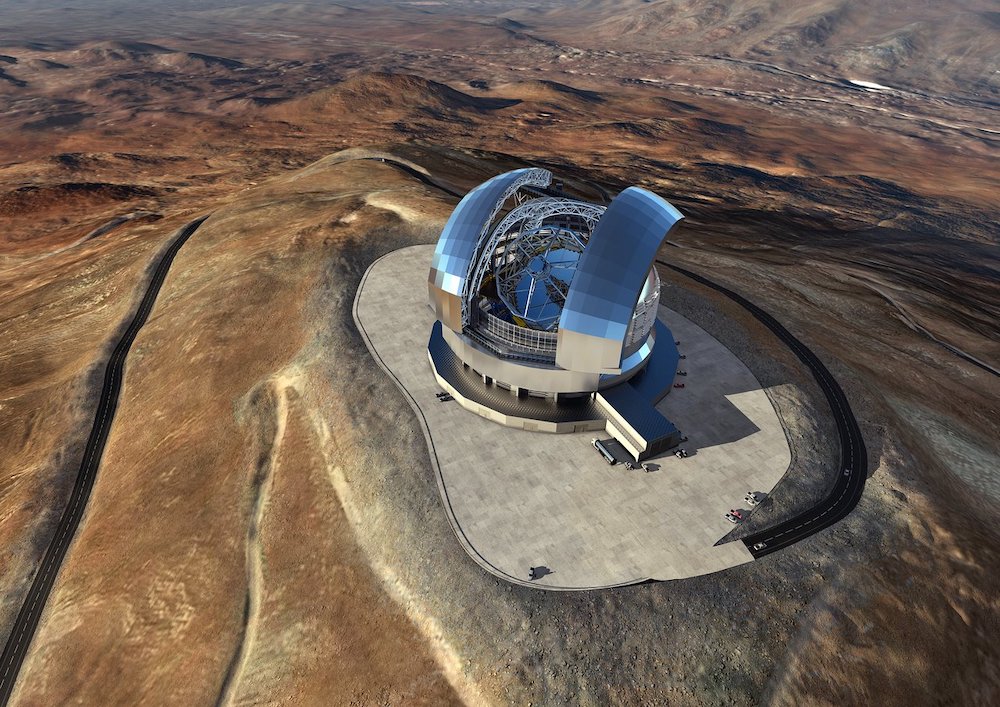

The development of a Dutch instrumentation package for the Extreme Large Telescope (ELT) will receive funding from the NWO's National Roadmap for Large-scale Scientific Infrastructure. The ELT is to become by far the largest telescope in the world. ELT's construction costs are budgeted at EUR 960 million.
With the ELT, formerly called the European Extremely Large Telescope (E-ELT), researchers hope to gain new insights into Earth as a living planet in the universe. A number of Dutch parties are working on the Dutch instumentation package for this telescope. This part is carefully tailored to Dutch scientific interests and expertise, reports the NWO. This should ensure the Netherlands' leading position in astronomy for decades to come.
Designed by the European Southern Observatory (ESO), the ELT has an effective area of 1,116 m2. ESO is stationing the telescope at Cerre Armazones in Chile
Telescope to deliver new insights
The new telescope should help find answers to a variety of scientific questions about the universe. For example, to what extent does exoplanet Promixa b resemble Earth? And to what extent is life present on this exoplanet? The ELT allows astronomers to study and bring into sharper focus than ever fainter objects in space. "Our neighbouring star has a planet that is very similar to Earth in size and orbit, called Proxima b. With the instruments coming on the ELT, we can find out exactly what the properties of that world are," explains lead researcher Ignas Snellen, lead applicant for the NWO funding.
Part of the instumentation package for the ELT is being developed from the Netherlands. Three instruments are involved. Of the mid-infrared instrument METIS, the Netherlands is project leader. Snellen: "With METIS, we can find out whether Proxima b has an atmosphere and what gases are in that atmosphere. We have been working on this instrument for about ten years. It will therefore be the first with which we can make measurements."
MOSIAC and EPICS
The second instrument is MOSIAC, a multi-object spectrograph. It can observe hundreds of stars and galaxies simultaneously and produce detailed spectra of them. The third instrument is EPICS, focused on detecting and characterising exoplanets. This instrument is still under development. Snellen: "For the third instrument called EPICS, we are really still in the early stages with studies on the instrument and the technical aspects."
EPICS construction is not scheduled until the mid-2030s. However, the instrument is promising, Snellen argues. "With it, we can look at reflected light. Instead of looking at one or two worlds, we can study a whole group of such objects. So not just exoplanet Proxima b, but also Earth-like planets around other stars. By the time EPICS is finished, I will be well into my sixties, but I am very much looking forward to it. EPICS and METIS are two instruments with which we can start observing exoplanets very well."
Measurements from Earth
The enormous size of the ELT offers interesting opportunities. Because where your James Web Space Telescope (JWST) takes measurements from space, the ELT has to do so from Earth. The surface of the ELT makes this possible. Snellen explains: "With the ELT's large surface area, we can capture more light and therefore observe fainter objects and look many times sharper than the JWST. The JWST's mirror has a diameter of 6.5 metres. The ELT is almost five times larger."
Mapping space from Earth presents challenges. Consider the Earth's atmosphere, which can distort the image. "When you look from space, you are not affected by Earth's atmosphere. A turbulent atmosphere sometimes makes it difficult to see sharply," says Snellen. The huge heat shield that the JWST is equipped with also offers advantages and keeps the telescope very cool, creating less window than if you are looking at thermal radiation from the ground.
The ELT should be able to make its first observations in five years' time. Snellen is enthusiastic. "The great thing is that we will then have the JWST, which is better in some things, along with the superior qualities of the ELT. We can then combine that data. That will be fantastic! We are going to learn so much about the first stars, the formation of galaxies and whether we are alone in the universe. Personally, I am mainly looking forward to learning more about Proxima b. That is very exciting," says the researcher.
The world's biggest eye on the sky
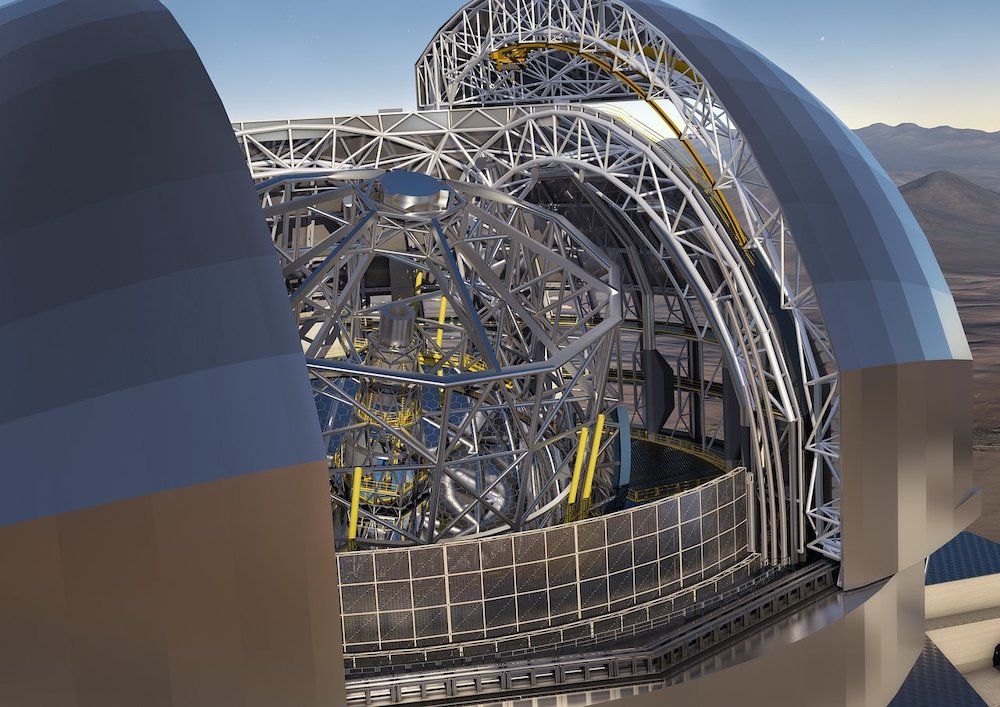
Dubbed 'the world's biggest eye on the sky', the telescope is comparable in size to a football stadium. This brings unique challenges. For instance, the telescope features a mirror consisting of 798 partial mirrors with a diameter of 39 metres. To support this, TNO was brought in, which designed a prototype in collaboration with VDL-ETG (builder/engineer) and NOVA (equipment and software measurements).
In this prototype, each of the 798 mirrors features a supporting structure made of steel and aluminium. A combination of a wafer-thin membrane, 27 thin pins and a metal balancing structure hold the individual mirror in place. Developing this structure is challenging. Partly because of the maximum deviation of only a few nanometres allowed. Indeed, a larger deviation would lead to a blurred image. The mirrors rotate using air pressure.
"Nice to see that the big investments this cabinet is making in science are now actually translating into large-scale scientific infrastructure. State-of-the-art scientific research facilities have an enormous attraction for (young) talent and are a boost for the strong position in Europe and in the rest of the world," said Minister Robbert Dijkgraaf of Education, Culture and Science (OCW).
Author: Wouter Hoeffnagel
Images: ESO/L. Calçada/ACe Consortium










