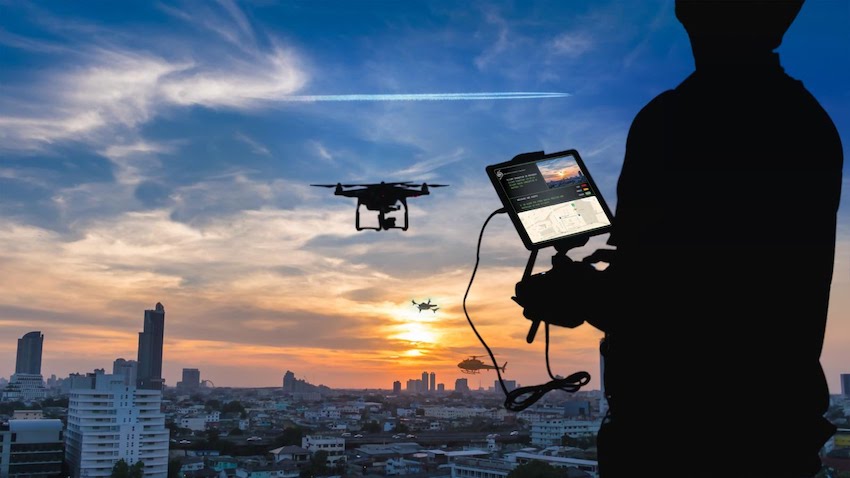

Urban air mobility, also known as Urban Air Mobility (UAM), enables cities to become more sustainable and smarter. Think of the deployment of air taxis for passenger transport and drones for carrying cargo or for emergency support. The European project AMU-LED aims to demonstrate safe integration of drones in an urban environment in the Netherlands, Spain and the UK by 2022.
AMU-LED stands for 'Air Mobility Urban - Large Experimental Demonstrations'. This is a Horizon 2020 project of the European Commission, aiming to demonstrate safe integration of different types of drone operations in the airspace of cities.
17 parties from Europe and the United States are involved in the project. The consortium consists of Airbus, AirHub, Altitude Angel, ANRA Technologies, Boeing Research & Technology-Europe, FADA-CATEC, Cranfield University, EHang, ENAIRE, the municipality of Amsterdam, INECO, ITG, Jeppesen, NLR, Space53 and Tecnalia. The project is coordinated by everis.
Mapping opportunities
Using practical tests and simulations, the parties involved want to explore how using UAM:
- roads on the ground can be relieved;
- transportation of people and goods can be improved;
- travel times can be reduced;
- air pollution can be reduced;
- can reduce traffic accidents.
The tests and demonstrations that AMU-LED will carry out will provide data, based on which the initiative intends to submit information to regulatory bodies. Think of the European Union Aviation Safety Agency (EASA), the European Aviation Safety Agency.
Round-trip drone flight
Senior R&D Manager Henk Hesselink is involved in the project on behalf of NLR as technical manager: "One of the partners involved is already letting tourists in China take a sightseeing flight in a drone controlled from the ground. Much still needs to be arranged, but we would like to make it as concrete as this: without a pilot flying along, transporting people and cargo coordinated in U-space - a highly automated air traffic control system for drones."
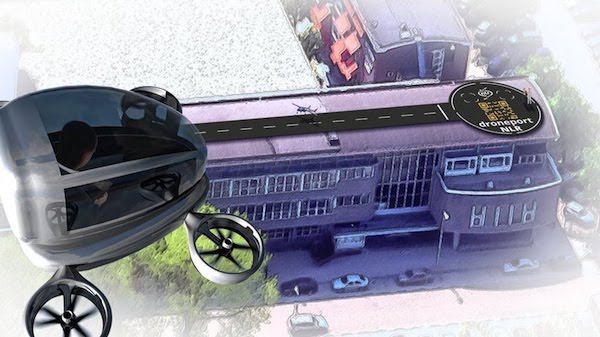
The parties plan to eventually realise demonstrations at locations in three different countries: Santiago de Compostela in Spain, Cranfield in the UK and Amsterdam, Rotterdam and Enschede in the Netherlands. The tests and demonstrations carried out within AMU-LED are expected to include more than 100 flight hours. Different types of drones and drone flights will also be combined with a view to different scenarios, use cases and applications. These include air taxi flights, cargo transport, medical equipment delivery, infrastructure inspection, police surveillance and emergency services support.
Building an international market position
"Globally, UAM is becoming a hot topic. Even our Dutch minister of IenW (ed: Infrastructure & Water Management) mentioned the air taxis that might start flying over Dutch cities in her opening of the last Amsterdam Drone Week. As a drone innovation cluster, we cannot wait to actually start working with this new technology in practice. We foresee good opportunities for Dutch developers to build an international market position in this, provided we can demonstrate in this project that this can be done safely and responsibly," said Marc Sandelowsky of drone innovation and test centre Space53.
"The AMU-LED project represents a wonderful opportunity to demonstrate the added value of UAM for society, bringing together new technologies such as 5G, artificial intelligence and drones. We look forward to showing what the Dutch drone industry has to offer," says Stephan van Vuren, Co-Founder at drone software developer and consultancy firm AirHub.
Author: Wouter Hoeffnagel










