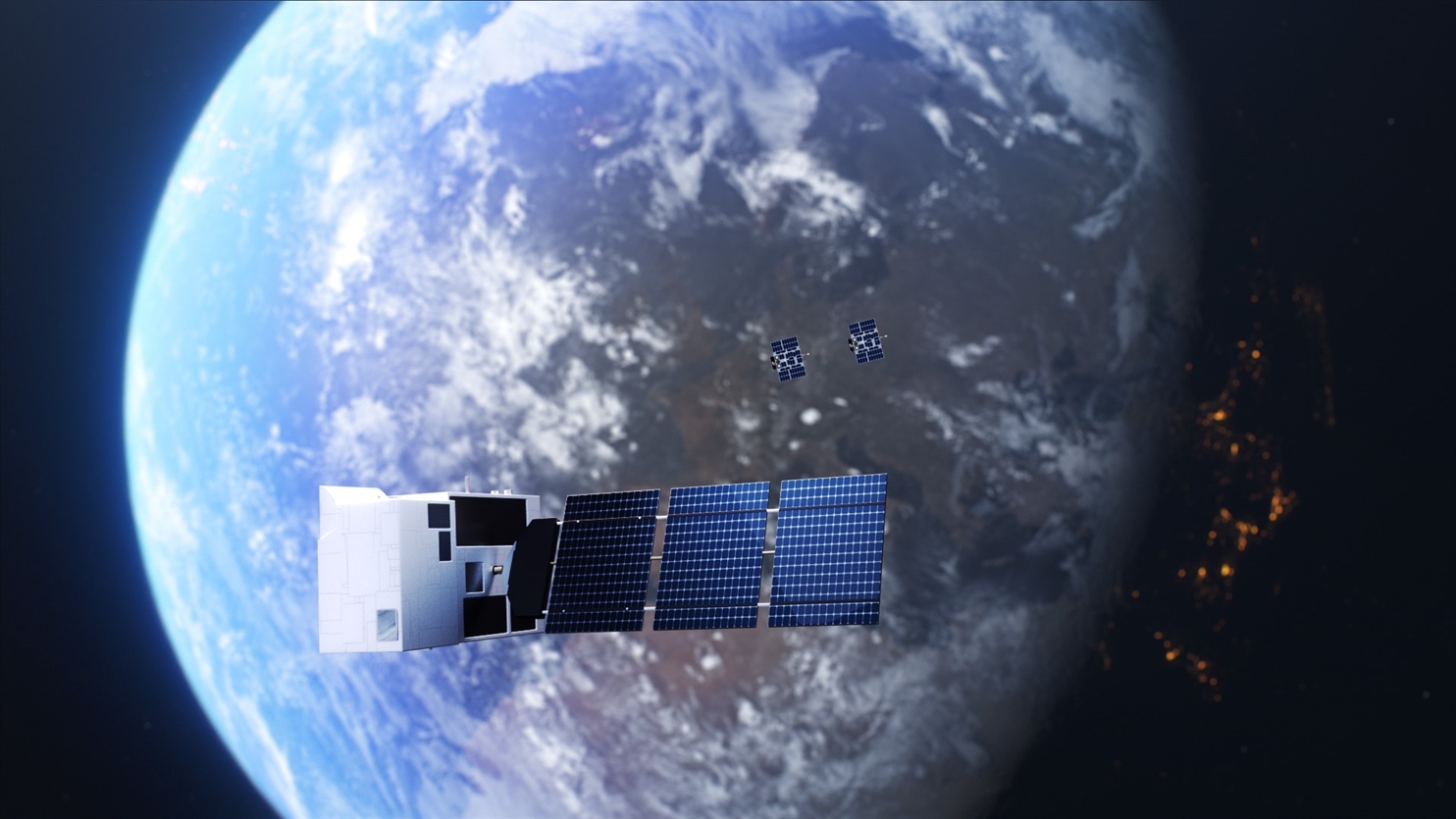

The European Space Agency (ESA) chooses Dutch-made TANGO satellites to monitor Earth's greenhouse gas emissions. The satellites are the successor to TROPOMI and can measure carbon dioxide (CO2) and nitrogen dioxide (NO2) in addition to methane (CH4).
All kinds of facilities on Earth can emit greenhouse gases, such as power plants, coal-fired power stations, landfills and factories. TROPOMI is a satellite that has been tracking the greenhouse gas methane worldwide for more than six years. In doing so, it can image about 5% of the sources of these emissions.
Better understanding sources of emissions
The TANGO satellites are still under development and should provide a significantly better picture of sources of emissions. For instance, the satellites should map three quarters of the sources. In addition, the satellites should be able to measure not only CH4, but also NOX2 and CO2. Important, since CO2 accounts for the largest greenhouse gas emissions worldwide.
Pepijn Veefkind, working at KNMI and co-scientific lead of the TANGO mission: "With this mission, we are mapping greenhouse gas emissions and making visible what is invisible. We are entering a new era where it is not just about measuring on a large scale, but where it also becomes clear who is doing it and that is important in the global challenge to greatly reduce greenhouse gases."
Under the magnifying glass
The TANGO satellite mission is to act as a kind of 'magnifying glass'. Other satellites identify places of interest, after which TANGO scrutinises these locations. It measures the exact emissions and provides accurate data about them. This data helps governments, scientists and companies verify the declared emissions of parties. And makes it possible to check whether parties comply with climate and environmental regulations, and take action to reduce emissions.
In practice, TANGO consists of two satellites, flying in tandem. TANGO stands for Twin Anthropogenic Greenhouse Gas Observers. The measurement system offers a spatial resolution of about 300 metres by 300 metres. If necessary, the satellites can be pointed at the same sources of emissions several times a week to accurately map emissions from a specific location. In this way, TANGO provides insight into trends, among other things. These include geographical distribution of emissions, variations in emissions and the impact of reduction measures.
Spectrolite instruments from TNO
The satellites use TNO's compact Spectrolite instruments. These provide spatial resolution sufficient for measuring emissions. At the same time, they can be mounted on a standardised nanosatellite platform of less than 20 kilograms. In comparison, a traditional satellite system easily weighs hundreds of kilograms. TNO reports that this feature, among others, saves time and money, as there is no need to build a specially adapted satellite platform.
The development of TANGO is possible thanks in part to additional funding from Ministries of Economic Affairs & Climate and Education, Culture and Science in 2022 in the Earth observation programme of the European Space Agency (ESA). This investment facilitates new applications in emissions monitoring.
Launch in early 2027
The launch of the TANGO missions is scheduled for early 2027. Satellite company ISISPACE is developing the satellite platforms for the mission, as well as taking on the day-to-day operations of the mission. ISISPACE previously led a consortium consisting of TNO, KNMI, national space research expertise institute SRON and 3D printing company 3D PLUS. Together, the parties developed the TANGO satellite mission, and demonstrated the feasibility of the project during an eight-month trajectory.
Jeroen Rotteveel, CEO of ISISPACE: "With TANGO, our company will provide scientific data as a service to ESA, with Dutch instrumentation on Dutch satellites. In this innovative way, which is also gaining popularity in the US, Dutch companies, knowledge institutions and the government can make a substantial contribution to the climate challenge via a satellite mission."
Author: Wouter Hoeffnagel
Image: TNO










