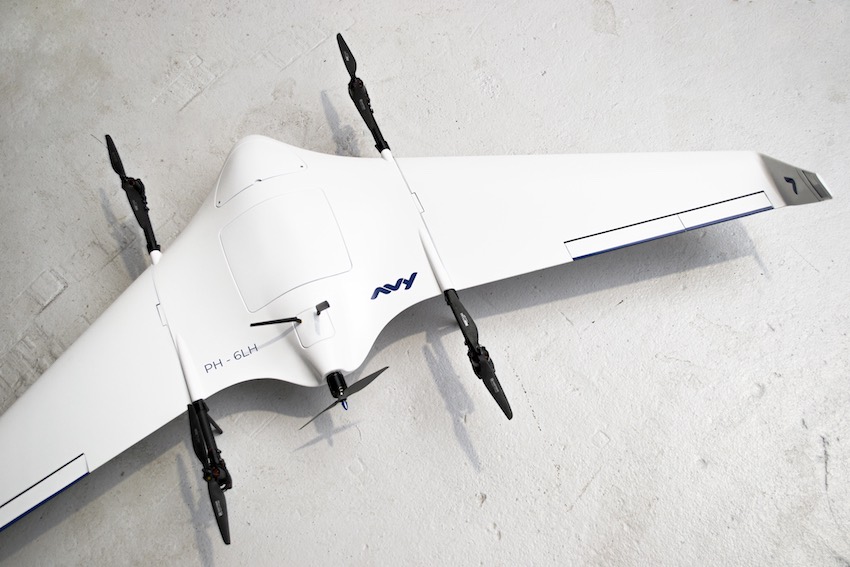

Avvy announces with its solar drone Aera conducted a first successful test flight. With the solar drone, Avy, together with partner Watllab, is targeting, among other things, urgent medical transport, the support of emergency services and initiatives around nature conservation.
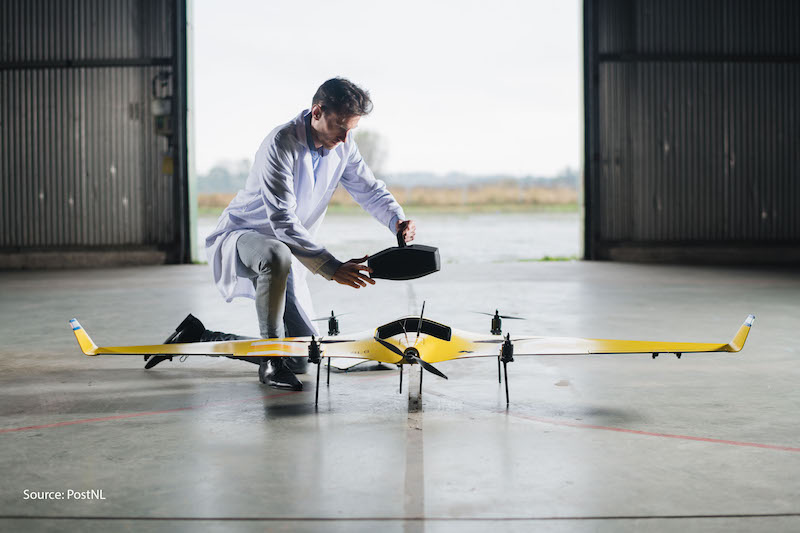
The Amsterdam-based company focuses on developing emission-free drones. These are fixed-wing drones, which are a combination between a drone and an aircraft. The Aera can take off vertically and then continue flying like an aircraft.
Range of up to 100 km
This mode of flight gives the drone a range of 70 to 100 kilometres at a cruising speed of 70 km/h. The maximum speed is 130 km/h. The Aera is 130 cm long and 50 mm high. The wing span is 240 cm.
The drone can lift a load of up to 2.2 kilograms. This payload can measure up to 200 by 275 by 135 mm. A medical module with temperature control and log functionality is also available.
The device can fly at cruising speed at wind speeds of up to 30 km/h. The drone is resistant to light rain and suitable for use in temperatures ranging from -10° C to +40° C.
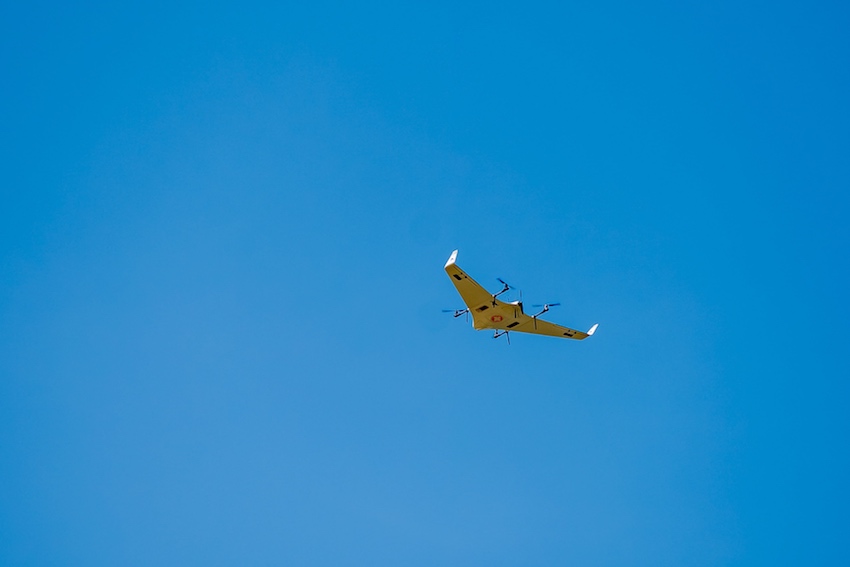
Solar drone from Watllab
The Aera features custom-made solar foil developed by Wattlab, a clean-tech startup founded by TU Delft's Vattenfall Solar Team. The solar foil reflects and absorbs more sunlight than alternatives. This solar foil is applied to the drone's fibreglass wings as an outer layer. This allows the device to generate energy while flying
The model that has now taken to the skies is a prototype, which will not be marketed. Knowledge gained during the test flight will be used in the development of new models by Avy.
Accelerating transition to sustainable aviation
"Our goal at Avy is to accelerate the transition to sustainable aviation," explains Patrique Zaman, founder of Avy. "By integrating solar cells into our wings, we are using the cleanest energy available. The Avy drone is equipped with wings and able to transport life-saving medication by air in both Europe and Africa and support emergency services in Europe. Our test flight in September with the solar-powered prototype shows promising results and was a first step towards a longer flight time."
For instance, the test flight shows that the wings can be further improved, without affecting aerodynamics or causing a weight gain. For instance, the company wants to make the wings lighter, achieve a larger wing area and integrate more solar cells into the wings. In the coming months, Avy will focus on testing solar cells with higher efficiency.
Author: Wouter Hoeffnagel










